Heterogeneous Reasoning Learning: From Pattern Compatibility to Local Bottlenecks

Standard SFT can learn heterogeneous reasoning patterns; scale eliminates global confusion; local bottlenecks fixed via critical-node single-step repair.
This study examines whether standard SFT can learn heterogeneous reasoning traces without pattern labels. Theory shows optimal autoregressive models dynamically weight patterns by prefix posterior. In an open-source symbolic graph search environment, paired BFS/DFS experiments show unlabeled mixed SFT is not inferior to baselines, and scaling from 0.6B to 14B eliminates global confusion, shifting the bottleneck to local state tracking. Critical Reasoning Nodes (CRNs) are proposed, where single-step repair can rescue failed traces at low cost.
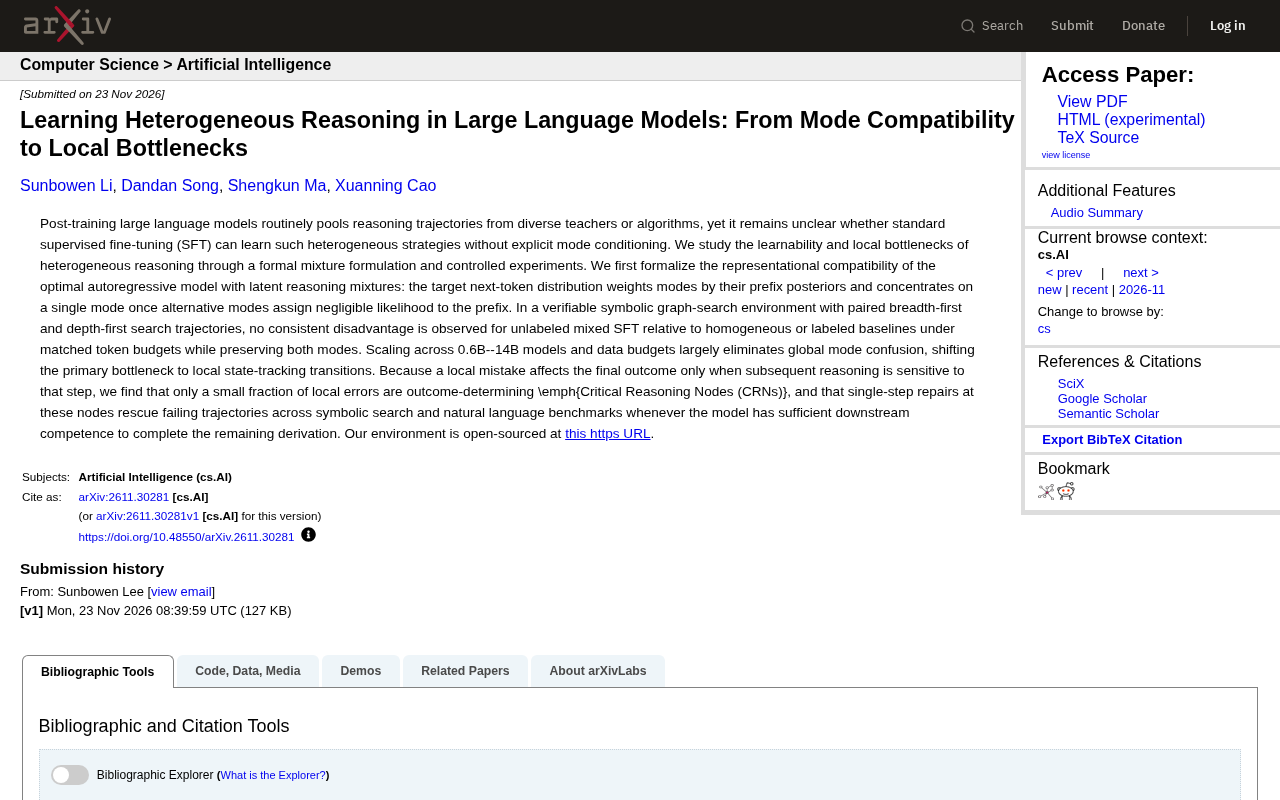
Large language models' post-training often mixes reasoning traces from different teachers or algorithms, but whether standard supervised fine-tuning (SFT) can learn these heterogeneous strategies without explicitly specifying the mode has lacked systematic study. A recent paper, through formalized mixture modeling and controlled experiments, delved into the learnability of heterogeneous reasoning and its local bottlenecks, and open-sourced a symbolic graph search environment.
Pattern Compatibility of Heterogeneous Reasoning
The researchers first formalized the representational compatibility of an optimal autoregressive model with a mixture of latent reasoning. Theoretical analysis shows that the target next-token distribution weights each pattern according to the prefix posterior; once other patterns assign negligible likelihood to the prefix, the distribution concentrates on a single pattern. This means that a model trained on mixed data does not simply memorize all patterns but dynamically adjusts the weight of each pattern.
In a verifiable symbolic graph search environment, the researchers compared paired traces of breadth-first search (BFS) and depth-first search (DFS). Under a matched token budget, unlabeled mixed SFT did not show a consistent disadvantage compared with homogeneous or labeled baselines, while preserving both patterns. This finding challenges the intuition that "mixed data inevitably leads to pattern confusion" and shows that SFT itself possesses a certain capacity for pattern compatibility.
Supervised fine-tuning (SFT) is a common post-training method that continues training a pretrained language model on annotated input-output pairs so that the model learns to follow instructions or specific task formats. Its loss function is usually token-by-token cross-entropy: given a prefix, maximize the probability of each true next token in the target sequence.
Autoregressive modeling means the model generates words one by one from left to right, with each step conditioned on all tokens generated so far. The so-called "mixture of latent reasoning" treats the training data as a mixture distribution generated by several latent variables (patterns): each trace corresponds to a strategy such as BFS or DFS, but the pattern label is invisible to the model. The "prefix posterior" in the formal analysis is the posterior probability that the model infers which pattern the current partially generated trace comes from after observing it. When a pattern has extremely low likelihood for the current prefix, the posterior is dominated by other patterns and the distribution concentrates accordingly—this is precisely the mathematical source of the "dynamic adjustment of pattern weights" mentioned in the text.
Breadth-first search (BFS) expands nodes layer by layer, first exploring all states close to the starting point; depth-first search (DFS) goes deep along one path to the end and then backtracks. The two produce token sequences with very different structures in symbolic graph search, making them ideal paired material for studying heterogeneous reasoning traces.
Scale Expansion Eliminates Global Pattern Confusion
The experiments scaled the model from 0.6B to 14B and adjusted the data budget. The results show that as scale increases, global pattern confusion basically disappears, and the main bottleneck shifts to transitions in local state tracking. In other words, large models can grasp the overall structure of different reasoning patterns, but they still make errors in the local connections between reasoning steps.
This finding has important practical significance: simply increasing model scale or data volume cannot fully solve the problem of local coherence in reasoning. The researchers point out that local errors affect the final result only when subsequent reasoning is sensitive to that step, so not all local errors are fatal.
Pattern confusion refers to the model mixing steps from different reasoning strategies during generation—for example, starting with BFS's layer-by-layer expansion but switching midway to DFS-style deep exploration, resulting in a self-contradictory trace structure. The text distinguishes two levels:
- Global pattern confusion: the strategic identity of the entire trace is unclear, which amounts to "choosing the wrong overall direction";
- Local state tracking: maintaining intermediate states such as the current node, the visited set, and the queue to be expanded under a given strategy, which is a "step connection" problem.
Scale expansion eliminates global confusion, which can be understood as the large model's capacity being sufficient to represent multiple strategies simultaneously and stably select one according to the prefix posterior; local state tracking, however, depends on precise maintenance of fine-grained information in long contexts and is not automatically solved as parameter count grows. This is consistent with the common observation of "scaling laws": increasing model size mainly improves overall distribution fitting, with limited gains for components that require precise step-by-step computation.
Critical Reasoning Nodes and Single-Step Repair
The researchers further proposed the concept of "Critical Reasoning Nodes" (CRNs): only a small subset of local errors are CRNs that determine the final result. In symbolic search and natural language benchmarks, as long as the model has sufficient downstream capability to complete the remaining derivation, single-step repair at CRNs can rescue failed traces.
This mechanism provides a new idea for reasoning error correction: rather than comprehensive retraining or relying on more complex reinforcement learning, it is better to precisely locate and repair critical nodes. Experiments show that single-step repair is effective on a variety of tasks and costs far less than full regeneration.
Critical Reasoning Nodes (CRNs) draw on the counterfactual idea from causal inference: to determine whether a step is a critical node, one can check "if this step were corrected, could the entire trace change from incorrect to correct?" If the final answer is still wrong after repair, it means the step was erroneous but downstream derivation is insensitive to it, making it a tolerable error; if the answer becomes correct after repair, then the step is a CRN.
Single-step repair means replacing the original step at an identified CRN with the correct step given by a teacher model or verifier, and then letting the model continue generating the remaining trace. Its difference from full regeneration lies in the granularity of intervention: the former changes only one position and preserves the already correct surrounding context, so the computational cost is low and it avoids the risk of introducing new errors through regeneration. This idea is complementary to directions such as "process reward models" and "step-level verification"—the latter are responsible for locating erroneous steps, while single-step repair provides a low-cost correction method.
Open-Source Environment and Future Directions
The paper open-sourced the symbolic graph search environment (https://github.com/Bowen1911/Symbolic_graph_env), providing a controllable experimental platform for subsequent research. The environment supports paired BFS/DFS trace generation, facilitating analysis of the learning dynamics of heterogeneous reasoning.
Future work can explore how to automatically identify CRNs, design more efficient repair strategies, and extend the method to more complex natural language reasoning tasks. This research not only deepens the understanding of SFT learning heterogeneous strategies but also provides an actionable path for local intervention in reasoning enhancement.
One-line Summary
Research reveals that standard SFT is compatible with heterogeneous reasoning patterns, scale expansion eliminates global confusion, and local bottlenecks can be repaired with single-step fixes at critical nodes.
Paragraph Summary
This study systematically examines whether standard supervised fine-tuning (SFT) can learn heterogeneous reasoning traces from different teachers or algorithms without pattern labels. Theoretical analysis shows that an optimal autoregressive model dynamically weights each pattern according to the prefix posterior. In an open-source symbolic graph search environment, the researchers conducted controlled experiments with paired BFS/DFS traces and found that under a matched token budget, unlabeled mixed SFT is not inferior to homogeneous or labeled baselines and can preserve both patterns simultaneously. After scaling the model from 0.6B to 14B, global pattern confusion basically disappears, and the bottleneck shifts to local state tracking transitions. The researchers accordingly propose the concept of Critical Reasoning Nodes (CRNs), pointing out that only a few local errors determine the final result and that single-step repair at these nodes can rescue failed traces at a cost far lower than full regeneration.
Related articles

Prospero: A Lightweight Native AI Coding Tool Built with ImGui
Prospero is a bloat-free native AI coding tool built with ImGui, emphasizing lightweight design, high performance, and low dependencies. This article analyzes its design philosophy, technical choices, and the divergence between platformization and toolization in AI coding tools.

WebRTC Abused: New Variant of Credit Card Skimming Scripts on Shopping Sites
Security researchers found skimming scripts on popular shopping sites using WebRTC data channels to exfiltrate credit card data. This article analyzes the technical原理, differences from traditional Magecart attacks, and defense strategies for e-commerce platforms in third-party script governance and CSP policies.

Single GB10 Card Hits 101 tok/s: Inkling 2 Mini Performance Tested on vLLM
A developer shared on Hacker News running Inkling 2 Mini with vLLM on a single GB10 at 101 tok/s. This article analyzes the technical context, the significance of vLLM with small models on single cards, and caveats for interpreting tok/s metrics.