Hexis: Managing AI Agent Skills and Knowledge Bases with Git

Hexis brings Git-based version control and governance to enterprise AI agent skills and knowledge management.
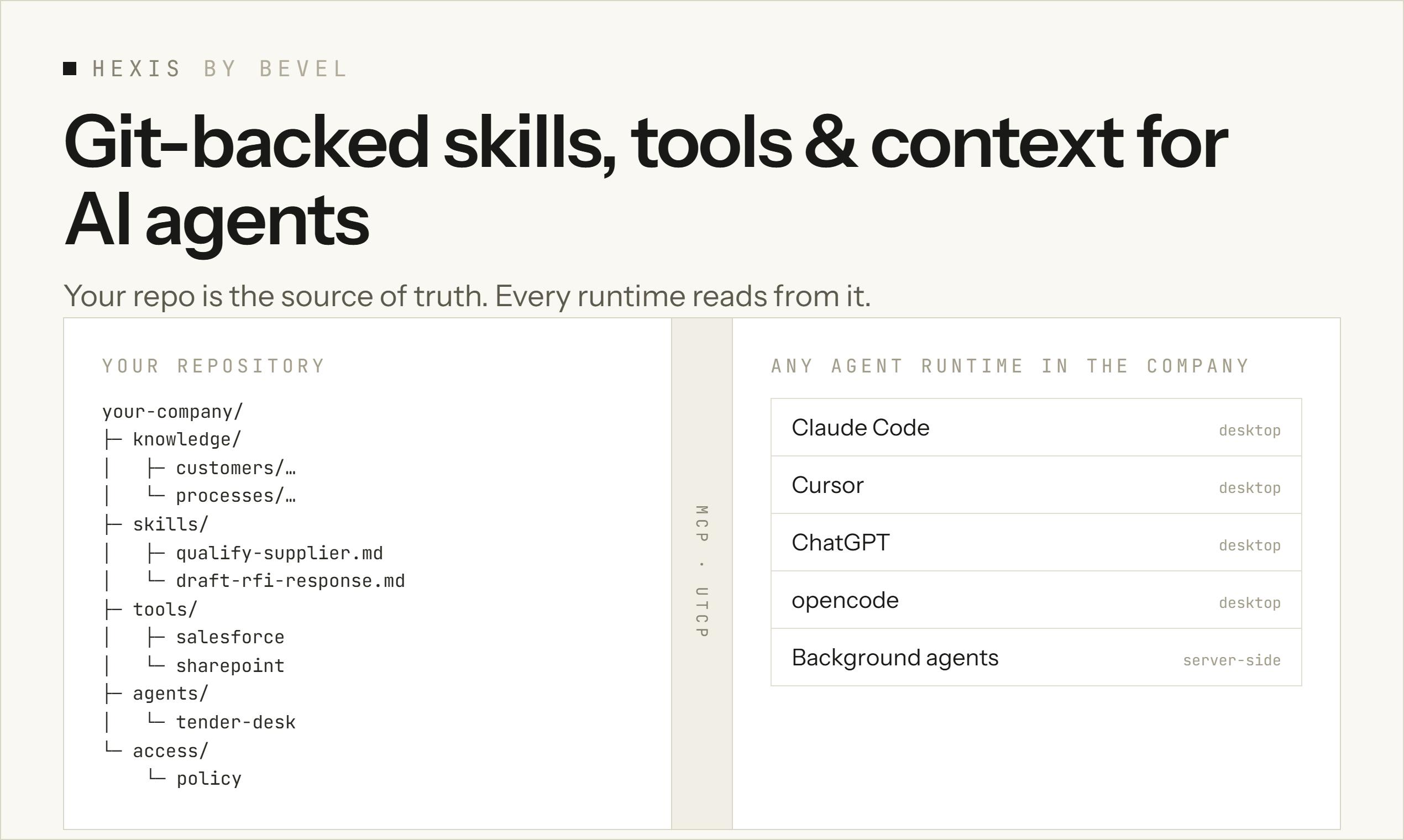
Hexis is an open-source project that provides a Git-backed management layer for AI agent skills, tools, and context. It leverages Git's versioning and PR workflows for governance while offering a clean UX for non-technical users. Through MCP protocol support, it enables cross-platform agent interoperability, positioning itself as a vendor-neutral capability hub for enterprise AI deployments.
As AI Agents Enter the Enterprise, Knowledge Management Becomes a New Challenge
As AI agents become increasingly prevalent in enterprise environments, a new pain point has emerged: AI skills, tools, and knowledge are scattered across the organization without unified management. Different teams maintain their own prompt templates, tool configurations, and contextual information separately, making reuse difficult and effective access control nearly impossible.
The open-source project Hexis, recently launched on Product Hunt, targets exactly this problem. Its positioning is clear and compelling — "A Git-backed skills, tools & context management layer for AI agents." The project received 109 upvotes upon release, ranking #4 on the daily leaderboard under the "Open Source" and "Artificial Intelligence" categories.
What Problem Does Hexis Actually Solve?
A Centralized "AI Capability Hub"
Hexis's core philosophy is to create a unified place where enterprise AI skills, tools, and knowledge are "centrally stored and uniformly managed." According to the official description, these assets are centrally managed, vetted, and access-controlled within Hexis, while remaining callable by any AI agent across the company.
The value of this design is clear: enterprises no longer need to configure capabilities separately for each agent. Instead, they govern everything through a centralized layer. Whether it's an individual employee, a team, or an automated agent, administrators can make granular decisions about which contexts, tools, and skills each can access.
Governance Logic Built on Git
Hexis's most elegant design choice is that it doesn't reinvent the wheel — it's a layer built on top of Git. This means it naturally inherits Git's two core capabilities:
- Versioning: Every change to skills and tool configurations is traceable, reversible, and auditable.
- Pull Request workflows (PRs): Anyone can propose modifications to existing skills or submit new ones, with review and merging handled through the PR mechanism.
In other words, Hexis transplants the battle-tested collaboration and governance paradigms from software engineering directly into AI capability management. For technical teams already familiar with Git workflows, this is a near-zero learning curve natural extension.
A Clean Experience for Non-Technical Users
While Git powers the backend, Hexis doesn't expose that complexity directly to users. The team specifically emphasizes that it layers a "clean UX" on top of the Git core, enabling anyone — regardless of technical background — to:
- Use existing skills
- Propose modifications
- Submit entirely new skills
This point is crucial. Building AI capabilities within an enterprise shouldn't be the exclusive domain of engineers. Business professionals and product managers also possess valuable domain knowledge. By lowering the barrier to entry, Hexis enables a broader range of roles to participate in co-building AI capabilities while preserving the rigorous governance that Git provides.
Cross-Agent Interoperability via MCP Protocol
Another technical highlight of Hexis is its consumption through MCP (Model Context Protocol). This means that regardless of which AI agent an enterprise uses internally, as long as it supports the MCP protocol, it can connect to and invoke the skills, tools, and context managed within Hexis.
As an increasingly important standardization protocol in the AI ecosystem, MCP is becoming the universal bridge connecting models to external capabilities. Hexis's choice of MCP as its access method reflects its "vendor-neutral, cross-platform" design philosophy — it doesn't lock users into a specific agent framework, but rather exists as a universal capability supply layer.
Quick Take: A Direction Worth Watching
From a product positioning standpoint, Hexis addresses a real and increasingly acute pain point in enterprise AI deployment. As more organizations move from "a single chatbot" to "multi-agent collaboration," unified capability governance, access control, and version management will inevitably become essential requirements.
Hexis's approach — "governance layer on Git + distribution via MCP" — is both pragmatic and forward-looking. Rather than attempting to build entirely new infrastructure, it reuses toolchains that developers already trust, significantly reducing barriers to enterprise adoption.
Of course, as a newly launched open-source project, its actual maturity, ecosystem support, and large-scale deployment effectiveness remain to be validated over time. But at this critical stage where AI agents are transitioning from experimentation to production, tools focused on "governance and collaboration infrastructure" like this are undoubtedly worth continued attention from technical teams.
Related articles

Chain of Thought Isn't Just for AI: How Humans Can Use CoT to Improve Thinking Quality
Chain of Thought isn't just a prompt trick for large models. Starting from a Hacker News discussion, this article analyzes why CoT works for human thinking too, breaks down actionable ways to transfer it, and highlights the key differences between human CoT and machine CoT.
Cloudflare Teams Up with OpenAI: Closi…
Cloudflare Teams Up with OpenAI: Closing the Loop from Vulnerability Discovery to Defense with AI
Cloudflare uses OpenAI Daybreak to investigate security vulnerabilities and generate reviewable remediation plans, while developers use Codex to boost coding efficiency and quality.

Orca Multi-Agent Orchestration in Practice: A Guide to Parallel Collaboration with Claude and Codex
Orca is Stable AI's free open-source agent workbench supporting 34 agents like Claude Code and Codex in parallel. Learn its Git worktree isolation, multi-model orchestration, and mobile management.