Hey Noah: An In-Depth Analysis of the Proactive AI Executive Assistant Built for Founders

Hey Noah is a proactive AI agent that acts as a founder's executive assistant across SMS, email, and WhatsApp.
Hey Noah is a proactive AI executive assistant designed specifically for founders, distinguishing itself from conversational AI by autonomously managing calendars, follow-ups, and networking across email, SMS, and WhatsApp. Using a Tesla FSD analogy, it positions itself as an always-on agent that makes human-like decisions rather than waiting for commands, effectively democratizing EA services for early-stage entrepreneurs at a fraction of traditional costs.
When AI Assistants Shift from "Passive Response" to "Proactive Execution"
On Product Hunt, a product called Hey Noah topped the daily chart with 185 votes. Its positioning is crystal clear—a "proactive AI executive assistant" designed specifically for founders.
Its most striking tagline is worth pondering: "Claude talks to you; Noah talks to your network." This sentence precisely distinguishes two forms of AI products today: one is the conversational assistant that waits for your questions and gives answers; the other is the agent-type assistant that can proactively act on your behalf to complete real tasks.
The Fundamental Technical Distinction Between AI Agents and Conversational AI
The "agent-type assistant" that Hey Noah represents has a fundamentally different technical architecture from traditional conversational AI. Conversational AI (like ChatGPT, Claude) relies on large language models' single-turn or multi-turn dialogue capabilities—at its core, it understands user input and generates responses, essentially functioning as a "reactive system." AI Agents, however, are built on a more complex architecture: they require persistent state management, external tool-calling capabilities (like sending emails, operating calendar APIs), multi-step task planning, and autonomous decision-making loops without human intervention.
Between 2024 and 2025, the industry consensus on AI Agent technology has become increasingly clear—a qualified Agent needs to include four core modules: Perception, Planning, Action, and Memory. Hey Noah is precisely a product that applies this Agent architecture to the vertical scenario of executive assistance.
Hey Noah's Core Philosophy: "Tesla FSD" Rather Than "Cruise Control"
The Hey Noah team used a vivid analogy to position themselves: it's more like Tesla's Full Self Driving (FSD) than cruise control.
The core of this metaphor lies in the difference in autonomy:
- Cruise control: You need to keep your hands on the wheel at all times; AI only performs limited actions after you've set the parameters;
- Full Self Driving: AI actively perceives the environment, makes judgments, and executes—you only need to intervene at critical junctures.
The Deeper Implications Behind the FSD Analogy
Tesla's Full Self Driving system began rolling out its Beta version to select users in 2020, undergoing a technical transition from rule-based to end-to-end neural networks. Starting with FSD V12, it adopted a pure vision approach where neural networks directly output steering and acceleration commands, no longer relying on manually coded rules. The core significance of this shift is that the system no longer operates under preset rules but has learned "universal patterns" of driving behavior through massive amounts of driving data.
Hey Noah uses this analogy to hint at its own technical philosophy—rather than managing schedules through preset if-then rules, it lets AI understand the overall context of a founder's work environment and make human-like judgments in complex, ambiguous situations. Of course, FSD still requires drivers to be ready to take over at any time, which also implies the realistic positioning of AI agent products as "human-machine collaboration" rather than "complete replacement."
Applied to the AI executive assistant scenario, traditional AI scheduling tools require you to constantly input commands: "Schedule a meeting for Wednesday afternoon" or "Remind me to reply to this email." Hey Noah's goal is to become an always-on, autonomous AI executive assistant that proactively manages your calendar, relationships, and follow-ups—ensuring that "nothing slips."
Cross-Channel Coordination: Seamless Integration Across Email, SMS, and WhatsApp
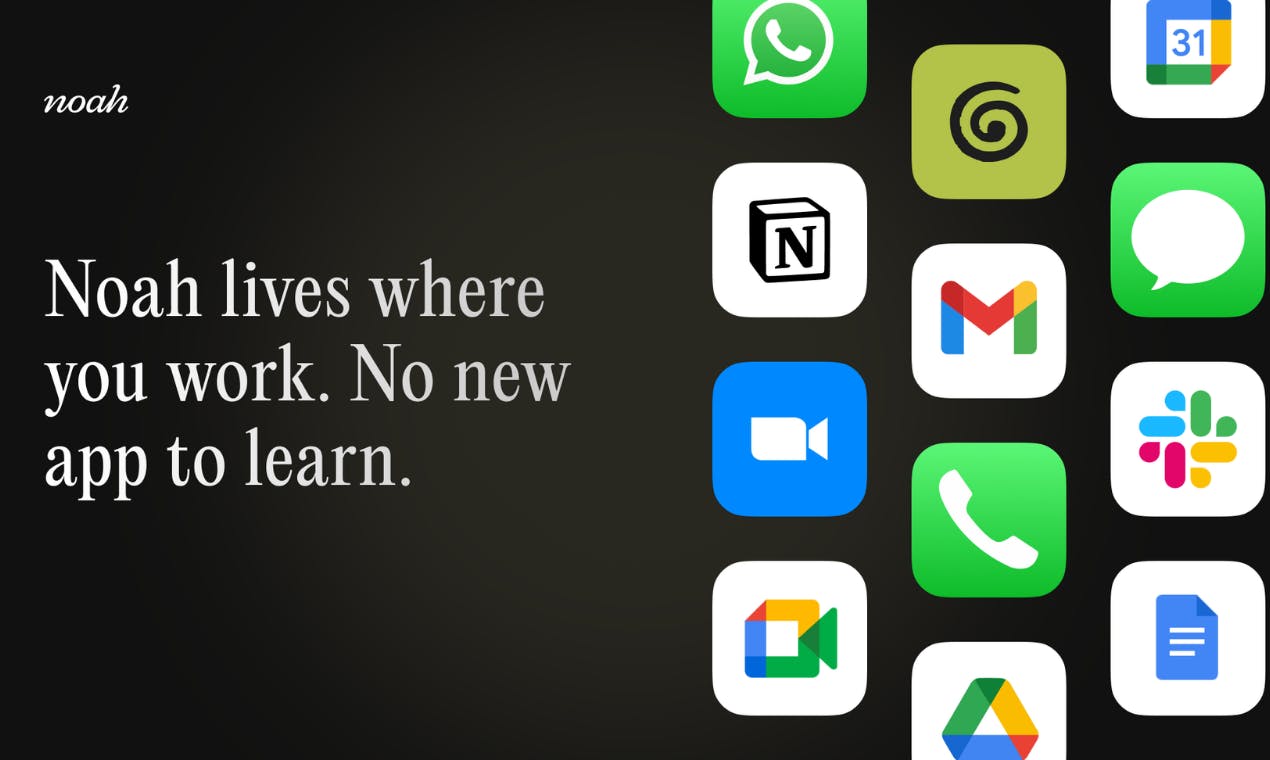
One of Hey Noah's standout features is that its working interface isn't confined to a single app—it embeds itself deeply into everyday communication channels.
The official description calls it an assistant "living in your SMS," coordinating meeting logistics through email, text messages, and WhatsApp. The product logic behind this is very clear:
Why Communication Channels Rather Than a Standalone App
For founders—users with high-frequency communication and fragmented time—the biggest pain point isn't a lack of tools but too many tools with excessive switching costs. Meeting scheduling often involves back-and-forth communication among multiple parties, and this communication naturally occurs in email and instant messaging.
Hey Noah's choice to embed directly into "zero-barrier" channels like SMS means users don't need to learn a new interface or open a new app to let AI intervene in actual coordination work. This is a product design approach focused on reducing usage friction.
This strategy stems from the concept of "ambient computing"—the best technology is technology that integrates into users' existing behavioral paths rather than requiring them to change habits. Data shows that WhatsApp has over 2 billion monthly active users globally, and SMS as a notification channel has an open rate of up to 98% (far exceeding email's 20%). For founders, daily communication is already scattered across these channels, and meeting coordination information naturally flows through these pipes. This "no interface is the best interface" product philosophy aligns with the early design thinking behind Slack bots and WeChat Mini Programs—reducing users' cognitive load and operational steps, letting AI run within users' most natural workflows rather than pulling them into a new product ecosystem.
Proactive Follow-Up Is the Key Differentiator for AI Assistants
The product's emphasis on "follow-ups" capability deserves particular attention. In real business scenarios, many opportunities are lost not due to lack of intent but because of forgetting to follow up—an unreplied email, an unconfirmed meeting time. Having AI proactively track these "pending" items is precisely the core value Hey Noah aims to create.
Precise Product Positioning for Founders
Hey Noah hasn't tried to be a generic AI assistant "for everyone" but has explicitly targeted founders as a specific segment.
This is a smart positioning choice. Founders typically:
- Have extremely scarce time yet bear heavy external communication loads;
- Are unable or unwilling to bear the cost of a full-time human executive assistant;
- Have relatively high willingness to pay for efficiency tools.
The Wave of AI-Driven Democratization of EA Services
In other words, founders are precisely the demographic with the highest demand elasticity when "dedicated executive assistant" services are made affordable through AI. Hey Noah is essentially using AI technology to bring EA (Executive Assistant) services—once exclusive to executives at large corporations—down to early-stage entrepreneurs.
The median annual salary for human executive assistants in the U.S. is approximately $60,000-$80,000, reaching over $100,000 in high-cost areas like Silicon Valley. For Pre-seed or Seed-stage founders, this is nearly impossible to bear as a personnel cost. Over the past few years, multiple companies have attempted to lower the accessibility threshold of EA services through different approaches: Belay and Time Etc offer remote part-time human EAs at monthly fees ranging from hundreds to thousands of dollars; Reclaim.ai and Clockwise use algorithms to optimize calendar management. Hey Noah represents the latest evolution of this trend—using AI Agents to fully replace the core functions of human EAs.
This aligns with the logic of AI service democratization in verticals like legal (Harvey AI) and finance (Pilot): achieving 10x or greater cost reductions through AI technology for professional services that were previously only affordable by large organizations, thereby unlocking enormous potential markets.
Challenges and Considerations Facing AI Agent Products
As an AI agent product focused on "autonomous execution," Hey Noah also faces challenges common to this category of products:
The boundaries of trust and authorization. Having AI proactively communicate with your network on your behalf means handing over a significant degree of decision-making power and communication tone to a machine. If wording is inappropriate or scheduling goes wrong, real interpersonal relationships are affected. Finding the balance between "proactive" and "controllable" will determine whether users dare to truly let go.
In AI agent products, "trust and authorization" isn't merely a user psychology issue—it's a system design problem. The industry's current mainstream solutions include several layers: First is the "Human-in-the-loop" mechanism, pausing execution and requesting human confirmation at critical decision points (such as first-time contact with new connections or commitments involving monetary amounts); second is the "progressive trust" model, where the system requests confirmation for every action initially and gradually expands autonomous permissions as user satisfaction accumulates; third is "auditability," where all actions executed by AI on the user's behalf have complete logs that users can review and reverse at any time. Google's Project Mariner, Anthropic's Computer Use, and other cutting-edge AI agent projects are all exploring similar safety frameworks. For Hey Noah, how to give founders a sense of security between "freeing their hands" and "maintaining external communication quality" is likely the key factor determining product retention.
The chasm from demo to reliability. The "Tesla FSD" analogy is compelling, but just as autonomous driving is still tackling long-tail scenarios, an AI executive assistant that truly achieves "nothing slips" likewise needs to prove its reliability across countless complex, ambiguous real-world communication scenarios.
Overall, Hey Noah represents a specific microcosm of AI applications evolving from "chatbots" to "autonomous agents." It grounds technical capabilities in a clear pain point, a defined user base, and specific channels—this pragmatic product approach is perhaps exactly why it topped Product Hunt.
Related articles

Workbuddy for Absolute Beginners: How a Desktop AI Agent Fits Into Real Workflows
A beginner's guide to the Workbuddy desktop AI agent: installation, claiming credits, file management, and building automated workflows—compared with CodeX for fit and cost, helping professionals shift from AI question-askers to AI managers.

OpenAI's New Agent Stack: Computer Use, Decisions API, and Ultra-Fast Workflows
OpenAI Dev Day unveiled a new agent stack: Computer Use outperforms humans, Decisions API delivers ultra-low-latency classification via Luna, Agents API opens the same Computer Use capabilities, and GPT-6.1 Sol costs only one-seventh of Astra. Core updates, benchmark data, and developer insights.

Liang Wenfeng Open-Sources DeepInfo Inference Framework, Takes On U.S. Ban
DeepSeek open-sources its DeepInfo inference framework after its models, featuring GPU/CPU cross-pipelining, small-model prediction with large-model verification, and full Huawei Ascend and NVIDIA chip support—facing the U.S. federal ban head-on. This article analyzes its significance for AI deployment and open-source strategy.