HeyGen Open-Sources Hyperframes: Render Video with HTML, Built for AI Agents

HeyGen's Hyperframes lets AI agents render video directly from HTML, hitting 56K+ GitHub Stars.
HeyGen's open-source Hyperframes project introduces a bold concept: write HTML, render video — built for AI agents. With 56K+ GitHub Stars, its key insight is that LLMs naturally generate HTML, so building video description on HTML/CSS enables agents to produce videos end-to-end without human intervention. Built in TypeScript, it's not replacing editing software — it's infrastructure for automated, programmatic video production at scale, signaling a shift toward machine-first design principles in creative tooling.
Making Videos the Way You Build Websites
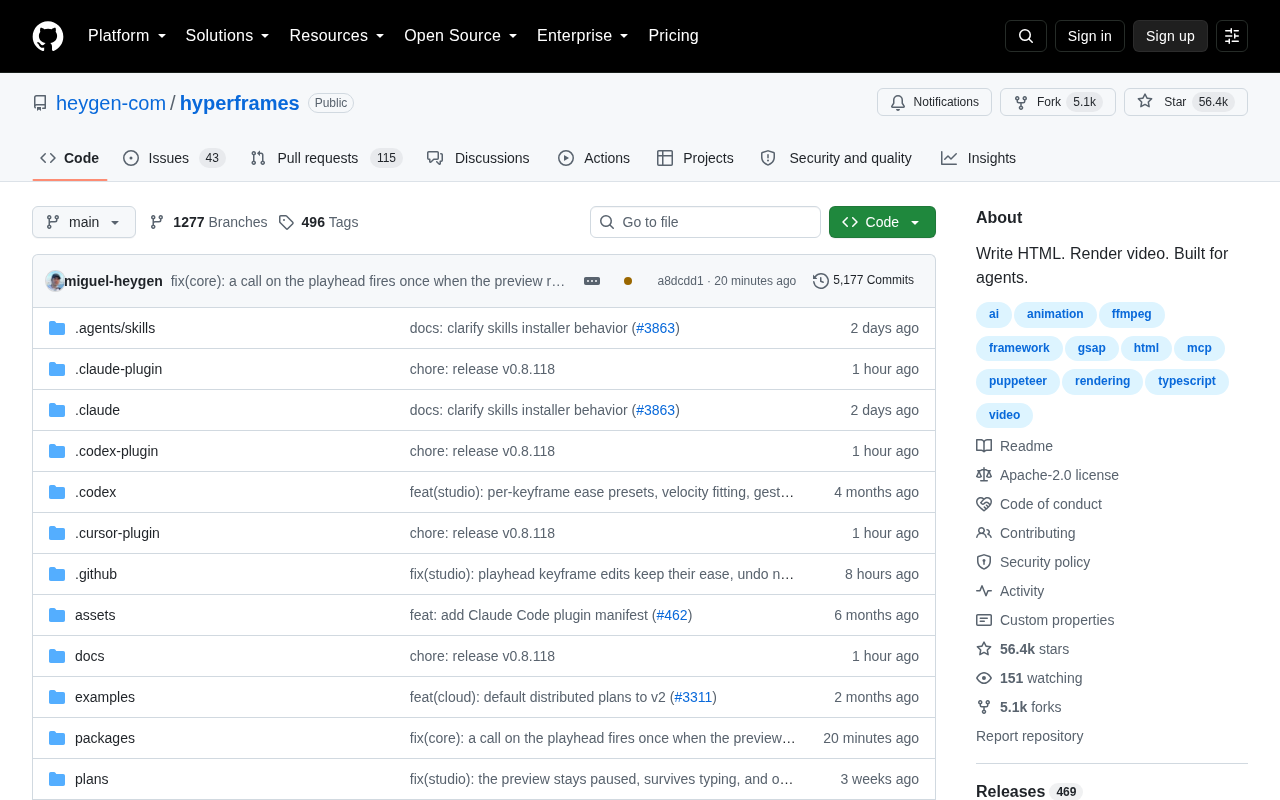
HeyGen recently open-sourced a project called Hyperframes, built around a genuinely disruptive idea: Write HTML. Render video. Built for agents. This TypeScript-based tool has already racked up over 56,000 Stars on GitHub in a short period — gaining more than 3,000 new Stars in a single week — making it one of the hottest new projects in the space.
The core idea is refreshingly straightforward: frontend developers have long mastered HTML and CSS to describe page layouts, so why not use the same approach to describe video content? Hyperframes abstracts video rendering into a process that mirrors web rendering — you write structured markup, and the engine converts it into frame-by-frame video output.
Why "Built for Agents"?
The most thought-provoking part of the project's tagline is "Built for agents." Traditional video production tools — whether editing software or programmatic video frameworks — are overwhelmingly designed for human operators, relying on GUIs or complex API calls. Hyperframes' choice of HTML as its input format is a deliberate and well-reasoned one.
Large language models are naturally good at generating structured text, and HTML happens to be one of the most common formats in their training data. This means an AI Agent can directly "write" an HTML description of a video and hand it off to Hyperframes to render into a finished clip — with no human intervention required at any step. For teams looking to build automated content production pipelines, this "text in, video out" model dramatically lowers the integration barrier.
In other words, Hyperframes isn't competing with editing software. It's laying the groundwork for AI-driven content generation infrastructure.
The role AI Agents play in content production pipelines is worth unpacking further. "Agent-friendly" tools generally need to meet a few key criteria: inputs must be plain text or structured data (not GUI interactions), outputs must be deterministic and predictable, and the entire call chain must be able to run unattended. HTML satisfies all three simultaneously — it's plain text, follows well-defined syntax rules, and produces highly consistent results from identical inputs.
Traditional video editing software, by contrast, is difficult for LLMs to drive directly. Even when APIs exist, they typically require handling low-level parameters like timeline coordinates and layer relationships — which are deeply unfriendly to language models. Hyperframes essentially performs a "semantic elevation": it lifts the language for describing video from "move layer to coordinates (120, 80) at 3.2 seconds" up to "this region shows the headline text, fading in on entry" — the latter being the natural granularity at which LLMs generate content.
Tech Stack and Ecosystem Positioning
From a technical standpoint, Hyperframes is built with TypeScript, making it a natural fit for the modern web engineering ecosystem — developers can use familiar package managers, type systems, and build tools to integrate it. Choosing HTML/CSS as the description layer also means it can leverage the mature layout, animation, and styling capabilities of browser rendering engines, rather than reinventing the wheel.
This design philosophy follows a lineage of similar thinking in the industry. Projects like Remotion have similarly advocated for "making videos with React," with the same underlying logic of migrating frontend tech stacks into the video domain. What sets Hyperframes apart is its stronger emphasis on agent-friendliness — treating generative AI as a first-class user from the ground up.
As an open-source project under HeyGen, it also reflects how the company — best known for AI-powered avatar videos — is progressively opening up its underlying capabilities to build a developer ecosystem around automated video generation.
Remotion is an important reference point for understanding where Hyperframes fits. Launched in 2021, Remotion lets developers describe video frames using React components and CSS animations, then uses Headless Chrome to capture screenshots frame-by-frame and assemble them into a video file. This approach has found solid adoption in use cases like programmatically generated financial report animations and data visualization videos.
Hyperframes shares the same underlying logic — describing video with a frontend tech stack — but the emphasis differs. Remotion's API remains human-developer-centric, requiring manually authored React component trees. Hyperframes is more focused on enabling LLMs to directly produce renderable descriptions, minimizing the need for human orchestration in the middle. The two aren't substitutes for each other; Hyperframes is better understood as a further product-level abstraction on top of the technical path Remotion already validated, specifically optimized for AI-generation scenarios.
What Could Change
If you follow this philosophy to its logical conclusion, several compelling use cases come into view: marketing teams letting agents auto-generate promotional clips from product copy; educational platforms batch-converting course scripts into explainer videos; news products rendering text stories into dynamic video cards in real time. What these scenarios share is the need to produce video at scale and programmatically — not to painstakingly craft individual pieces.
Of course, how expressive HTML-based video descriptions can really be — and how well they handle complex animations and audio-visual sync — still needs validation through real-world projects. Over 56,000 Stars signals high expectations from the developer community, but there's still significant engineering work between "an interesting concept" and "a reliable production tool."
For developers tracking AI-driven content generation, Hyperframes is worth keeping a close eye on. It represents a clear and emerging trend: as AI Agent capabilities grow, more and more creative tools will treat "machine-readable and machine-writable" as a primary design principle — not just an afterthought to the human interface.
Related articles

AtomicRL: Atomic Reinforcement Learning Solves Long-Horizon Robotic Manipulation Challenges
AtomicRL introduces atomic reinforcement learning with Semantic-Aware Policy Optimization (SAPO) and Bottleneck-Adaptive Targeted Exploration (BATE) to solve credit assignment and subtask imbalance in VLA long-horizon robotic manipulation, outperforming PPO on LIBERO-LONG and CALVIN and improving real-world task performance by 21.3%.

Gaussian Mixture NPMLE Achieves Minimax Optimality: A New Breakthrough in Hellinger Distance
Recent research proves that the nonparametric maximum likelihood estimator (NPMLE) for Gaussian mixtures achieves the minimax optimal rate log(n)/n in squared Hellinger distance, with faster rates under compact support and empirical Bayes applications.

Quasipolynomial-Time Breakthrough for ℓ∞ Contractions: New Algorithm for Stochastic Games
The paper proposes a quasipolynomial-time algorithm for ℓ∞ contraction mappings, using a boosting argument to geometrically shrink the search region and deriving that simple stochastic games can be solved in quasipolynomial time, bringing new breakthroughs to algorithmic game theory and complexity theory.