Gaussian Mixture NPMLE Achieves Minimax Optimality: A New Breakthrough in Hellinger Distance

The paper proves that the Gaussian mixture NPMLE achieves the minimax optimal rate in Hellinger distance.
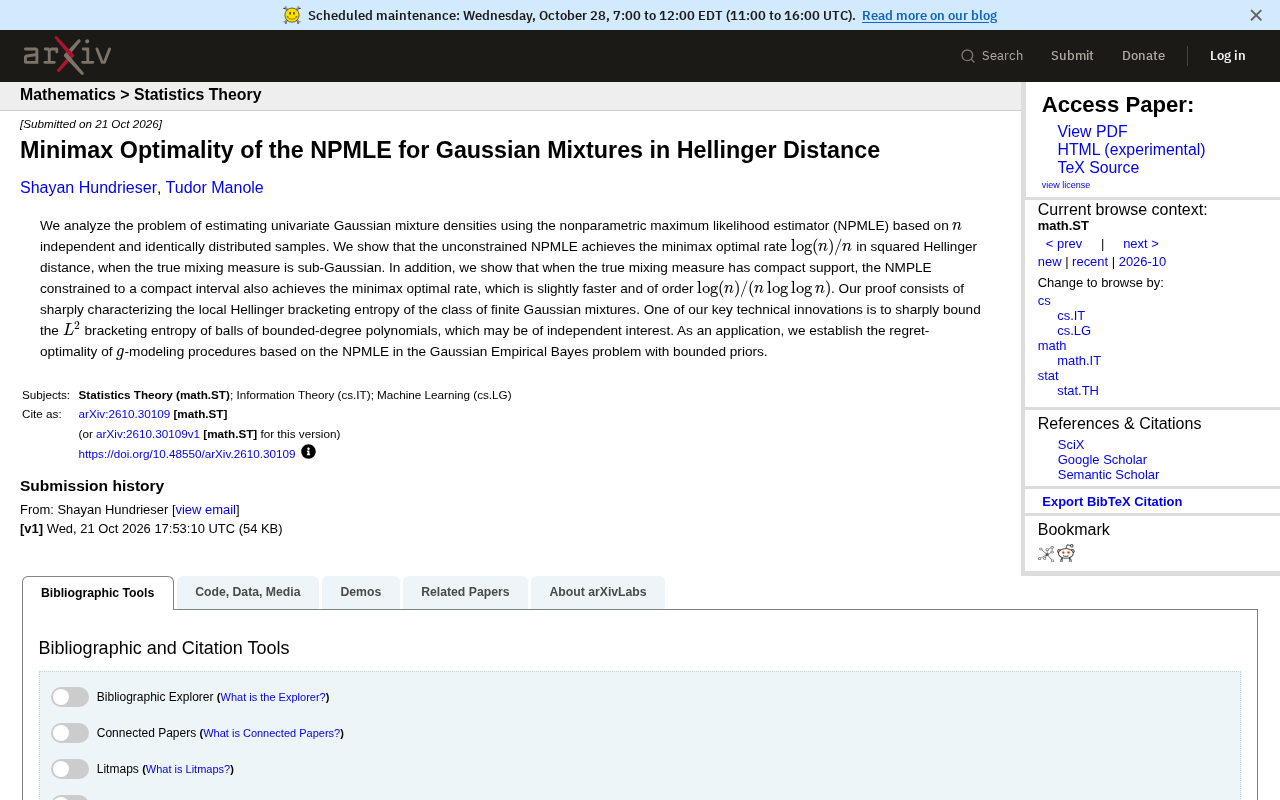
This study resolves the convergence rate problem of the nonparametric maximum likelihood estimator (NPMLE) in Gaussian mixture models. Under a sub-Gaussian mixing measure assumption, the unconstrained NPMLE achieves the minimax optimal rate log(n)/n in squared Hellinger distance; under compact support, the constrained NPMLE improves to log(n)/(n log log n). The core technique is a sharp characterization of local Hellinger bracketing entropy, especially a sharp upper bound for the L^2 bracketing entropy of bounded sub-polynomial balls. As an application, the paper establishes regret optimality of NPMLE-based g-modeling in Gaussian empirical Bayes. This work fills a theoretical gap and provides new entropy analysis tools for nonparametric estimation.
Research Background and Core Problem
In nonparametric statistics, Gaussian mixture models are an important tool for modeling complex distributions. Given independent and identically distributed samples from an unknown Gaussian mixture density, estimating that density is a classic problem. The nonparametric maximum likelihood estimator (NPMLE) has attracted much attention for its intuitiveness and asymptotic properties, but whether its convergence rate is minimax optimal, especially in Hellinger distance, had not been fully resolved. A recent paper analyzes this problem in depth and gives a positive answer.
Nonparametric maximum likelihood estimation (NPMLE) refers to a statistical method that estimates an unknown distribution or density in a nonparametric model by maximizing the empirical likelihood function. Unlike parametric maximum likelihood, NPMLE does not assume the distribution belongs to a finite-dimensional parametric family; instead, it searches directly in an infinite-dimensional function space (such as all probability densities) for the estimator that maximizes the likelihood. For Gaussian mixture models, NPMLE aims to estimate the mixing measure (i.e., the distribution of the mixture weights) from the data, thereby obtaining an estimate of the mixture density. NPMLE is usually a discrete distribution with an intuitive interpretation and is consistent under certain regularity conditions. However, whether its convergence rate is minimax optimal depends on model complexity and the distance metric—precisely the core question studied in this paper.
Main Theoretical Results
The paper proves that when the true mixing measure satisfies a sub-Gaussian assumption, the unconstrained NPMLE achieves the minimax optimal rate log(n)/n in squared Hellinger distance. This rate matches known lower bounds, meaning that NPMLE is rate-optimal in this setting.
A more refined conclusion appears when the mixing measure has compact support: constraining the NPMLE to a compact interval achieves a slightly faster rate log(n)/(n log log n). This improvement stems from the change in entropy structure induced by the constraint and also shows that prior knowledge (compact support) can yield a gain in rate.
Squared Hellinger distance is a commonly used distance measure between probability densities, defined as (H^2(p,q) = \frac{1}{2}\int (\sqrt{p} - \sqrt{q})^2 d\mu). Unlike Kullback-Leibler divergence, it is symmetric and does not require absolute continuity, so it is more robust for density estimation. Hellinger distance is bounded between 0 and 1 and is equivalent to total variation distance (total variation distance is at most (\sqrt{2}H)). In nonparametric density estimation, convergence rates in squared Hellinger distance are often used to measure the quality of estimators, because this distance naturally handles tail behavior of densities and has good theoretical connections with likelihood methods. The minimax optimal rate (\log(n)/n) proved in this paper is defined under this metric.
Technical Contribution: A Sharp Characterization of Hellinger Bracketing Entropy
The core of the proof lies in a sharp characterization of the bracketing entropy of finite Gaussian mixture classes under local Hellinger distance. Specifically, the authors precisely characterize the local entropy structure of the mixture class under the Hellinger metric, which is key to controlling the convergence rate of the NPMLE.
A key technical innovation is that they give a sharp upper bound for the L^2 bracketing entropy of bounded sub-polynomial balls. This result is of independent value and may be used in other entropy calculations involving polynomial classes. By decomposing the entropy of the mixture density into the entropy of the mixing weights and the entropy of the kernel functions (Gaussian densities), and combining this with bounds on polynomial entropy, the authors obtain the required rate.
Bracketing entropy is a tool for measuring the complexity of a function class, defined as the logarithm of the minimum number of "brackets" needed to cover the function class. An (\epsilon)-bracket is a pair of functions (l \le u) such that (|u-l| \le \epsilon), and every function in the class is contained in some bracket. Bracketing entropy is often used in empirical process theory to bound the supremum of empirical processes via the Dudley entropy integral, and thus to control the convergence rate of the MLE. For Gaussian mixture classes, the local behavior of the Hellinger bracketing entropy directly determines the convergence rate of the NPMLE. One of the key contributions of this paper is to give the precise order of this entropy, in particular by decomposing the entropy of the mixing weights and the kernel functions and using a sharp upper bound for the (L^2) bracketing entropy of polynomial balls, thereby obtaining the optimal rate.
Application: Regret Optimality in Gaussian Empirical Bayes
As an application of the theory, the paper establishes the regret optimality of the g-modeling procedure based on the NPMLE in Gaussian empirical Bayes problems with bounded priors. Empirical Bayes methods aim to estimate the prior distribution from multiple observations, and g-modeling uses the NPMLE to estimate the mixture density of the prior. Regret optimality shows that this procedure achieves the optimal rate in the sense of cumulative regret, providing a theoretical guarantee for the practical use of NPMLE.
Empirical Bayes is a method for estimating a prior distribution from multiple observations, often used in Bayesian analysis when the prior is unknown. In Gaussian empirical Bayes problems, the observations are (X_i \sim N(\theta_i, 1)), where (\theta_i) are independently drawn from some unknown prior distribution (G). The goal is to estimate (G) or to make decisions based on it. g-modeling is a nonparametric empirical Bayes method that uses the NPMLE to estimate the marginal density (f(x) = \int \phi(x-\theta) dG(\theta)), and then uses deconvolution to obtain an estimate of the prior (G). Regret optimality means that the proposed procedure achieves the asymptotically optimal rate in the sense of cumulative regret, i.e., the additional growth in cumulative loss compared with the optimal decision when the prior is known is minimal. This paper proves that g-modeling based on the NPMLE is regret-optimal under bounded priors, providing a theoretical basis for the method.
Significance and Outlook
This work fills the gap in the rate optimality of the NPMLE for Gaussian mixture models in Hellinger distance and provides rigorous theoretical support for empirical Bayes problems. Its technical tools (sharp bounds for polynomial ball entropy) are expected to play a role in a broader range of nonparametric estimation problems. Possible future research directions include high-dimensional extensions, rate analysis under other distance metrics, and trade-offs between computational efficiency and statistical optimality.
Summary
The study proves that under sub-Gaussian mixing measures, the NPMLE achieves the minimax optimal rate log(n)/n in squared Hellinger distance; under compact support, the constrained NPMLE can achieve log(n)/(n log log n). The key technique is a sharp characterization of Hellinger bracketing entropy, especially sharp bounds for the L^2 entropy of polynomial balls. In application, this leads to the regret optimality of g-modeling in Gaussian empirical Bayes.
One-line Summary
The paper proves that the Gaussian mixture NPMLE achieves the minimax optimal rate in Hellinger distance.
Paragraph Summary
This study resolves the convergence rate problem of the nonparametric maximum likelihood estimator (NPMLE) in Gaussian mixture models. Under a sub-Gaussian mixing measure assumption, the unconstrained NPMLE achieves the minimax optimal rate log(n)/n in squared Hellinger distance; under compact support, the constrained NPMLE improves to the rate log(n)/(n log log n). The core technique of the proof is a sharp characterization of the local Hellinger bracketing entropy of finite Gaussian mixture classes, in particular a sharp upper bound for the L^2 bracketing entropy of bounded sub-polynomial balls. As an application, the paper establishes the regret optimality of NPMLE-based g-modeling in Gaussian empirical Bayes problems. This work fills a theoretical gap and provides new entropy analysis tools for nonparametric estimation.
Related articles

Amphibious Transforming Drone: Beyond 100x Power Savings, What Are the Real Needs?
Is the amphibious transforming drone just a gimmick? Starting from the 100x power difference of the M4 Morphobot, explore real application scenarios and thesis topic ideas, analyzing boundary conditions where pure drones and pure ground robots both fail.

Warhound Raises $200 Million: Genetically Engineered "War Dogs" Paired with Anduril Gear
Warhound raises $200M, backed by Ben Lamm and Palmer Luckey, to genetically engineer dogs for military and law enforcement use and equip them with Anduril gear. This article analyzes its technology direction, funding logic, and ethical controversy.

Claude API Comes to Google Cloud: IAM Integration and SDK Access Guide
Anthropic hosts the full Claude API on Google Cloud with IAM-controlled permissions and unified billing. This guide covers the Vertex AI and Anthropic-hosted entry points, IAM role configuration, and SDK access.