HG-ESR-NET: Modernizing the Real-ESRGAN Open-Source Super-Resolution Tool

HG-ESR-NET modernizes Real-ESRGAN with updated dependencies and OpenModelDB model support.
HG-ESR-NET is a community-driven modernization of the classic Real-ESRGAN image super-resolution project. Created by a developer who was frustrated by outdated dependencies and TorchVision errors, this fork updates the codebase for modern Python/PyTorch environments and adds support for loading models from OpenModelDB, transforming it from a single-model tool into a flexible, pluggable platform for various super-resolution tasks.
From Boredom to Action: An Unexpected Open-Source Practice
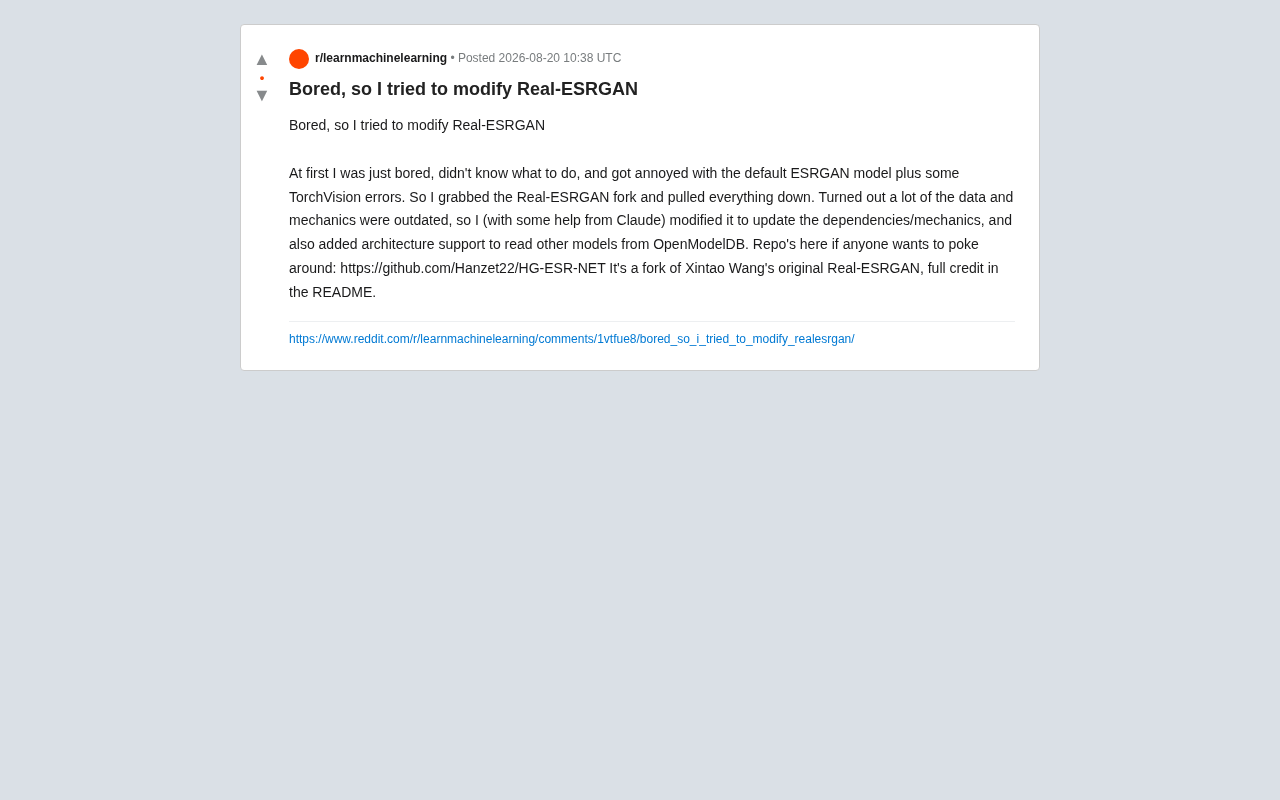
Many excellent open-source projects have humble beginnings. Recently, a developer shared on Reddit their experience modernizing the classic image super-resolution project Real-ESRGAN. In their own words, it started simply because they were "bored with nothing to do," combined with dissatisfaction with the default ESRGAN model and a series of TorchVision-related errors.
So they pulled a fork of Real-ESRGAN, dug into the code, and discovered that much of the project's data and runtime mechanisms had become outdated — a common ailment among popular open-source projects: after the initial hype fades, dependency library versions evolve and APIs change, making old code difficult to run in new environments.
Ultimately, with the help of Claude, the developer completed the modernization and open-sourced the results in the HG-ESR-NET repository. It's a fork based on Xintao Wang's original Real-ESRGAN, with full attribution given in the README.
What Is Real-ESRGAN?
A Classic Model in Image Super-Resolution
Real-ESRGAN (Real-World Enhanced Super-Resolution GAN) is an image and video super-resolution model proposed by Xintao Wang et al. It's an advanced version of ESRGAN, with the core goal of restoring low-resolution images suffering from real-world degradation (such as compression noise, blur, and artifacts) into clear, high-resolution images.
To understand Real-ESRGAN's value, it helps to know the development trajectory of image super-resolution technology. Image Super-Resolution (SR) is a classic problem in computer vision, aiming to reconstruct high-resolution images from low-resolution inputs. Traditional methods like bicubic interpolation can only perform simple pixel filling without recovering real details. After the deep learning era began — from SRCNN in 2014, through EDSR and RCAN, to GAN-based SRGAN and ESRGAN — super-resolution technology made quantum leaps. The introduction of GANs enabled generated images to not only perform well on numerical metrics (like PSNR) but also approach real photo quality in perceptual terms, capable of "hallucinating" reasonable high-frequency texture details.
Architecturally, ESRGAN introduced Residual-in-Residual Dense Block (RRDB) as the generator backbone, removed batch normalization layers to avoid artifacts, and used a relativistic discriminator to improve training stability. Real-ESRGAN inherited these architectural designs and built upon them with its most critical innovation — the High-Order Degradation Model. In reality, image degradation is complex and chain-linked: an image might first be compressed, then screenshot-scaled, then undergo secondary compression through social media. Traditional super-resolution methods only simulate single degradation (like one downsampling plus noise), and their performance drops dramatically when facing multiple degradations. Real-ESRGAN synthesizes training data by cascading multiple degradation processes — including multiple random combinations of blur, downsampling, noise, and JPEG compression — enabling the model to handle virtually any combination of image degradation found in the real world.
Because of this, unlike "clean downsampled" images in laboratory settings, Real-ESRGAN was specifically trained and optimized for complex, diverse real-world degradation scenarios. It excels at old photo restoration, anime image enhancement, and low-quality video upscaling, and was once one of the most popular super-resolution solutions in the community.
Why Old Projects Need Modernization
The "shelf life" of open-source projects is a chronically underestimated issue. Real-ESRGAN was released several years ago, during which time core dependencies like PyTorch and TorchVision have undergone multiple major version iterations. Functions that once worked have been deprecated or renamed, causing new users to frequently encounter import errors and compatibility issues during deployment.
Specifically, since PyTorch's release in 2016, it has gone through multiple major version iterations from 0.x to 2.x. Each major version update may involve API renaming, function signature changes, module reorganization, and other breaking changes. For example, TorchVision's models module adjusted how pretrained weights are loaded between versions, and the transforms module underwent a V1 to V2 migration. Additionally, the correspondence between CUDA versions and PyTorch versions has been continuously changing. For projects released before 2021, running them directly in a 2024 environment will almost certainly encounter compatibility issues — this isn't a matter of poor code quality, but rather an objective consequence of the extremely fast evolution of deep learning frameworks.
The TorchVision errors this developer encountered are a textbook example. For users who just want to get started, these environment issues are often the first barrier that drives people away. Therefore, updating dependencies and fixing outdated mechanisms is itself a valuable community contribution.
What HG-ESR-NET Changed
Updated Dependencies and Fixed Runtime Mechanisms
The first step of the modernization was updating the project's dependencies and underlying mechanisms. With Claude's assistance, the author reviewed and updated outdated dependency versions, fixing mechanisms that had broken due to library updates. This means the new repository can run smoothly in more modern Python and PyTorch environments, reducing deployment costs for ordinary users.
Notably, the author openly acknowledged that this modernization was aided by the AI coding assistant Claude. This reflects a new normal in open-source development today — by leveraging large models to quickly understand unfamiliar codebases, locate dependency conflicts, and generate fix proposals, individual developers can efficiently complete maintenance work that previously required enormous effort. In the context of codebase modernization, AI coding assistants provide value on three levels: first, code comprehension — large models can quickly parse the architecture and data flow of thousands of lines of unfamiliar code; second, error diagnosis — when encountering version incompatibility errors, AI can precisely locate the root cause based on error messages and code context, and suggest corresponding new APIs; and third, migration plan generation — AI can batch-convert old syntax into equivalent new implementations. This human-AI collaboration model is particularly suited to "archaeological" maintenance work, where the developer handles decisions and verification while AI handles the heavy lifting of code comprehension and finding alternative solutions.
Introducing OpenModelDB Model Architecture Support
The most valuable feature in this modernization is the addition of architecture support for loading models from OpenModelDB.
OpenModelDB (openmodeldb.info) is a community-driven super-resolution model database, similar to Hugging Face's role for NLP models. It hosts hundreds of super-resolution models trained by community members, each annotated with metadata including applicable scenarios, scale factors, architecture type, and training data sources. Model architectures span ESRGAN, Real-ESRGAN, SwinIR, HAT, DAT, and many other types. Community members train specialized models for specific domains (such as pixel art, manga line art, old photos, game textures), and these targeted models often outperform general-purpose ones.
The original Real-ESRGAN was primarily tied to a few officially provided models, but this modernization allows the tool to load third-party model architectures from OpenModelDB.
The significance of this change should not be underestimated: it transforms a "single-model tool" into a "pluggable model platform." Users can select the most appropriate weights from the community's vast model library based on their specific task — choosing an anime-specialized model for anime screenshots, a portrait enhancement model for old photo restoration, or a texture optimization model for upscaling game assets — rather than being limited to the default model's performance. This greatly improves the tool's flexibility and practicality.
Open-Source Ecosystem Vitality Through Personal Projects
Community Contributions Driven by Real Pain Points
What makes this case interesting is that it didn't originate from some grand technical roadmap, but rather from a purely interest-driven, "annoyed by bugs" hands-on practice. Yet it's precisely these small modifications driven by real usage pain points that constitute the most vibrant part of the open-source ecosystem.
When official projects stop being maintained or lag behind in updates for various reasons, someone in the community will always step up to carry the torch, breathing new life into old projects through forks. This decentralized maintenance model is the source of open-source software's long-term vitality.
AI Coding Assistants Lower the Barrier to Open-Source Participation
Another noteworthy point is the role AI coding assistants play in this process. In the past, taking over an unfamiliar, dependency-heavy codebase for modernization required considerable experience and patience from developers. Now, tools like Claude can help developers quickly understand code, diagnose dependency issues, and generate migration plans.
This means that even a developer acting on a whim can complete meaningful technical contributions within a reasonable time investment. AI is tangibly lowering the barrier to open-source participation, giving more good ideas the opportunity to materialize.
Conclusion
HG-ESR-NET is a textbook example of a "small but beautiful" community modernization project: it doesn't introduce disruptive innovation, but by updating dependencies, fixing mechanisms, and expanding OpenModelDB model support, it tangibly improves Real-ESRGAN's usability and flexibility.
For users who need image super-resolution capabilities, a modernized fork that supports community models is undoubtedly worth considering. And for the broader open-source community, it once again confirms a simple truth: technical progress often hides within these seemingly casual yet thoughtful "quick fixes."
Project link: https://github.com/Hanzet22/HG-ESR-NET (a fork based on Xintao Wang's original Real-ESRGAN)
Related articles

Python 3.15 New Feature: Is the sentinel Type Better Than None?
Python 3.15 adds the sentinel type, using named unique sentinel objects to replace None and bare object(), resolving confusion among missing values, explicit emptiness, and invalid input while avoiding type hint failures.

Deep Learning's Three Architectures and the Universal Approximation Theorem: A Complete Guide to MLPs, CNNs, and Transformers
Explaining the inductive bias differences among MLP, CNN, and Transformer, the existence meaning of the Universal Approximation Theorem (UAT), and the role of Taylor expansion in approximation analysis, while clearing up common misconceptions.

GitLab Emergency Patch Release: Analysis of Critical Security Fixes
GitLab releases critical patch 19.5.1, sparking 355 points of discussion on Hacker News. This article analyzes the background, upgrade steps for self-hosted instances, and verification points to help DevOps teams respond quickly to security updates.