Hidden Concerns Behind Grocery Giant Merger: $165 Million Deal Could Expand Surveillance Network

Kroger's acquisition of Giant Eagle may integrate both parties' surveillance assets; AELP report warns of data concentration risks.
The American Economic Liberties Project (AELP) latest report points out that Kroger's $1.65 billion acquisition of Giant Eagle not only involves reduced market competition and price increases, but may also integrate the surveillance equipment each supermarket chain has deployed—including Flock license plate recognition cameras—into a larger-scale surveillance infrastructure. After data aggregation, license plate trajectories cross-referenced with purchase records and membership information can build more detailed personal profiles. The report thus reveals a blind spot in existing antitrust review: assessments focus mainly on price and market share, lacking systematic tools for the consolidation of data assets and surveillance facilities. Divergence remains over how to characterize the risk—some argue for adding it as a new dimension to merger review, while others emphasize that data use constraints are the key.
Supermarket mergers usually bring to mind rising prices, brand consolidation, or store closures. But a new report reminds us that the consequences of retail consolidation may go far beyond that—it could also quietly weave a broader surveillance network.
The Core Controversy of the Merger
Kroger plans to acquire Giant Eagle for $1.65 billion, a deal already noteworthy enough under the traditional antitrust lens: reduced market competition, narrower consumer choice, and possible price increases. However, the American Economic Liberties Project (AELP), an advocacy group pushing for competition policy reform, points out a more insidious risk in its latest report—the merger would combine the surveillance assets each supermarket chain has deployed, creating a larger-scale surveillance infrastructure.
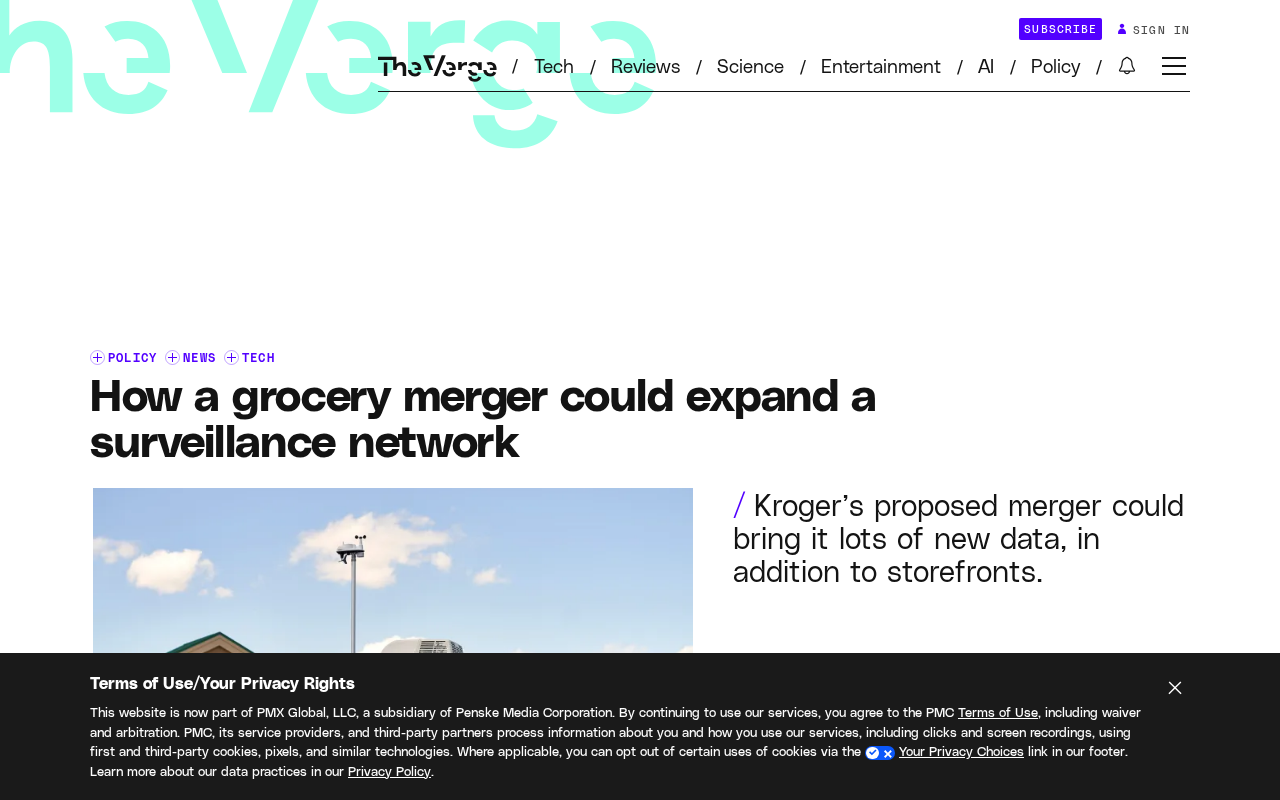
The report specifically mentions Flock cameras. These devices are typically used for license plate recognition and community surveillance, and when they come under the control of a single company through a merger, the breadth and depth of data aggregation increase significantly.
Flock is a U.S. manufacturer of license plate recognition (LPR) and community surveillance equipment. Its cameras are usually installed at community entrances, road junctions, or commercial parking lots, automatically capturing the license plates, vehicle models, and timestamps of passing vehicles, and uploading the data to the cloud for customer retrieval. Flock's customers include police departments, homeowners associations, and private businesses. The devices can form a networked "camera network," enabling a single organization to retrieve records across regions. Precisely for this reason, when such devices are concentrated in the hands of a single retail enterprise through a merger, previously scattered capture points become a wider-coverage observation network, and the data retention period, sharing scope, and secondary use methods also change accordingly. This is exactly why the report treats it as a merger risk rather than a mere security procurement.
Why Retail Surveillance Deserves Vigilance
Supermarket chains often deploy cameras for loss prevention and security, but the capability boundaries of technology can easily spill over beyond their original purpose. Once license plate recognition data is cross-referenced with purchase records, membership information, and in-store movement patterns, companies can build far more detailed personal profiles than "who bought what."
AELP's report discusses this risk within the framework of merger review, effectively raising the issue of a regulatory blind spot: existing antitrust assessments focus primarily on price and market share, lacking systematic tools to examine the consolidation of data assets and surveillance infrastructure.
In practice, antitrust review typically revolves around relevant market definition, market share, unilateral effects, and coordinated effects, with price increases being the core quantitative indicator. This framework has a natural blind spot for the consolidation of data and surveillance assets: factors such as the number of cameras, data retention periods, and cross-store data integration capabilities are difficult to translate into price effects, and mature evaluation standards are lacking. In recent years, regulators have begun attempting to incorporate "data concentration" into competition analysis—for example, examining data barriers and entry obstacles in digital platform mergers—but the integration of surveillance equipment in offline retail has not yet been systematically included in review checklists. The AELP report is precisely raising its argument at this gap.
Consensus and Divergence Across Multiple Perspectives
According to the AELP report and follow-up coverage by multiple tech media outlets, the core fact driving concern over this deal—that the merger could lead to surveillance network expansion—has been cross-corroborated by multiple independent sources. There is broad agreement that the presence of devices such as Flock cameras makes the data concentration issue concrete and urgent.
Divergence arises over how to characterize this risk. Some views tend to treat it as a new dimension that should be included in merger review, arguing that regulators should consider the concentration of surveillance and data assets alongside competitive effects. Another perspective holds that the integration of security equipment does not necessarily lead to abuse; the key remains whether data use is effectively constrained. The two positions have not yet converged.
Implications for Industry and Regulation
The significance of this merger goes beyond a single transaction. It puts a question on the table: as offline retail increasingly relies on smart cameras and data analytics, what companies merge is not just stores and supply chains, but also the ability to observe the public.
For regulators, this means the merger review checklist may need updating—data assets, surveillance equipment scale, and historical data retention strategies all deserve to be evaluation items. For consumers, it is a reminder that beyond discussing prices, we should also pay attention to how we are being recorded in everyday shopping scenarios.
The final outcome of the deal remains to be seen, but the perspective raised by the AELP report will likely be repeatedly cited in future retail merger discussions.
The risk of data aggregation often lies not in the sensitivity of individual records, but in the cross-correlation of data from different sources. License plate recognition provides the spatiotemporal trajectory of "when and where a vehicle appears," while membership information provides the identity and preferences of "who consumes what." Combined, they can reconstruct a person's travel habits, residential area, and rhythm of life, forming a profile that is difficult to undo. Such risks are delayed and irreversible: once data is aggregated and retained, even if the business is later divested, the correlation analysis already completed cannot be retracted. Therefore, academia and advocacy groups generally argue that at the merger review stage, preemptive constraints should be imposed on the scope of data asset consolidation, retention strategies, and sharing arrangements, rather than remedying the situation after abuse occurs.
One-line Summary
Kroger's acquisition of Giant Eagle may integrate both parties' surveillance assets; AELP report warns of data concentration risks.
Paragraph Summary
The American Economic Liberties Project (AELP) latest report points out that Kroger's $1.65 billion acquisition of Giant Eagle not only involves reduced market competition and price increases, but may also integrate the surveillance equipment each supermarket chain has deployed—including Flock license plate recognition cameras—into a larger-scale surveillance infrastructure. After data aggregation, license plate trajectories cross-referenced with purchase records and membership information can build more detailed personal profiles. The report thus reveals a blind spot in existing antitrust review: assessments focus mainly on price and market share, lacking systematic tools for the consolidation of data assets and surveillance facilities. Divergence remains over how to characterize the risk—some argue for adding it as a new dimension to merger review, while others emphasize that data use constraints are the key.
Related articles

Vibe Coding Full-Stack in Practice: AI Programming from Beginner to Enterprise Deployment
From Cursor to Claude Code, this Bilibili AI programming course uses four progressive projects to cover full-stack development, open-source secondary development, and team collaboration. The article analyzes the shock to frontend roles, the efficiency shift from 50 people to 5, and the methodology required for enterprise-grade projects.

David Blaine's Global Quest for Real Magic: From South Africa to Japan and India
David Blaine travels to South Africa, Japan, and India in his Do Not Attempt special, documenting Spinning drivers, black mamba rescuers, iaijutsu masters, and ascetics—exploring the boundary between magic and real human极限 challenges.

Is a Touchscreen MacBook Coming? Vergecast Reveals Apple Executive's Response
Vergecast podcast reveals a conversation between a reporter and Apple executive John Ternus about a touchscreen MacBook and Apple Pencil support. Ternus says iPad is the best device for a stylus, while the reporter bets MacBook will eventually support Apple Pencil.