Hierarchical Budgets: Aligning AI Spend with Your Org Chart

Hierarchical budgets delegate AI quota allocation down the org chart, aligning budget managers with budget users.
The article addresses failing cost control after enterprise-wide AI adoption by proposing hierarchical budgets. Traditional centralized budgets allocate uniformly by headcount or department, struggling with cross-departmental projects and temporary teams. Hierarchical budgets delegate ACU budget authority from admins to department heads, who distribute and approve limits for sub-teams, projects, and individuals. This three-layer mechanism delivers clear accountability, faster approvals, and budgets that sync with organizational change.
When enterprise AI tool usage expands from a handful of early adopters to the entire workforce, cost control becomes an unavoidable challenge. Centralized budget allocation often falls out of step with how organizations actually collaborate—IT doesn't know how many tasks each project team will run this month, and frontline teams can't see their own consumption ceilings. Hierarchical budgets are a management model designed for exactly this pain point: delegating budget allocation authority down through the organizational hierarchy.
What Problem Do Hierarchical Budgets Solve
In the traditional approach, enterprise administrators manage all AI quotas centrally and allocate them uniformly by headcount or department. This works when teams are small, but once cross-departmental projects, temporary task forces, or outsourced collaboration appear, budgets become a rigid numbers game.
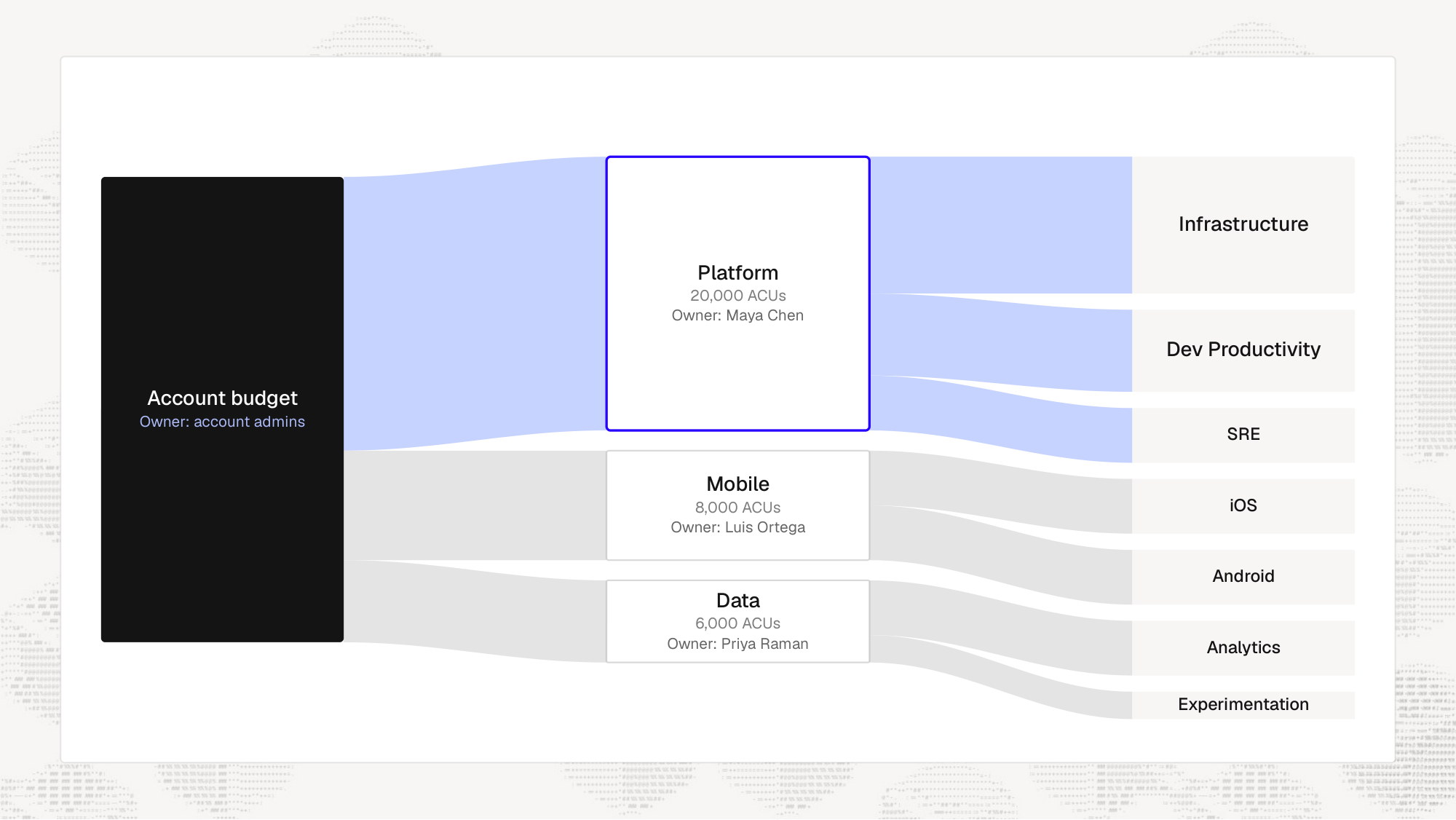
Hierarchical budgets change the direction of authority. According to the original source, enterprise administrators no longer directly manage every user's quota; instead, they allocate ACU budgets to department heads, who then distribute and approve usage limits for their subordinate sub-teams, projects, and individuals. Budget granularity thus aligns with real reporting relationships—whoever best understands the team's workload holds the allocation authority.
The management logic behind this is worth noting: AI spend isn't just a financial line item—it's a resource directly tied to productivity. Giving allocation authority to those closest to the business both shortens approval chains and keeps quota adjustments in tune with actual demand fluctuations.
ACU (AI Compute Unit) is the core unit of measurement that appears repeatedly in the original text but is never expanded upon. It typically refers to an abstract unit used by AI platforms to measure model calls or compute resource consumption, similar to vCPU-hours in cloud services or token quotas in API calls. ACU definitions may vary across vendors, but what they share is converting heterogeneous AI tasks (text generation, image processing, inference calls, etc.) into a unified, comparable value for budget allocation and accounting. When enterprises build hierarchical budgets around ACUs, they're effectively managing a kind of "compute currency": department heads receive not a monetary amount but a quantity of ACU quota, which they then redistribute. Understanding ACU conversion rules (how many ACUs different models and tasks consume) is a prerequisite for judging whether hierarchical budgets are fair—otherwise you get mismatches where one team has heavy tasks but low ACU consumption while another has light tasks yet burns through its quota quickly.
How Authority Cascades Down
The mechanics of hierarchical budgets can be understood in three layers.
Enterprise Administrators: Set Totals and Draw Lines
Top-level administrators are responsible for splitting the enterprise-level ACU budget across departments and defining the operating space available to department heads. This step addresses total control, preventing budgets from being rapidly consumed without oversight.
Total control and quota delegation are typically implemented in enterprise management software through a "budget pool" model: the top level sets a master pool, which is split into sub-pools by department, with sub-pools isolated by default to prevent one department from overspending and crowding out others' quotas. The "operating space for department heads" mentioned in the original corresponds in practice to two types of constraints: first, the sub-pool cap (the maximum a head can distribute), and second, the allowable depth of delegation (whether they can further redistribute to lower-level departments). This design draws on the "zero-based budgeting" and "rolling budget" concepts from financial management—quotas aren't locked down once and for all but adjusted with project cycles. Enterprise administrators must weigh the trade-off: slice too finely and department heads lose flexibility; slice too coarsely and total control becomes nominal. It's generally advisable to retain a certain proportion of enterprise-level reserve pool for cross-departmental task forces or emergency projects, preventing dead zones where "no one can approve anything" after delegation.
Department Heads: Distribute and Approve
Once department heads receive their budgets, they can allocate usage limits to sub-teams, specific projects, or individual users, and they bear approval responsibility. The original source specifically emphasizes the act of "approval"—meaning that when subordinates request quota, it must go through their own department's decision-making rather than bypassing the organizational hierarchy to reach IT directly.
Sub-Teams and Individuals: Use Within Limits
The teams and individuals at the bottom see a clear usage boundary. Quotas are visible and requestable, and consumption is transparent to superiors, reducing the awkwardness of "discovering overspend halfway through."
Quotas and hard caps are the key technical details for implementing such mechanisms. Quotas typically come in soft and hard varieties: soft quotas remind users and notify superiors when approaching the limit, while hard quotas directly block calls when the threshold is reached. In hierarchical budget scenarios, sub-teams and individuals mostly see soft quotas, making it easy to initiate requests before overspending; the department level may configure hard caps to prevent budgets from being unexpectedly drained. Another related concept is "quota inheritance and rollback": when a project closes or a team disbands, unused quota should be recoverable to the upper-level pool according to rules, rather than settling in an organizational unit that no longer exists. The risk of "budget settling at a certain level" mentioned in the original is precisely the result of lacking a recovery mechanism. At the tool level, three capabilities are typically needed—consumption detail, alert thresholds, and automatic recovery policies—to make quota management both strict and flexible.
Practical Value for Enterprises
The value of hierarchical budgets isn't just about saving money. Clear accountability is the more critical benefit: every AI consumption event maps to a specific organizational unit, giving finance a clear audit trail during reviews.
From an efficiency standpoint, delegating approval authority to the department level shortens response times for quota requests. Department heads can flexibly adjust based on project pace without going through centralized approval every time. For enterprises running multiple AI-intensive projects simultaneously, this flexibility directly affects delivery speed.
Another easily overlooked point is the synchronization of budgets with organizational change. Team restructuring, project closures, new group formation—operations that require IT to adjust permissions one by one under centralized management can be handled by department heads themselves in the hierarchical model, reducing management costs accordingly.
Boundaries to Consider During Implementation
Delegating authority through hierarchical budgets also places demands on department heads' management capabilities. Whether quota allocation is reasonable and approvals are timely directly determines whether the mechanism runs smoothly. Enterprises need to clarify operating standards at each level during rollout to avoid situations where budgets settle at a certain level and subordinate teams have no channel to request more.
Moreover, the more layers there are, the more budget visibility requires tool support. Administrators need to view overall consumption distribution at any time, department heads need to know their remaining distributable quota, and users need to know their remaining limits—all three views are essential. The management interface shown in the original source is designed around exactly this multi-layer visibility.
For organizations rolling out AI tools to their entire workforce, hierarchical budgets offer a governance approach isomorphic to the company structure: not tightening the grip on budgets, but putting the people who manage the money on the same reporting line as the people who spend it.
One-line Summary
Hierarchical budgets delegate AI quota allocation down the org chart, putting budget managers and budget users on the same reporting line.
Paragraph Summary
The article addresses the pain point of failing cost control after enterprise-wide AI tool adoption and proposes hierarchical budgets as a management model. Traditional centralized budgets allocate uniformly by headcount or department, struggling to adapt to cross-departmental projects and temporary teams. Hierarchical budgets delegate ACU budget allocation authority from enterprise administrators to department heads, who then distribute and approve limits for sub-teams, projects, and individuals, aligning budget granularity with real reporting relationships. The mechanism has three layers: the top sets totals and operating space, the department level handles distribution and approval, and the bottom uses within visible limits. Its value lies in clear accountability, faster approval response, and budgets that adjust in sync with organizational change. Implementation requires clear operating standards at each level and multi-layer visibility tools serving three views: administrators, department heads, and users.
Related articles

AI Tools Quietly Altering Settings: Postman Silently Installs Plugin, Codex Sharing Option Auto-Resets
AI Daily reports: Postman silently installs a Mac plugin and self-approves startup hooks, logged as auto-existing upgrade; Hacker News developers say Codex data-sharing opt-out flips back. Plus Simon Willison's raw float weight experiment with QEN 3.8-27B.

AI Learns to Rewrite AI: MIT's "Weightspace Programming" Redraws the Path to Recursive Self-Improvement
MIT team proposes weightspace programming: GPT-6 Astra reads and edits AI model weights directly. Math scores jump several-fold, hand-written networks beat trained models. Eight experiments analyzed, plus Anthropic's same-day warning and the real boundaries of recursive self-improvement.

Running Qwen 3.8 on a Laptop to Read Raw Weights: 46 Minutes Per Answer
Simon Willison reproduced weight space programming with Qwen 3.8 27B on a laptop: a 17GB model file, 46 minutes per answer, 43,506 reasoning tokens, Pong over an hour, Freeway failed. Suited for interpretability researchers.