Hierarchical Gaussian Processes Revolutionize Survey Weighting: A Local Equivalent Weight Approach

New research proposes an HGP regression framework for survey weighting that borrows information across sparse cells, improving nonlinear estimation stability.
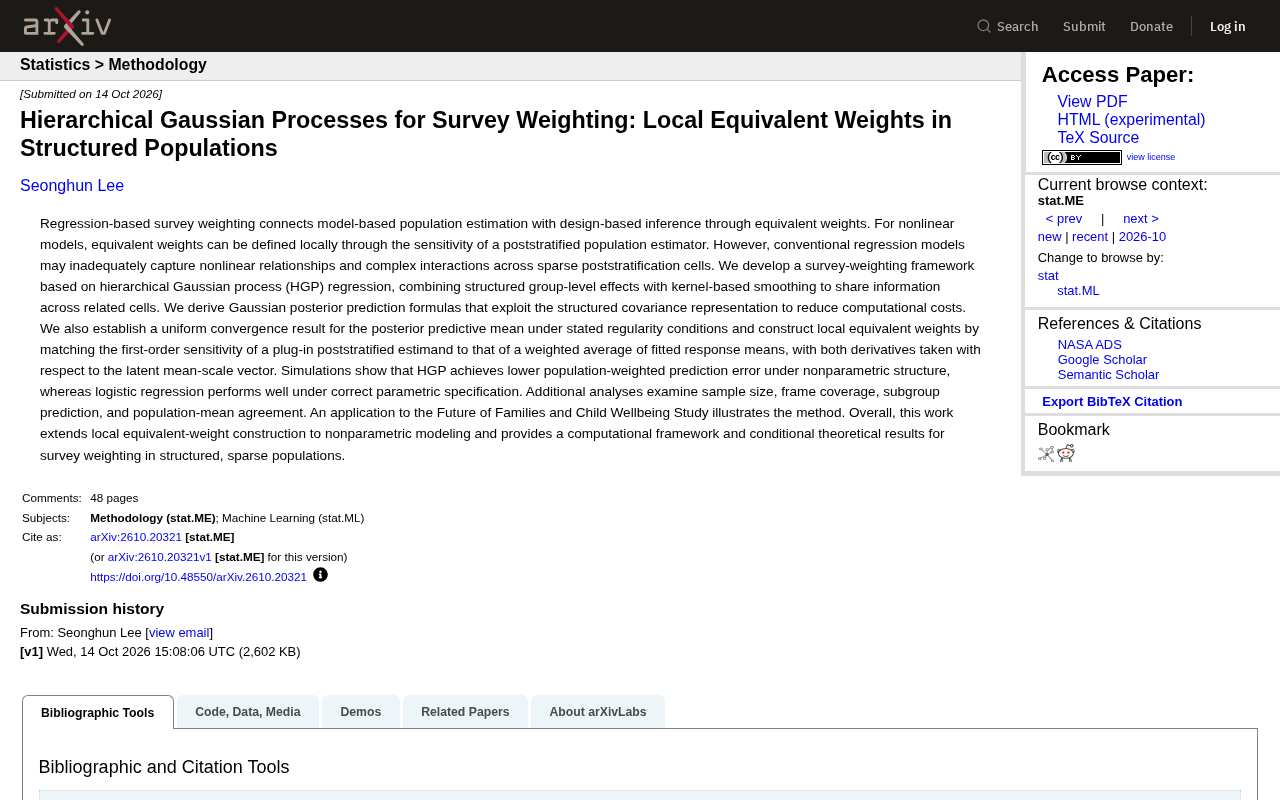
This paper presents a Hierarchical Gaussian Process (HGP) regression framework for survey weighting, addressing traditional regression models' difficulty in capturing nonlinear relationships in sparse post-stratification cells. HGP shares information across related cells via kernel smoothing and derives local equivalent weights linking model-assisted estimation with design-based inference. The study provides efficient Gaussian posterior predictive formulas and uniform convergence guarantees. Simulations show HGP outperforms logistic regression under nonparametric structures. The method is applied to the Future of Families and Child Wellbeing Study, extending local equivalent weight construction to nonparametric modeling.
Regression-based survey weighting methods connect model-based population estimation with design-based inference through equivalent weights. However, traditional regression models struggle to capture nonlinear relationships and complex interactions in sparse post-stratification cells. A new study proposes a survey weighting framework based on Hierarchical Gaussian Process (HGP) regression, leveraging kernel smoothing to share information across related cells and deriving local equivalent weights.
The Dilemma of Traditional Survey Weighting and the HGP Breakthrough
Survey weighting is a critical step in ensuring that a sample represents the target population. Traditional methods such as logistic regression perform well when the model is correctly specified, but real-world populations often exhibit complex nonlinear structures, and post-stratification cells may be very sparse, leading to unstable estimates.
This study introduces Hierarchical Gaussian Process regression, which combines structured group-level effects with kernel-based smoothing. This approach allows relevant information to "borrow strength" across neighboring or similar cells, thereby producing more robust estimates of the response mean for each cell.
Computational Efficiency and Theoretical Guarantees
To reduce computational costs, the authors derive a Gaussian posterior predictive formula that leverages structured covariance representations to accelerate computation. This is particularly important for large-scale survey data.
Furthermore, the study establishes uniform convergence results for the posterior predictive mean under certain regularity conditions, providing theoretical support for the method. Local equivalent weights are constructed by matching the first-order sensitivity of the plug-in post-stratification estimator with the first-order sensitivity of the weighted average fitted response mean, both differentiated with respect to the latent mean scale vector.
Post-stratification is one of the most commonly used calibration tools in survey weighting: researchers divide the target population into non-overlapping cells based on several auxiliary variables (e.g., age × gender × region), then adjust sample weights using known population cell counts so that the weighted sample distribution aligns with the population. Ideally, each cell should have sufficient sample size to stably estimate its response mean.
However, in practice, cross-classification often creates a large number of sparse cells—some cells contain only a handful or even zero respondents. In such cases, the classical estimator based on within-cell sample means has extremely high variance, and regression models also struggle to identify nonlinear structures due to the lack of local data. The traditional approach is to merge adjacent cells or impose parametric constraints, but this introduces bias. The core motivation of HGP is precisely this: to allow information to flow smoothly from data-rich cells to sparse cells while preserving the cell structure.
Gaussian Process (GP) is a Bayesian nonparametric model that treats the unknown function as a stochastic process, fully characterized by a mean function and a kernel function (covariance function). The kernel function encodes the prior belief that "similar inputs produce similar outputs," with commonly used examples including the squared exponential kernel and Matérn kernel. The advantage of GP is that it can automatically adapt to nonlinearities and interaction effects without presupposing a functional form.
Hierarchical Gaussian Process (HGP) builds on GP by introducing group-level structure: each post-stratification cell has its own group effect, while group effects are interrelated through a shared kernel structure. This is equivalent to treating "cells" as random effects with hierarchical dependencies, thereby achieving a balance between pooling and independent estimation. Computationally, the posterior prediction of HGP can be accelerated using block-diagonal or low-rank representations of the structured covariance matrix, avoiding direct inversion of the full covariance matrix, making it feasible for large-scale surveys.
Simulation Experiments: HGP Outperforms Under Nonlinear Structures
Simulation experiments compared the performance of HGP with logistic regression. Under nonparametric structures, HGP achieved lower population-weighted prediction error; when the parametric model was correctly specified, logistic regression performed well. This suggests that practitioners should choose methods based on prior knowledge of the population structure.
Effects of Sample Size and Frame Coverage
Additional analyses examined sample size, frame coverage, subgroup prediction, and overall mean consistency. Results indicate that HGP has advantages in sparse data scenarios, enabling more stable estimation of subgroup parameters.
The concept of equivalent weights serves as a bridge connecting model-assisted estimation and design-based inference. The basic idea is: if a model-assisted estimator can be written in the linear form of a weighted sample mean, then the corresponding weights are the equivalent weights; when the model is correct, the weighted estimator based on these weights is asymptotically equivalent to the model prediction results.
In traditional regression weighting, equivalent weights are derived from the first-order sensitivity of the model. This paper extends this to the nonparametric HGP framework: by matching the first-order derivatives of the plug-in post-stratification estimator and the weighted average fitted response mean with respect to the latent mean scale vector, local equivalent weights are obtained. These weights vary across cells and data locations, reflecting the degree of information borrowing induced by kernel smoothing. The existence of local equivalent weights allows the HGP estimator to still be incorporated into the classical survey inference framework, facilitating variance estimation and confidence interval construction.
Practical Application: The Future of Families and Child Wellbeing Study
The study applies the method to the "Future of Families and Child Wellbeing Study," demonstrating the operational workflow and effectiveness of HGP in real-world surveys. The application illustrates how to construct local equivalent weights and perform post-stratification estimation.
Implications for Survey Methodology
This work extends the construction of local equivalent weights to nonparametric modeling, providing a computational framework and conditional theoretical results for survey weighting in structured, sparse populations. For researchers and statisticians engaged in large-scale surveys, HGP offers a flexible and theoretically reliable tool.
Conclusion
Hierarchical Gaussian Processes open a new path for survey weighting, especially in scenarios where traditional regression fails. With the growth of computational resources and algorithmic optimization, such nonparametric methods are expected to become one of the standard tools in survey statistics.
One-line Summary
A new study proposes a Hierarchical Gaussian Process regression framework for survey weighting that borrows information across sparse post-stratification cells, improving nonlinear estimation stability.
Paragraph Summary
This article introduces a new survey weighting framework based on Hierarchical Gaussian Process (HGP) regression, aimed at addressing the difficulty traditional regression models face in capturing nonlinear relationships and complex interactions in sparse post-stratification cells. HGP shares information across related cells through kernel smoothing and derives local equivalent weights, linking model-assisted estimation with design-based inference. The study provides an efficient Gaussian posterior predictive formula and uniform convergence theoretical guarantees. Simulation experiments show that under nonparametric structures, HGP achieves lower population-weighted prediction error than logistic regression, while logistic regression retains advantages when the parametric specification is correct. The method is applied to the "Future of Families and Child Wellbeing Study," demonstrating practical operability. This work extends the construction of local equivalent weights to nonparametric modeling, providing a flexible and theoretically reliable tool for survey weighting in structured, sparse populations.
Related articles

Chain of Thought Isn't Just for AI: How Humans Can Use CoT to Improve Thinking Quality
Chain of Thought isn't just a prompt trick for large models. Starting from a Hacker News discussion, this article analyzes why CoT works for human thinking too, breaks down actionable ways to transfer it, and highlights the key differences between human CoT and machine CoT.
Cloudflare Teams Up with OpenAI: Closi…
Cloudflare Teams Up with OpenAI: Closing the Loop from Vulnerability Discovery to Defense with AI
Cloudflare uses OpenAI Daybreak to investigate security vulnerabilities and generate reviewable remediation plans, while developers use Codex to boost coding efficiency and quality.

Orca Multi-Agent Orchestration in Practice: A Guide to Parallel Collaboration with Claude and Codex
Orca is Stable AI's free open-source agent workbench supporting 34 agents like Claude Code and Codex in parallel. Learn its Git worktree isolation, multi-model orchestration, and mobile management.