Hierarchical RAG Architecture Research: How Independent Developers Can Break Into Academic Research
An indie developer's quest for RAG mentorship exposes the gap between engineering skill and academic recognition in the AI era.
An independent developer posted on Reddit seeking an IR professor to guide his Hierarchical RAG research, highlighting a common struggle in the AI era. Hierarchical RAG uses coarse-to-fine retrieval to improve accuracy on heterogeneous documents — a cutting-edge area in both academia and industry. His real obstacles aren't technical but structural: academic writing norms, lack of institutional affiliation, and turning engineering prototypes into scholarly output. The article argues that mentorship isn't the only path — publishing work openly, reaching out to niche researchers, engaging with open-source communities, and self-learning academic writing are all viable alternatives.
A Help-Wanted Post on Reddit
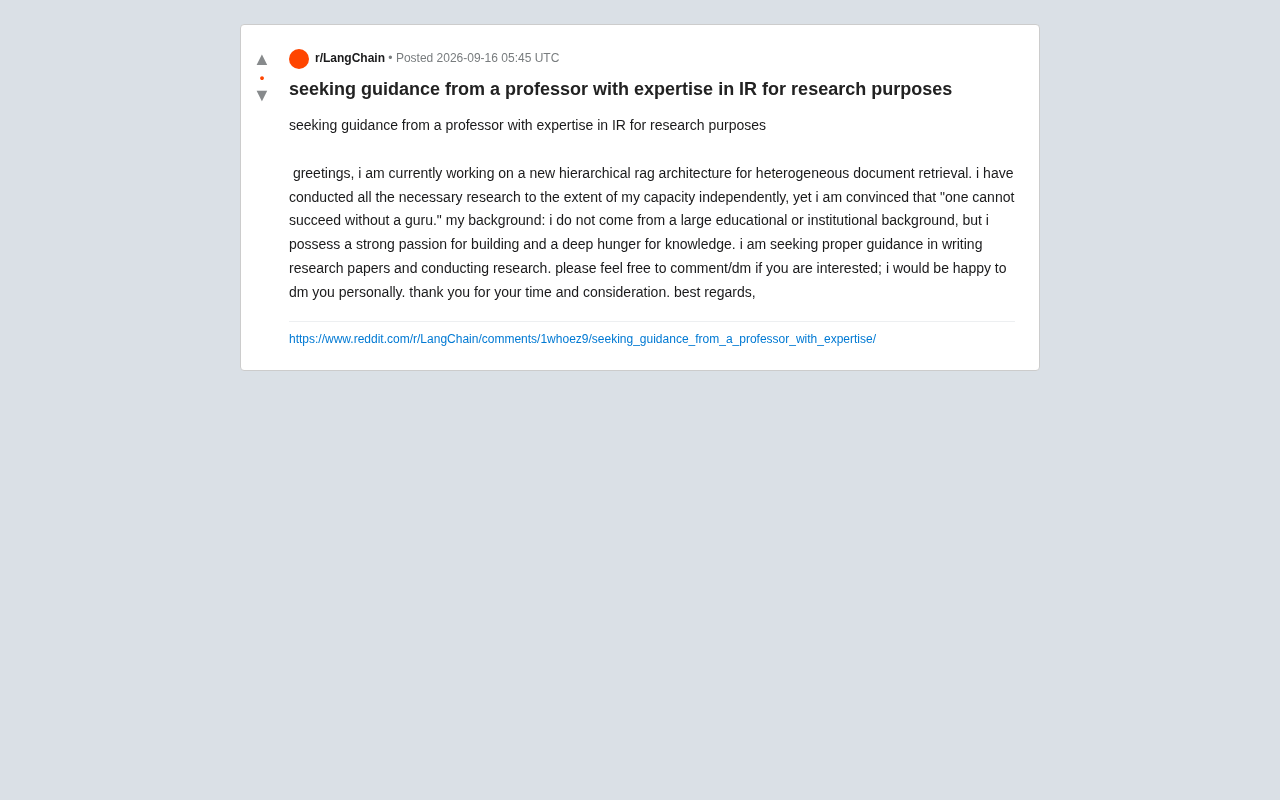
In a technical subreddit, an independent developer posted a notably relatable plea for help. The author is researching a novel Hierarchical Retrieval-Augmented Generation (Hierarchical RAG) architecture aimed at solving the challenge of heterogeneous document retrieval. He candidly admitted to having done all the preliminary research he could on his own, but firmly believed that "one person cannot succeed without a mentor" — and so publicly sought guidance from a professor with expertise in Information Retrieval (IR).
The post itself doesn't say much, yet it reflects a growing, collective struggle in today's AI wave: the gap between technical ability and academic barriers. The author explicitly noted that he lacks a prestigious educational or institutional background, but possesses a strong desire to build and a hunger for knowledge.
Technical Background: Hierarchical RAG and Heterogeneous Document Retrieval
To understand the challenge this developer faces, we need to clarify a few key concepts.
What Is Heterogeneous Document Retrieval
Heterogeneous documents refer to collections of documents that vary in format, structure, and source — potentially including PDFs, web pages, tables, mixed image-text content, code snippets, and more. Traditional RAG systems perform reasonably well on uniform document formats, but retrieval accuracy tends to drop significantly when dealing with heterogeneous data. The semantic granularity and structural hierarchy of different documents vary enormously, making it difficult for a single vector retrieval strategy to handle them all.
The core challenge in heterogeneous document retrieval lies in "semantic alignment." Documents of different modalities and formats produce distributional differences during vectorization — for example, a table containing financial data and a descriptive paragraph, even if semantically similar, may end up with embedding vectors that are far apart in vector space. Traditional single dense retrieval relies on a unified vector space to measure similarity, making it less robust to this kind of distribution shift. In recent years, hybrid retrieval strategies — combining sparse retrieval (such as BM25) with dense retrieval — have become a common compromise for handling heterogeneous documents. However, how to dynamically adjust weights across different document types remains an open research question.
The Idea Behind Hierarchical RAG
Hierarchical RAG architectures attempt to solve this problem through "layering": first locating relevant documents or sections at a coarse granularity, then drilling down layer by layer to fine-grained paragraphs or sentences. This coarse-to-fine retrieval approach theoretically improves precision while maintaining recall, and is better suited for handling heterogeneous corpora with complex structures. This is a cutting-edge direction in current RAG research, with both academia and industry actively exploring it.
The author's choice of this topic suggests he has genuinely landed on a technically valuable niche. The issue isn't the research topic itself — it's how to transform engineering practice into rigorous academic output.
Hierarchical RAG implementations typically draw on the "Coarse-to-Fine Ranking" paradigm from information retrieval. The first stage uses computationally lightweight retrievers (such as BM25 or lightweight bi-encoders) to quickly filter a candidate document set from a large corpus; the second stage then applies more precise cross-encoders or rerankers to re-rank the candidates. At the document hierarchy level, this process can be further refined into a "document-level → paragraph-level → sentence-level" step-down approach. Closely related is the concept of "indexing granularity" — whether to use whole documents, fixed-size chunks, or semantically complete paragraphs as the basic unit when building a vector index. The choice of granularity directly affects the tradeoff between recall and precision.
The Real Challenges Facing Independent Researchers
What's most worth discussing about this post isn't the RAG technology itself, but the universal phenomenon it reveals.
Being Able to Build ≠ Being Able to Write
Many independent developers have solid hands-on skills — they can build working prototype systems — yet get stuck at the "writing a paper" stage. Academic writing has its own distinct paradigms: how to conduct a literature review, how to design controlled experiments, how to quantify evaluation metrics, how to position one's own contributions relative to existing work. These skills can't be acquired through coding alone and typically require mentorship from experienced researchers.
The Challenge of Lacking Institutional Affiliation
The author repeatedly emphasizes that he doesn't come from "a big educational or institutional background." In academia, institutional affiliation affects not just resource access, but also the perceived credibility and publication prospects of a paper. For researchers outside the system, finding a willing mentor is, in some ways, the key to opening the academic door.
The Belief That "You Can't Succeed Without a Mentor" — Conviction or Self-Limitation?
The line the author cites — "one person cannot succeed without a mentor" — is both humble and potentially self-limiting. In reality, there are independent researchers who have gradually entered the academic spotlight through arXiv preprints, open-source community collaboration, and public peer review channels. A mentor can accelerate this process, but is not the only path.
Practical Advice for Independent Researchers in the Same Situation
While the original post was a simple request for help, it naturally extends into several actionable paths for independent AI researchers.
Make Your Work Public First
Rather than waiting for a mentor to appear, start by organizing your completed research into a technical report or blog post and publishing it on GitHub, arXiv, or a personal website. Clear, reproducible results are themselves the best "resume" and significantly increase the chances of attracting potential collaborators.
Proactively Seek Out Researchers in Your Niche
The IR field has active conferences and communities, such as SIGIR and ECIR. Following the public work of researchers in these areas and politely reaching out via email about specific technical questions is often more effective than posting broadly on social platforms. Specific, well-prepared questions are far more likely to receive substantive responses.
The most important academic conference in information retrieval is SIGIR (ACM Special Interest Group on Information Retrieval), held annually and considered the top venue in the field. ECIR (European Conference on Information Retrieval) is more focused on European academia and slightly smaller in scale but equally influential. Additionally, TREC (Text REtrieval Conference) is a long-running evaluation benchmark project where participants submit retrieval system results on a shared dataset and compare them against others — for independent researchers, it offers both an opportunity to validate system performance and a low-barrier way to build academic credibility. NLP top conferences closely related to RAG in recent years — such as ACL, EMNLP, and NAACL — have also been publishing large numbers of papers on retrieval-augmented generation and are important sources for keeping up with the latest developments.
Leverage Open-Source Community Collaboration
Hierarchical RAG is a hot topic right now, with many enthusiasts in communities like Hugging Face and LangChain. Contributing to open-source projects, writing code, and sharing your architectural ideas in discussion threads are all low-barrier ways to get involved.
Fill the Gap in Academic Writing Skills
Systematically studying the structure of high-quality papers — especially top-conference papers on RAG — and modeling their experimental design and argumentation logic is a worthwhile exercise. Academic writing is a learnable skill, and there are abundant public resources online.
Conclusion
This Reddit user's plea for help is a small but telling footnote in the era of AI democratization. The accessibility of tools and knowledge has never been lower, and more and more people without traditional academic backgrounds are now able to engage with cutting-edge technology. Yet the gap between "being able to build" and "being recognized by academia" is still a threshold that must be crossed.
For this developer, finding a mentor is certainly a plus — but more critically, the key is to make the hierarchical RAG work publicly available and formalized, using visible results to create opportunities. Passion and curiosity are rare qualities, and in the highly open field of AI, these two things alone may well carve out a path for independent researchers.
Related articles
The Technical Challenges of Developing a Linux GPU Driver for the M4 Mac Mini in One Month
Developer Cody Ho built a Linux GPU driver for the M4 Mac Mini in one month. We break down the core challenges of reverse engineering Apple Silicon's closed GPU architecture.
SEO Page Builder Enhanced: Breaking Free from Generic AI-Generated SEO Content
An open-source enhanced SEO content tool that adds editorial review, firsthand experience, fact-checking, and writing-style guardrails to combat generic AI content.
Blind Entrepreneur Uses Claude to Build Accessible Product, Sells It for $1,700
A blind entrepreneur used Claude to build an accessible tool for a blind client and sold it for $1,700 — revealing why domain knowledge, not just AI, makes products truly usable.