High Agency: The Philosophy of Action Behind a Hot Wings Challenge

A hot wings challenge metaphor unpacks "high agency": acting boldly despite lacking natural advantages.
Starting from a humorous tweet, this article explores "high agency" — a concept widely discussed in Silicon Valley and startup culture. Using the Hot Ones wing challenge as a metaphor, it illustrates that high agency isn't about natural talent; it's about choosing to act under difficult conditions and pushing through with willpower. Crucially, stopping at 9 wings rather than 10 also matters — high agency means persisting while staying clear-eyed about your limits. The concept is widely seen as a key differentiator between ordinary executors and true drivers of outcomes.
A Tweet That Got People Thinking
A short post circulating on Twitter put it this way: having high agency means signing up for the Hot Ones wing challenge with absolutely no spice tolerance — and then grinding your way through 9 out of 10 wings anyway.
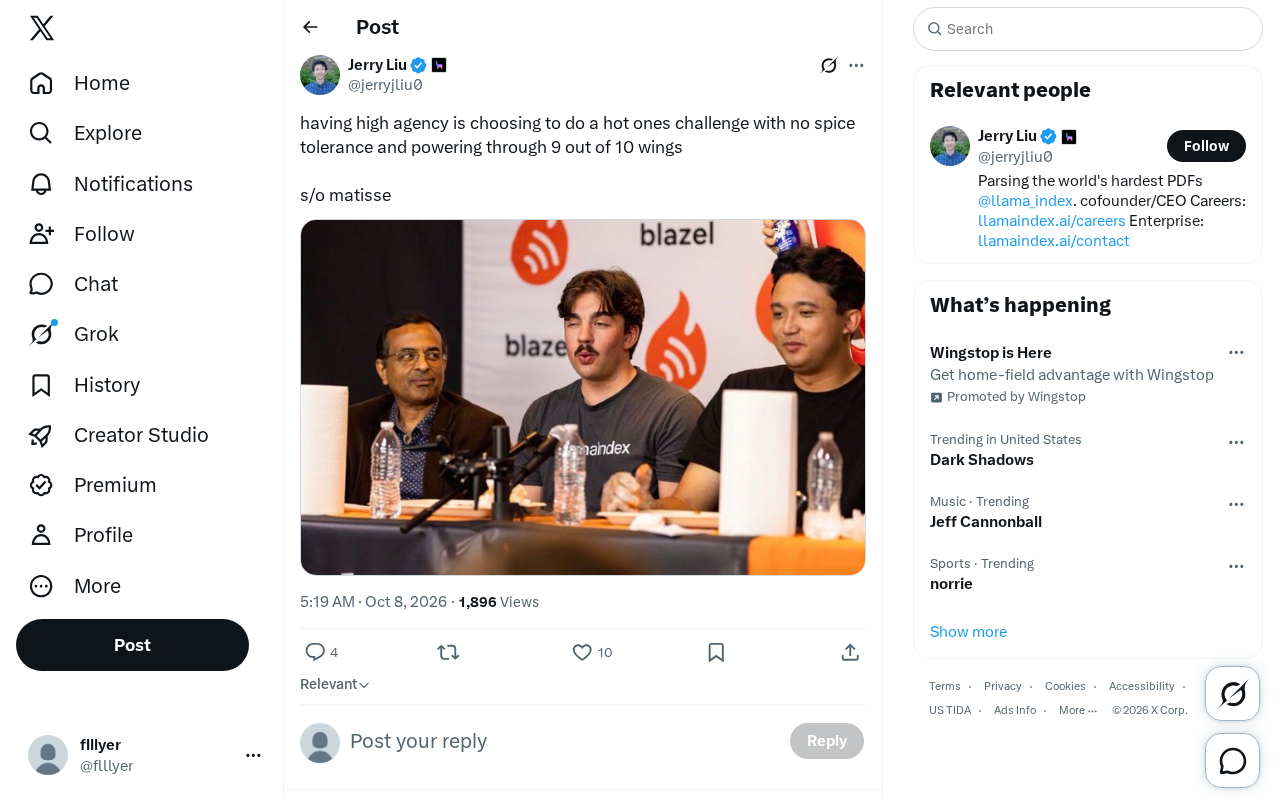
It reads like a joke, but it captures something that Silicon Valley and startup circles have been debating for years — high agency. It's not about what you're naturally good at. It's about whether you choose to act, even when the situation is uncertain, uncomfortable, or outright painful.
"Hot Ones" is an interview show on the YouTube channel First We Feast, which has amassed tens of millions of subscribers since launching in 2015. The format is simple: guests sit down with host Sean Evans and eat 10 chicken wings coated in sauces of escalating heat, all while being interviewed. The final wing typically uses a hot sauce exceeding 2 million Scoville units — well beyond what most people can handle. Many guests, including celebrities and athletes known for their mental toughness, break down, cry, or tap out entirely. That's exactly what makes the show such a vivid metaphor for high agency: the question isn't whether you can handle spice. It's whether you choose to sit down at the table knowing full well it's going to hurt.
What Is High Agency?
"High agency" is a term that has gained traction in tech and startup culture, roughly translating to a strong sense of personal initiative or drive. It describes a quality: when faced with constraints, obstacles, or situations that seem unsolvable, a high-agency person doesn't wait passively or give up easily — they actively look for a path forward, take on risk, and make things happen.
The tweet's analogy works well. Taking on a challenge like Hot Ones is genuinely hostile to anyone without a natural spice tolerance. What demonstrates agency isn't being able to handle heat in the first place — it's choosing to show up anyway and pushing through to the 9th wing.
In other words, high agency is fundamentally about two actions: choosing to engage and powering through — not about starting from a position of advantage.
The rise of "high agency" as a concept in Silicon Valley owes much to venture capitalists and startup thinkers who helped spread it. Marc Andreessen, co-founder of Andreessen Horowitz, is among the most prominent voices — his "PMARCA Guide" series repeatedly emphasized the psychological trait of actively driving situations forward as essential for founders. Eric Weinstein, mathematician and podcast host, later distilled "high agency" into a standalone label to describe people who refuse to accept existing frameworks, preferring to redefine the rules themselves and act accordingly. The counterpart is "low agency" — defaulting to waiting for permission, relying on external direction, and attributing obstacles to the environment rather than looking for ways around them. This contrast has since become an informal screening dimension in tech hiring and team evaluation.
Why This Concept Matters
In entrepreneurship and tech careers, high agency is often seen as the key distinction between people who execute and people who actually drive things forward. Talent and resources matter, but when goals are ambiguous, resources are limited, and outcomes are uncertain, the willingness to act proactively often determines just how far things can go.
What this tweet does well is take a slightly abstract concept and ground it in something immediate and relatable:
- Don't wait until conditions are perfect — start even when they aren't;
- Don't avoid discomfort — accept the pain that comes with the process and keep going;
- But don't mistake it for recklessness — finishing 9 wings instead of 10 carries a quiet acknowledgment of real limits, and knowing when to stop.
This posture — actively taking on discomfort and pushing yourself through to completion — is what high agency looks like in everyday life and work.
The Real-World Mirror Behind a Throwaway Joke
Content like this resonates on social media precisely because it strips a piece of polished workplace jargon down to something anyone can recognize. It's a reminder that agency isn't some distant, heroic ideal — it's the accumulation of countless small decisions that follow the same logic: knowing it won't be easy and choosing to do it anyway.
Whether it's a hot wings challenge or a project that pushes well past your comfort zone, the underlying principle is the same: choose to participate first, then use sheer will to carry yourself through most of the way.
A note: this piece builds on a brief social media post as its jumping-off point, and is intended as an extended exploration of the "high agency" concept rather than a rigorous academic definition.
Related articles

Workbuddy for Absolute Beginners: How a Desktop AI Agent Fits Into Real Workflows
A beginner's guide to the Workbuddy desktop AI agent: installation, claiming credits, file management, and building automated workflows—compared with CodeX for fit and cost, helping professionals shift from AI question-askers to AI managers.

OpenAI's New Agent Stack: Computer Use, Decisions API, and Ultra-Fast Workflows
OpenAI Dev Day unveiled a new agent stack: Computer Use outperforms humans, Decisions API delivers ultra-low-latency classification via Luna, Agents API opens the same Computer Use capabilities, and GPT-6.1 Sol costs only one-seventh of Astra. Core updates, benchmark data, and developer insights.

Liang Wenfeng Open-Sources DeepInfo Inference Framework, Takes On U.S. Ban
DeepSeek open-sources its DeepInfo inference framework after its models, featuring GPU/CPU cross-pipelining, small-model prediction with large-model verification, and full Huawei Ascend and NVIDIA chip support—facing the U.S. federal ban head-on. This article analyzes its significance for AI deployment and open-source strategy.