Hindsight: An Open-Source Long-Term Memory Solution for AI Agents

Hindsight gives AI Agents persistent cross-session memory via three actions: Retain, Recall, and Reflect.
Hindsight is an open-source long-term memory solution from Vectorize that addresses the cross-session amnesia of large language models. Rather than replacing the underlying model, it operates through three core actions: Retain extracts facts, relationships, and timestamps from conversations or tasks and stores them in a memory bank; Recall retrieves relevant evidence using parallel semantic, keyword, knowledge graph, and temporal search; and Reflect synthesizes stored memories for deeper reasoning. Unlike static knowledge bases, Hindsight tracks dynamic, evolving context. It supports API, SDK, and MCP integration with managed or self-hosted deployment options.
The AI "Amnesia" Problem
You tell your coding assistant which language a project uses and which files are off-limits — then open a new window the next day and have to explain everything all over again. This constant context re-explaining is a frustration familiar to anyone who works with AI Agents over extended periods. Large language models have no cross-session memory; every conversation starts from a blank slate.
Hindsight, open-sourced by Vectorize, is designed to fix exactly this kind of "amnesia." It doesn't write code for you, and it doesn't replace the LLM you're already using. Instead, it focuses on one thing: storing valuable information and retrieving it accurately when needed — giving your Agent a persistent memory bank that works across sessions.
Three Core Actions: Retain, Recall, Reflect
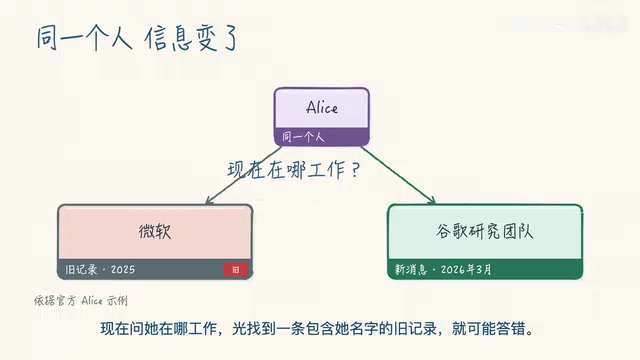
Hindsight's workflow breaks down into three actions. The official documentation uses an example involving Alice to illustrate a key challenge: an earlier record says Alice works at Microsoft, but a later message says he joined Google's research team in March. If the system only surfaces the older record with his name, it could give the wrong answer — time and relationships must both be taken into account.
Retain: Remember
The first action is Retain. The input can be a conversation or a task experience. The system uses a large language model to extract facts, relationships, and timestamps, then organizes them into retrievable memories. "Who did what, and when" is no longer buried in a vague wall of text.
Notably, the original content is preserved, extracted facts are written into the memory store, and related facts are synthesized into "observations." For instance, if someone's job information is updated multiple times, the system continuously revises its understanding based on accumulated evidence rather than holding onto the very first record it ever saw.
Recall: Retrieve
The second action is Recall. It runs multiple retrieval strategies in parallel: semantic search finds content with similar meaning, keyword search targets exact terms, a knowledge graph handles relationships between people and events, and temporal search handles date ranges. Results are then merged, ranked, and returned within a budget of relevant memories.
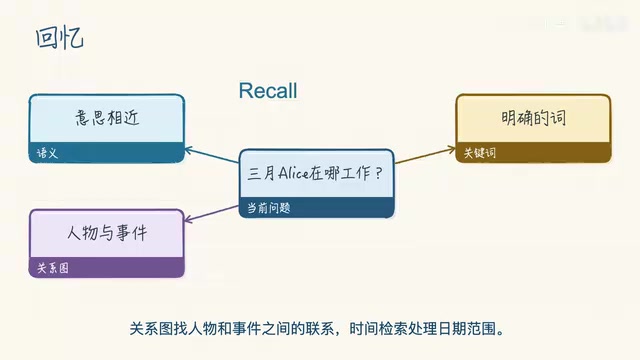
In other words, recall isn't about stuffing the entire chat history back into the prompt — it's about surfacing relevant evidence. Both raw facts and synthesized observations are candidates; the retrieval layer does the filtering. Whether the final answer is correct ultimately depends on the completeness of the information and how the model uses that evidence.
Semantic search relies on vector embedding technology: text is converted into high-dimensional numerical vectors, and content with similar meaning sits closer together in vector space, making it retrievable even when the wording differs. Keyword search is traditional exact matching, well-suited for proper nouns, code variable names, and other content that semantic embeddings struggle to capture. A knowledge graph represents people, organizations, and events as nodes and their relationships as edges — it excels at answering questions like "What is the relationship between A and B?" Running these mechanisms in parallel and merging the ranked results is a common "hybrid retrieval" strategy in the Retrieval-Augmented Generation (RAG) field. The goal is to cover each approach's blind spots: pure semantic search tends to miss exact terms, while pure keyword search struggles with semantic variations.
Reflect: Reason
The third action is Reflect. Asking "Where does Alice work now?" is primarily a factual lookup. But asking "Is he a good fit for a machine learning project?" requires synthesizing work history, team context, and past recommendations. Reflect performs further reasoning over stored memories before generating a response.
A word of caution: the reasoning itself can be wrong. Don't treat it as a guarantee.
How Is This Different from a Knowledge Base?
Many people ask: how is this different from a knowledge base?
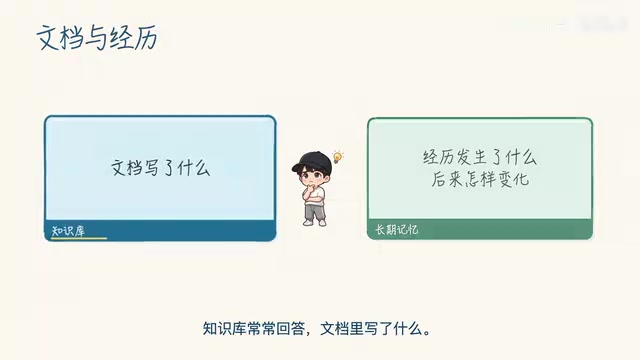
A knowledge base typically answers "what the document says" — it's static content retrieval. Long-term memory is more concerned with "what we did before, what changed since then, and what understanding has accumulated over time." The two can complement each other; they're not mutually exclusive.
One key design decision: Hindsight does not rewrite the LLM's parameters by saving chat logs. All memories live in a Bank (memory store) that you can organize by user, project, or Agent. Multiple devices connecting to the same Bank share the same memories; connecting to different Banks keeps things separated. Before sharing memory across contexts, think carefully about who should have access to what — you don't want one customer's data mixed into another's.
Integration Options and Practical Considerations
Hindsight offers an API, an SDK, and MCP support. Via MCP, the save, retrieve, and reflect operations can be exposed as Agent tools.
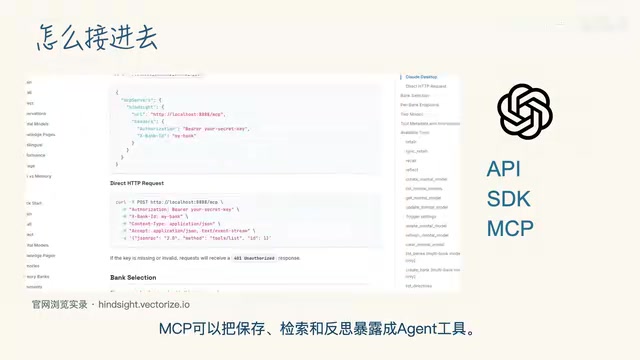
One common misconception: a successful tool connection only means the tool "can be called." Whether memories are automatically saved every turn, or automatically recalled at the start of each session, depends on how the integration is configured. Official integration guides are also available for coding-focused Agents.
On the deployment side, you can choose a managed service or self-host. But self-hosting still requires setting up storage and model services — it doesn't mean zero operational cost. If the model calls an external API, relevant content may still be sent to that service, which is especially worth noting when handling sensitive data.
The recommended approach: start with a small set of non-sensitive data to validate — are memories stored correctly, can they be retrieved, and how is outdated information handled?
MCP (Model Context Protocol) is an open protocol introduced by Anthropic in late 2024, designed to standardize how large language models connect to external tools and data sources. Think of it like a universal USB standard: tool developers implement the MCP interface once and can be called by any AI client that supports the protocol, without needing to build separate adapters for each platform. Exposing Hindsight's memory operations as tools via MCP means that Agent frameworks supporting MCP (such as Claude Desktop and certain open-source Agents) can directly call save and retrieve actions without modifying the underlying model logic. This is also why the article emphasizes that "a successful tool connection" and "memory actually being triggered" are two separate things — protocol-level connectivity is just a prerequisite; the actual timing of those calls is governed by the Agent's own business logic.
When Is This Worth Using?
If you're only asking a question once in a while, you probably don't need this system. But if your Agent is tracking a long-running project and you're constantly re-explaining context, Hindsight is worth trying.
To summarize the division of labor in one sentence: Retain accumulates, Recall retrieves evidence, and Reflect synthesizes. Together, these three actions let an AI "remember" your prior agreements — even after you've opened a new window.
Related articles

Felix Rieseberg Personal Homepage
Felix Rieseberg's personal homepage sparks attention on Hacker News. This article covers the Slack engineer's technical background, the rise and fall of nativefier, and the value of a developer homepage as a tech calling card.

@ai-sdk/vue 3.0.306 Patch Release Syncs with [email protected] Update
@ai-sdk/vue 3.0.306 released, synced with [email protected]. A routine patch release for the Vercel AI SDK ecosystem with no public API changes; the Vue adapter layer stays version-aligned with the core package.

Gemini 4 Argon API Launches: The Era of Million-Token Output Begins
Google launches Gemini 4 Argon with sparse MoE architecture, up to 1M output tokens, and a 68.90% Vals Index score, available across API, AI Studio, and the Gemini app.