Hindsight: Inside the AI Agent Memory System That Learns From Experience

Hindsight upgrades AI Agent memory from static vector storage to a self-learning system, gaining 14K+ GitHub Stars in one week.
Hindsight, open-sourced by the vectorize-io team, repositions AI Agent memory from passive vector storage to a dynamic learning system. Unlike traditional RAG approaches that only store and retrieve, Hindsight draws on the concept of "hindsight" to enable memory that reflects and synthesizes after interactions, distilling concrete experiences into reusable high-level knowledge. Written in Python and compatible with frameworks like LangChain and LlamaIndex, the project has surpassed 45K GitHub Stars with 14K added in a single week — reflecting urgent developer demand for long-term, personalized Agent memory. That said, learnable memory introduces new engineering challenges around memory updates, forgetting strategies, and error entrenchment, so thorough validation before production deployment is strongly recommended.
Why AI Agents Need Memory That Actually Learns
LLM-powered AI Agents are moving from experiments into production, but one long-standing bottleneck continues to frustrate developers — memory. Traditional Retrieval-Augmented Generation (RAG) approaches typically dump conversation history or document chunks into a vector database and retrieve them by similarity at query time. This works well enough for short-lived tasks, but when an Agent needs to accumulate experience across sessions and tasks, it can neither retain important lessons nor distill higher-level insights from past interactions.
Hindsight, an open-source project by the vectorize-io team, is aimed squarely at this problem. Its core positioning is "Agent Memory That Learns" — a memory layer for Agents that continuously learns and evolves through use. The project has earned over 45,000 GitHub Stars, with more than 14,000 new Stars in a single week. That growth rate alone signals just how eagerly the developer community has been waiting for a "learnable memory" solution.
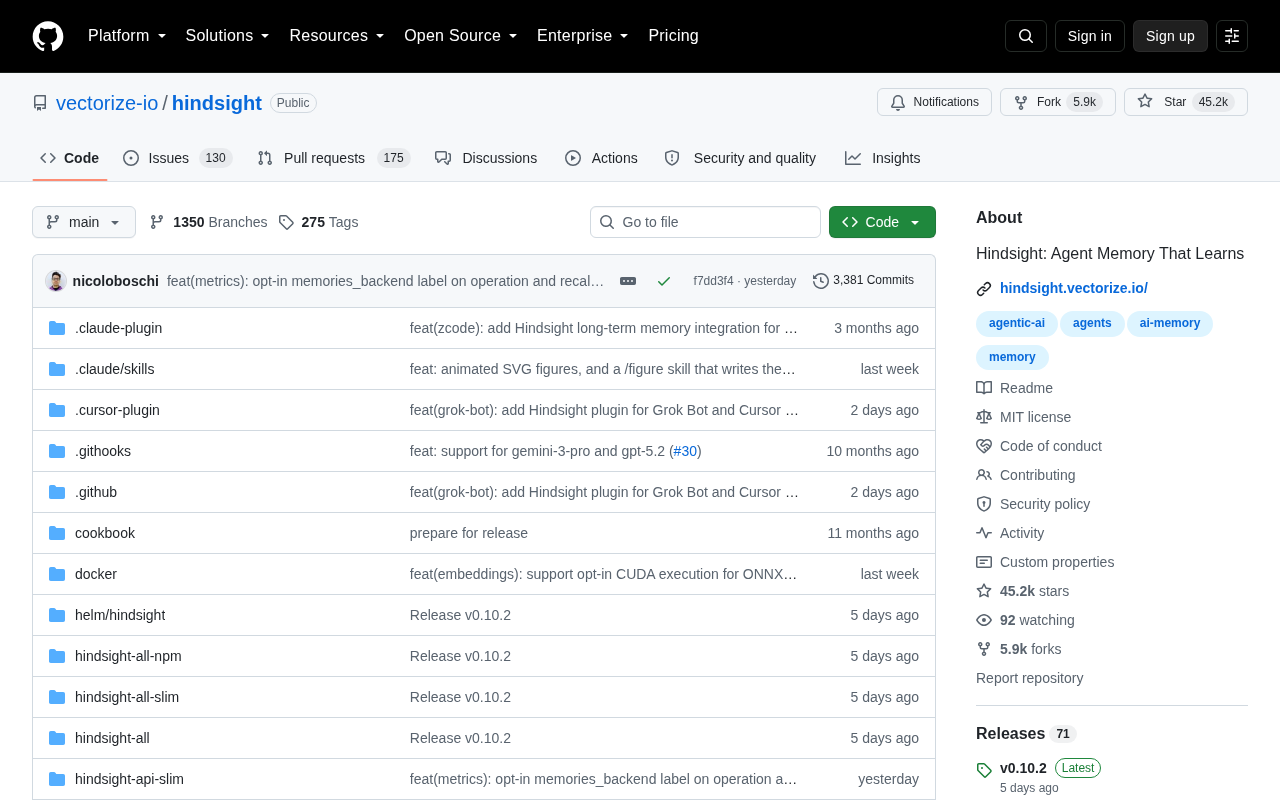
The Core Problem Hindsight Aims to Solve
The project name itself telegraphs the designers' intent. "Hindsight" refers to the clearer, deeper understanding we gain after experiencing something. Applied to an Agent memory system, this conveys a clear philosophy: memory shouldn't be passive storage of raw information — it should work like human retrospection, settling into reusable knowledge only after reflection and synthesis.
This stands in sharp contrast to mainstream memory approaches. Conventional vector memory focuses on "store and retrieve," while Hindsight emphasizes learning — the memory system itself has the ability to extract patterns from interactions and update its understanding over time. For Agents that run long-term and continuously interact with users or environments, this means the system can gradually become more attuned to specific contexts, rather than starting from scratch every time.
From a cognitive science perspective, "hindsight" maps to the process of episodic memory converting into semantic memory: specific experiences, through repeated retrieval and re-encoding, gradually abstract into generalizable rules or concepts. Transplanting this mechanism into an Agent system means the memory layer needs to run an additional "reflection" or "summarization" pass on top of raw conversation segments — using a model to automatically distill high-level behavioral patterns or user preferences. This aligns closely with research directions like MemGPT and Reflexion, both of which found that having Agents explicitly generate "experience summaries" after tasks and write them back to memory significantly improves cross-task transfer. Hindsight's value lies in engineering this research idea into a directly integrable open-source library.
Technical Positioning and Ecosystem Context
The project is written in Python, which fits the mainstream AI Agent development stack and makes integration straightforward with frameworks like LangChain and LlamaIndex, as well as various vector databases. The developer, vectorize-io, already has a strong background in vector retrieval and data pipelines — extending that engineering expertise into the Agent memory layer is a natural evolution.
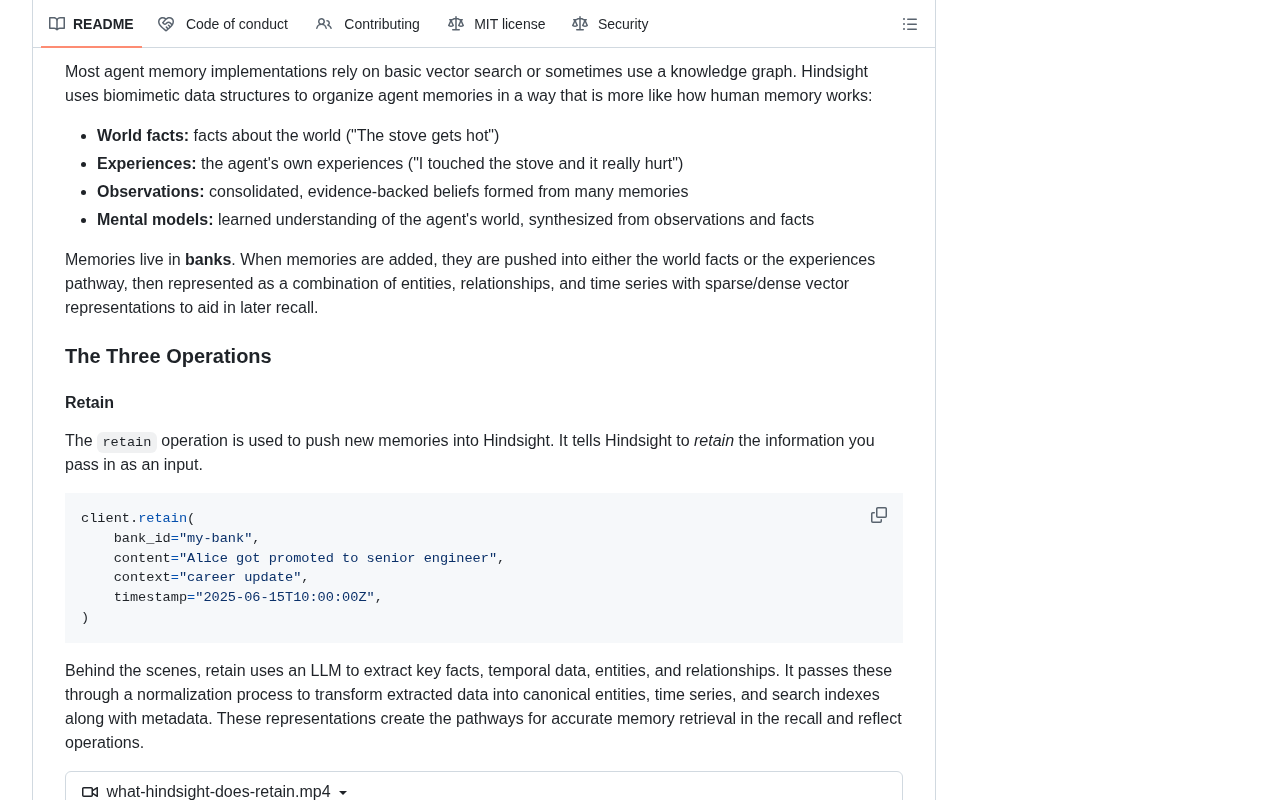
From a broader industry perspective, Agent memory is becoming a key battleground in AI infrastructure heading into 2026. Whether for general-purpose Agent frameworks or vertical-domain intelligent assistants, the strength of memory capabilities directly determines whether a product can deliver coherent, personalized long-term experiences. Open-source projects like Hindsight, focused on "learnable memory," fill a relatively weak link in the Agent technology stack.
RAG is currently the most prevalent external memory solution for Agents: documents or conversation history are split into text chunks, converted into vectors via an embedding model, and stored in a vector database (such as Pinecone, Weaviate, or Chroma). At query time, the current input vector serves as an anchor for nearest-neighbor retrieval, and the recalled chunks are injected into the prompt. The limitation of this approach is that it only "stores" and "retrieves" — it makes no quality judgments or knowledge distillation on the stored content. Noise and valuable information get mixed together, retrieval precision degrades over long-running sessions, and there's no mechanism to proactively update stale knowledge. Hindsight targets precisely this structural deficiency of RAG in long-term Agent memory scenarios. Its approach is to add an LLM-driven "memory manager" on top of the vector store — one that decides which information is worth keeping, how to summarize it, and when to overwrite it.
What This Means for Developers
For teams building production-grade Agents, Hindsight offers a path worth evaluating. Compared to implementing memory management logic from scratch, adopting a purpose-built, community-validated memory layer can significantly reduce engineering overhead. The rapid surge in Stars also reflects enthusiasm from early adopters — while Star count doesn't equate directly to production readiness, it is a meaningful signal of community interest.
A word of caution: "memory that learns" introduces new complexity alongside its capability gains. How memory gets updated, how outdated knowledge is forgotten or corrected, and how to prevent bad experiences from becoming entrenched — these are all issues that require careful handling in real deployments. Developers are advised to read the project documentation thoroughly and run small-scale validation against their own use cases before full integration.
Designing memory update mechanisms is one of the most challenging engineering problems in learnable memory systems. The core challenges include: forgetting strategies (how to identify and retire stale or low-value memories to prevent unbounded storage growth), conflict resolution (which side wins when new experience contradicts existing memory), and error reinforcement (if an Agent draws an incorrect conclusion during an interaction and writes it to memory, subsequent tasks may keep failing as a result). These issues map to the "forgetting curve" and "memory reconsolidation" theories in human memory research, but engineering implementations require trade-offs between accuracy, latency, and cost. When evaluating Hindsight, developers are advised to pay particular attention to how it handles these scenarios — especially whether memory quality remains stable under high-frequency write conditions.
Conclusion
Hindsight represents an interesting exploration in the AI Agent memory space: upgrading memory from a static "storage warehouse" to a dynamic "learning system." As Agent applications proliferate rapidly, this approach fits the industry's growing demand for long-term, personalized intelligent agents. Its fast-growing community momentum is worth watching closely. For developers focused on Agent infrastructure, this is an open-source project worth adding to your technology radar.
Related articles

How Big Can Stars Really Get? The Physical Limits of the Largest Stars
Red supergiants are the largest stars by volume, with radii up to 2,000 times the Sun, engulfing the inner solar system. But there is no precise upper limit on stellar size—models predict up to 15,000 solar radii. The most massive blue stars are far smaller than red supergiants—biggest and heaviest are two different things.

Apple HomeView Smart Display Full Feature Breakdown: Wall-Mount or Desktop, $299
Apple launches HomeView, a $299 smart display with wall-mount and desktop options, 12MP camera for facial recognition, smart home control, music playback, and recipe step-by-step cooking. Full breakdown of watch faces, apps, privacy, and cooking integration.

Where Did the Promised New Studio Go? Craft Computing Answers After Five Years
Craft Computing's host responds to viewer questions: the new studio promised five years ago was shelved as construction costs soared from $30,000 to $75,000, and was replaced by a 168-square-foot garage conversion.