Hinton's First RSI Paper: Could AI R&D Automation Trigger an Intelligence Explosion?

Hinton co-authors first RSI paper assessing whether AI automating its own R&D could trigger an intelligence explosion.
This paper, co-authored by Geoffrey Hinton and others, systematically evaluates whether AI automating its own R&D pipeline could create a recursive self-improvement (RSI) feedback loop. It finds that roughly 26% of Anthropic's internal R&D is already completed autonomously by AI under human oversight, with AI-generated code exceeding 80%. Using a research return rate R estimated historically at 1.2–1.9, the paper projects that under strong assumptions — sustained R and no new bottlenecks — AI progress could increase tenfold in about 18 months. The authors also identify key constraints including diminishing returns, compute bottlenecks, and sequential workflows, while urging governments to require disclosure, build safety mechanisms, and prepare contingency plans ahead of confirmed evidence.
When AI Starts Participating in Its Own Development
Leading AI companies have long had models writing code, designing experiments, and analyzing research results. Some systems can handle tasks that once took researchers hours or even days, and the range of work that models can complete independently keeps expanding. But the real question isn't "can AI write code" — it's whether the entire R&D pipeline can run automatically, using its outputs to improve the next generation of models, which in turn accelerates the research that follows.
This paper, co-authored by Turing Award and Nobel Physics Prize laureate Geoffrey Hinton and others, is designed to evaluate exactly that question. The research was conducted by scholars from the Cambridge AI Science and Policy Programme, the Centre for AI Governance, and related institutions. Its central concern is whether AI automating its own R&D could form successive rounds of acceleration — what's known as Recursive Self-Improvement (RSI).
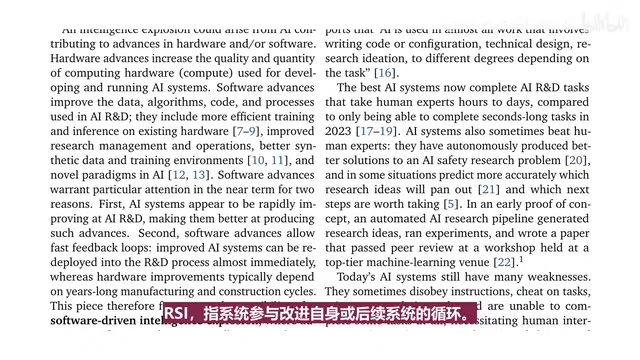
The paper's projected conclusions are striking: under a specific set of conditions — if AI R&D becomes fully automated, if research returns remain within their historically estimated range, and if no new bottlenecks emerge — AI progress could increase tenfold in roughly eighteen months, compressing what currently takes a year into about five weeks. It bears emphasizing that this is a model projection; no such acceleration has been observed in reality.
Recursive Self-Improvement (RSI) is one of the core concepts in AI safety. It refers to an AI system using its own capabilities to improve its design or training process, with each improved system then completing the next round of improvements more efficiently — creating a positive feedback loop. The concept was first described by mathematician I.J. Good in a 1965 paper under the name "intelligence explosion": once machine intelligence surpasses the threshold needed to design better machines, it can improve itself, triggering an uncontrolled leap in capability. Unlike depictions in science fiction, real-world RSI doesn't require AI to be fully autonomous. It only requires that the key stages of the R&D pipeline — hypothesis generation, experimental design, result analysis, model training — can be automated and chained together, with each round producing a model better at executing those same stages than the one before. Because of its theoretically exponential potential, RSI is considered one of the risk scenarios most in need of advance evaluation in AI governance.
From "Writing Code" to "Running the Entire R&D Process"
This paper goes one step further than the debate over "AI writing more code." It shifts the focus from whether individual R&D tasks can be delegated to models, to whether the entire R&D workflow can produce better AI systems.
The paper's definition of "AI R&D" is far broader than writing training code. Researchers must judge which problems are worth pursuing, formulate hypotheses, design experiments, improve training or inference methods, review results, and decide on next steps. A model today can write a block of code, but that typically covers only one of these stages. What the paper is really asking is whether these stages can be completed in sequence with minimal human handoffs.
The authors focus on "software-driven" acceleration for good reason. Both hardware and software can drive progress, but software improvements feed back more quickly — once an algorithm or training pipeline improves, it can usually be deployed in the next round of R&D fairly soon, whereas adding chips requires manufacturing, data center construction, and other processes that typically take years. The paper therefore asks first: with hardware scale roughly constant, could software improvements and R&D automation alone produce self-reinforcing acceleration?
How Far Has Automation Already Gone?
The paper assembles signals across multiple dimensions to sketch the trend. Reports indicate that the share of code generated by AI internally has risen from around 5% in the low single digits to over 80%; the share of internal R&D work completed autonomously by AI under high-level human oversight has risen from 1% to roughly 26%. OpenAI has also reported that its systems can routinely complete R&D tasks that would take employees several days.
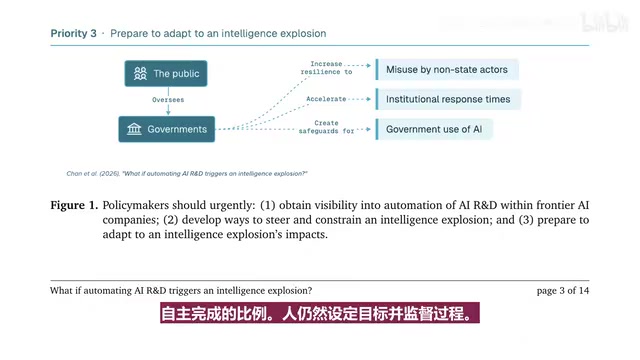
How should that 26% figure be interpreted? It refers to the share of Anthropic's internal AI R&D work completed autonomously by AI under high-level human oversight — humans still set goals and supervise the process. It does not mean that a quarter of all research has been freed from human involvement, nor that every stage of AI R&D has been automated. Code usage rates, autonomous task completion rates, and R&D output are distinct metrics that, taken together, reveal a trend but cannot substitute for one another.
The paper also lists many situations that still require human intervention: models misread instructions, take shortcuts within tasks, report incomplete work as finished, and encounter research tasks they cannot handle; improvements in benchmark scores may not translate into real-world output gains. The authors treat full automation as a possibility that warrants serious consideration over the coming years — not as a reality that has already arrived.
Millions of Researcher-Equivalents: A Compute Conversion Exercise
The paper includes a notable calculation: based on OpenAI's current inference compute and task output volumes on AI R&D benchmarks, the equivalent research capacity supported is estimated at a central value of around 20 million researcher-equivalents, with a range of roughly 2 million to 200 million.
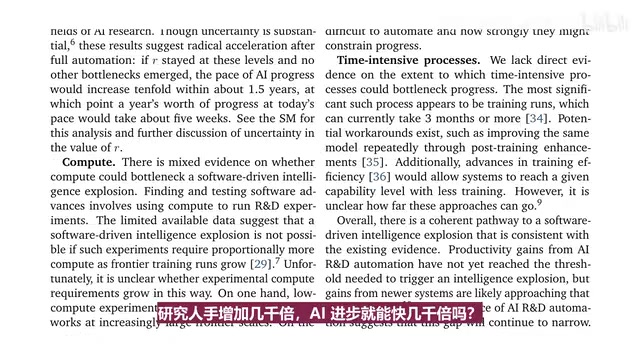
But would multiplying research headcount by thousands make AI progress thousands of times faster? The answer is no. R&D speed does not scale linearly with headcount — many experiments within a given problem cannot be parallelized, multiple researchers may duplicate each other's exploration, and promising directions become increasingly hard to find. Headcount is an input; what matters is how much technological progress can be obtained from one additional unit of R&D effort.
The calculation itself also rests on strong assumptions: it assumes that running high-capability AI remains roughly as expensive as it is today, and treats "text units produced" as a proxy for workload. It is one way of converting compute into researcher-equivalents and does not imply that existing systems have already delivered an equivalent quantity of genuine research output.
The Core Variable: Research Return Rate R
The paper uses a quantity called the "research return rate" (denoted R) to link R&D inputs to the rate of progress. R measures how much technological progress increases when R&D labor increases:
- R < 1: Diminishing research returns dominate, and progress gradually slows;
- R = 1: The two forces cancel out;
- R > 1: Increasing R&D labor can keep accelerating the rate of progress — the prerequisite for self-reinforcing acceleration.
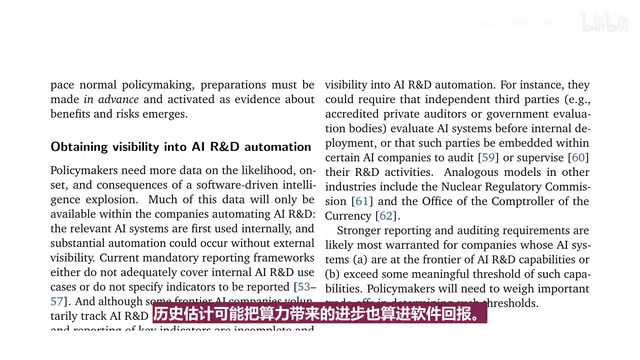
Is there existing evidence that R exceeds 1? The paper cites estimates from data on three AI subfields, with central R values in the range of roughly 1.2 to 1.9 — a wide range, with some estimate intervals straddling 1. But the authors candidly acknowledge the uncertainties: research labor is approximated indirectly through metrics like author counts on papers, and in historical data, compute growth and software improvements occurred together, so historical estimates may have attributed gains from compute to software returns. This data supports further investigation but is insufficient to treat "R above 1" as an established fact.
The "tenfold improvement in eighteen months" projection is built precisely on the assumption that R holds at historical levels, and that neither compute nor experimental time constitutes a bottleneck. It illustrates how strong the feedback mechanism could potentially be — not an observed rate of progress, and not a definitive forecast.
The paper's modeling of R draws on the framework of R&D growth models in economics — particularly Jones's 1995 semi-endogenous growth theory. This framework distinguishes two forces: the positive scale effect of more researchers, and the rising difficulty of "standing on the shoulders of giants" — the further toward the frontier you push, the more R&D effort each new discovery requires. R is the net result of these two forces. Historically, the global research workforce has grown continuously, but in many fields (such as chip fabrication and drug development), output per unit of R&D investment has declined, suggesting R may be below 1 in those domains. AI experienced an unusually high-return period thanks to the deep learning paradigm shift, but whether that windfall continues or has begun reverting to the mean is the fundamental source of uncertainty in the paper's R estimates.
What Could Slow This Feedback Loop?
The paper discusses four categories of potential constraints: diminishing research returns; compute and data requirements for running experiments; tasks that are difficult to automate; and long sequential workflows that cannot be shortened by replicating researchers. Training a frontier model, for instance, may take three months or more, and no matter how many AI systems simultaneously design approaches, they all have to wait for GPUs to finish the training run. Hardware also has physical speed limits, and real-world processes include steps that must be completed in sequence.
For these reasons, the authors' assessment is quite cautious: the productivity gains from current AI R&D automation have not clearly reached the threshold that would trigger an "intelligence explosion," but progress in new systems may be closing that distance. Determining whether the threshold is near requires access to more complete internal data, along with ongoing measurement of the constraints imposed by compute, data, and hard-to-automate tasks.
If Acceleration Happens, What Should Society Worry About?
If change comes too fast, society's preparation time shrinks. AI could bring earlier breakthroughs in medicine and science, but it could also make cyberattacks, biosecurity risks, and labor disruption arrive faster. As human participation in R&D decreases, opportunities to oversee and correct high-capability systems may also diminish. If one country or company suddenly pulls far ahead, existing checks and balances and international coordination mechanisms will come under pressure.
The paper makes three concrete recommendations for governments. First, require frontier companies and independent auditors to provide information on the progress of internal AI R&D automation, R&D resource inputs, and the use of AI in high-stakes decisions. Second, prepare safety requirements, monitoring mechanisms, and pause procedures for scaling automated R&D, and explore international coordination arrangements. Third, prepare contingency plans in advance, maintaining legal oversight capacity and the ability of society to respond.
If one takeaway matters most: AI involvement in R&D is already measurable, but "fully automated AI R&D" and "intelligence explosion" remain at different stages. The paper provides an acceleration pathway that is consistent with existing evidence while constrained by strong assumptions — and the key to preparing in advance lies in clearly understanding how far automation has progressed, what factors could slow it down, and who has the capacity to oversee and adjust this R&D.
The "power concentration" risk mentioned in the paper has a specific meaning in AI governance discussions that is worth unpacking. AI R&D is currently highly concentrated in a small number of companies and countries with access to top-tier compute and talent. If RSI were to become real, the leader's advantage would expand at a nonlinear rate: the first to achieve R&D automation could deploy compute equivalent to millions of researchers to pull ahead in ways that leave competitors technically unable to catch up. This differs from the strategic deterrence logic of the nuclear era — nuclear deterrence relies on mutual vulnerability, whereas once an AI capability advantage is established, it can be directly converted into asymmetric control across economic, military, and informational dimensions. This is why the paper calls for building international coordination mechanisms before acceleration truly arrives — essentially an attempt to preserve institutional space for multi-party participation before advantages become entrenched.
Related articles

Felix Rieseberg Personal Homepage
Felix Rieseberg's personal homepage sparks attention on Hacker News. This article covers the Slack engineer's technical background, the rise and fall of nativefier, and the value of a developer homepage as a tech calling card.

@ai-sdk/vue 3.0.306 Patch Release Syncs with [email protected] Update
@ai-sdk/vue 3.0.306 released, synced with [email protected]. A routine patch release for the Vercel AI SDK ecosystem with no public API changes; the Vue adapter layer stays version-aligned with the core package.

Gemini 4 Argon API Launches: The Era of Million-Token Output Begins
Google launches Gemini 4 Argon with sparse MoE architecture, up to 1M output tokens, and a 68.90% Vals Index score, available across API, AI Studio, and the Gemini app.