HomeView Lacks Native Video Apps: Even Apple TV Isn't Supported

HomeView supports no native video apps—even Apple TV requires iPhone casting.
Apple's HomeView home entertainment hub has a major gap in video app support: its official specs show Apple TV, Apple Books audiobooks, Apple Music Classical, and Apple News Plus are all absent from native support. Watching Apple TV on HomeView requires AirPlay from an iPhone, demanding the phone stay nearby and active throughout—far worse than native apps. This exposes HomeView's immaturity, fragmented UX, and clear disadvantage against Roku and Google TV. Despite possible future updates, there's a significant gap between its "perfect way" promise and reality, so video-focused buyers should think twice.
Apple's recently promoted HomeView feature was intended to create the "perfect way" to integrate audio and video entertainment. But when we take a closer look at its official specs page, we find a rather awkward fact: HomeView currently has no native support for any video app—not even Apple's own Apple TV.
This means that if you plan to open Apple TV directly on HomeView to watch content, sorry—you'll have to AirPlay from your iPhone.
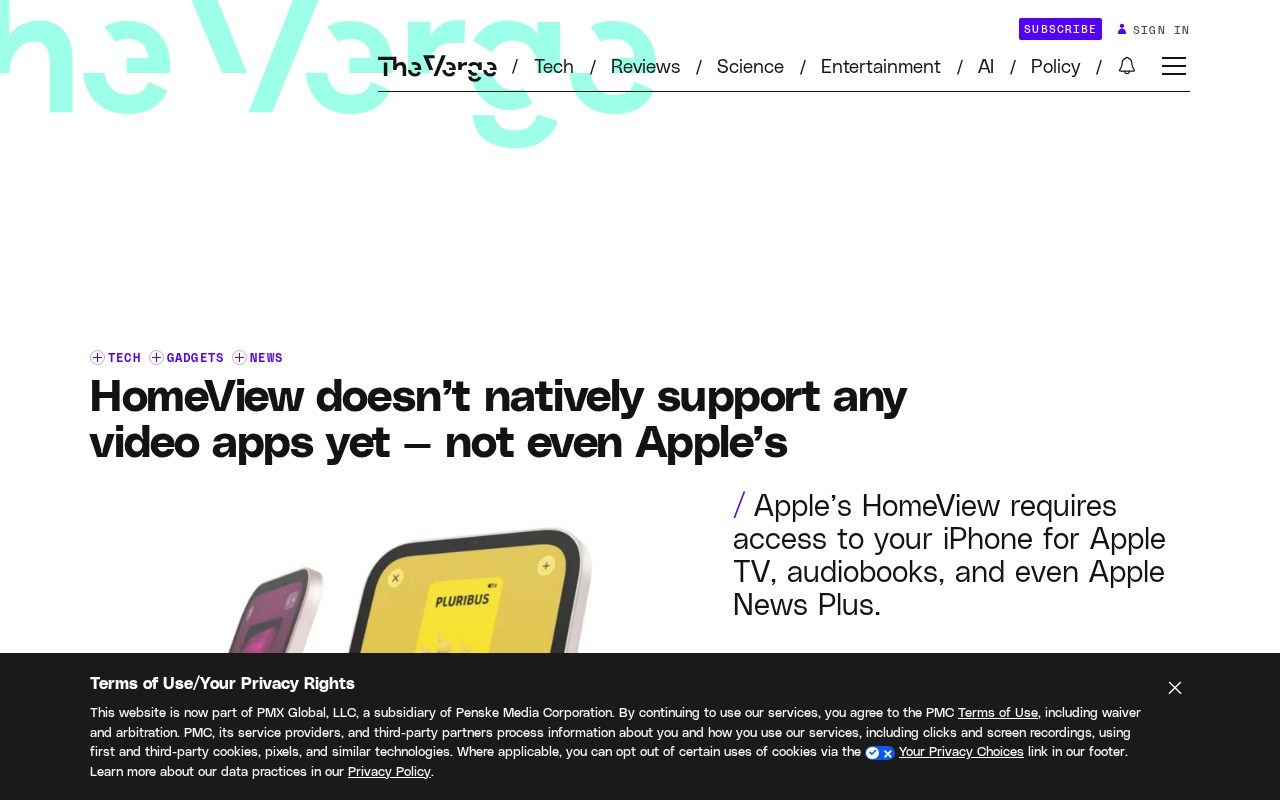
The Blank List of Native Support
According to the HomeView specs page, the following core Apple services are not natively supported:
- Apple TV: The core video streaming app—must be played on the big screen via iPhone AirPlay
- Apple Books audiobooks: Cannot be accessed directly from HomeView
- Apple Music Classical: The classical music-dedicated app is likewise absent
- Apple News Plus: The subscription news service is also not on the list
This list sends a clear signal: HomeView is currently more of a half-finished framework than the "perfect way" Apple claims it to be.
Apple Music Classical is a standalone classical music streaming app Apple launched in March 2023, built on Primephonic, the classical music service Apple acquired in 2021. Its core selling point is a specialized metadata system for classical music—allowing structured searches by composer, conductor, orchestra, recording era, and more, which is difficult to match precisely in regular Apple Music. Apple News Plus, meanwhile, is Apple's subscription news and magazine service launched in 2019, giving users access to content from hundreds of publications for a monthly fee. Apple Books audiobooks is the audiobook section integrated into Apple's Books app, supporting CarPlay and voice control on select smart speakers. While these three services are not video streaming, they are important content subscription entry points within the Apple ecosystem. Their lack of native HomeView support indicates that the platform's current integration scope is quite limited—possibly focused only on specific audio services or system-level features—and has yet to unify the content layer of the entire Apple suite.
Does AirPlay Screen Mirroring Count as "Support"?
From a technical standpoint, AirPlay does allow users to cast Apple TV content from their iPhone to a HomeView device. But this is fundamentally different from "native support":
Native support means the app runs directly on the device without relying on an external phone. The AirPlay approach requires users to own an iPhone, and the phone must remain nearby and continuously active throughout playback. For a living room scenario, this phone-dependent design is clearly not elegant—especially when you want to operate things directly with a remote control.
More critically, Apple emphasizes the "perfect way to enjoy your audio and video entertainment apps" when promoting HomeView. But the reality is that the video entertainment portion is currently almost entirely blank.
AirPlay is Apple's proprietary wireless streaming protocol, first introduced in 2004 as AirTunes and renamed AirPlay in 2010 when it expanded to video. It works like this: the sending device (such as an iPhone, iPad, or Mac) encodes audio and video data and pushes it over the local Wi-Fi network to the receiving device (such as Apple TV, HomePod, or HomeView), which handles decoding and playback. The key point is that the content is always provided by the sender—the receiver is merely a rendering endpoint. This means the receiver cannot independently obtain media sources, manage playlists, or run application logic. Compared to Chromecast's Google Cast protocol, AirPlay often places more computational and network burden on the phone during casting, and some apps restrict background casting. Therefore, while the AirPlay approach can "show the picture," there is a significant gap from native app operation in terms of interaction logic, power consumption, and multi-user sharing.
What This Means for HomeView
HomeView was positioned to become the hub of home entertainment, integrating various content services within the Apple ecosystem. However, the absence of core video apps exposes several issues:
First, insufficient product maturity. A platform that can't even natively run its own flagship video app will struggle to convince third-party developers to actively adapt.
Second, a fragmented user experience. Apple users are already accustomed to a unified viewing experience in the Apple TV app, which HomeView currently cannot provide.
Third, competitive pressure. In the streaming device market, competitors like Roku, Google TV, and Amazon Fire TV have long offered native support for mainstream video apps. HomeView is clearly lagging behind in this regard.
Of course, Apple may gradually fill in these features in future updates. But for now, there is a clear gap between HomeView's video app support and the vision it promotes.
For users considering purchasing a HomeView device, if your primary use case is watching video content, you may want to think twice at this stage—unless you're willing to AirPlay from your iPhone every time.
In the streaming device market, native app support is one of the core metrics for measuring platform competitiveness. Roku has over 10,000 channel apps, and both Google TV and Amazon Fire TV deeply integrate mainstream video services like Netflix, Disney+, and YouTube, allowing users to browse, search, and play directly on the big screen without needing a phone. These platforms have also established mature app store revenue-sharing and recommendation mechanisms that attract developers to keep joining. By contrast, if HomeView cannot natively run video apps, not only is the user experience limited, but developers' motivation to adapt is also greatly reduced—because they cannot directly reach users, cannot obtain viewing data, and cannot implement in-app interactions. If Apple wants to make HomeView the hub of home entertainment, filling in native video app support will be a crucial step it cannot bypass; otherwise, its competitiveness in the living room will continue to lag behind competitors that have been entrenched for years.
One-line Summary
HomeView currently supports no native video apps—even Apple TV requires iPhone casting.
Paragraph Summary
Apple's heavily promoted HomeView home entertainment hub has a serious gap in video app support: the official specs page shows that Apple TV, Apple Books audiobooks, Apple Music Classical, and Apple News Plus are all absent from native support. To watch Apple TV content on HomeView, users can only AirPlay from an iPhone, which requires the phone to be nearby and continuously active throughout—a far less seamless experience than native apps. The article notes that this absence exposes HomeView's insufficient product maturity, a fragmented user experience, and a clear disadvantage against competitors like Roku and Google TV. Although Apple may fill in features later, for now there is a significant gap between its promoted "perfect way" and actual capabilities, and video-focused users should think twice before buying.
Related articles

Chain of Thought Isn't Just for AI: How Humans Can Use CoT to Improve Thinking Quality
Chain of Thought isn't just a prompt trick for large models. Starting from a Hacker News discussion, this article analyzes why CoT works for human thinking too, breaks down actionable ways to transfer it, and highlights the key differences between human CoT and machine CoT.
Cloudflare Teams Up with OpenAI: Closi…
Cloudflare Teams Up with OpenAI: Closing the Loop from Vulnerability Discovery to Defense with AI
Cloudflare uses OpenAI Daybreak to investigate security vulnerabilities and generate reviewable remediation plans, while developers use Codex to boost coding efficiency and quality.

Orca Multi-Agent Orchestration in Practice: A Guide to Parallel Collaboration with Claude and Codex
Orca is Stable AI's free open-source agent workbench supporting 34 agents like Claude Code and Codex in parallel. Learn its Git worktree isolation, multi-model orchestration, and mobile management.