Homingo Hack Days: India's Free Online AI Hackathon — Format, Schedule, and a Two-Week Development Strategy

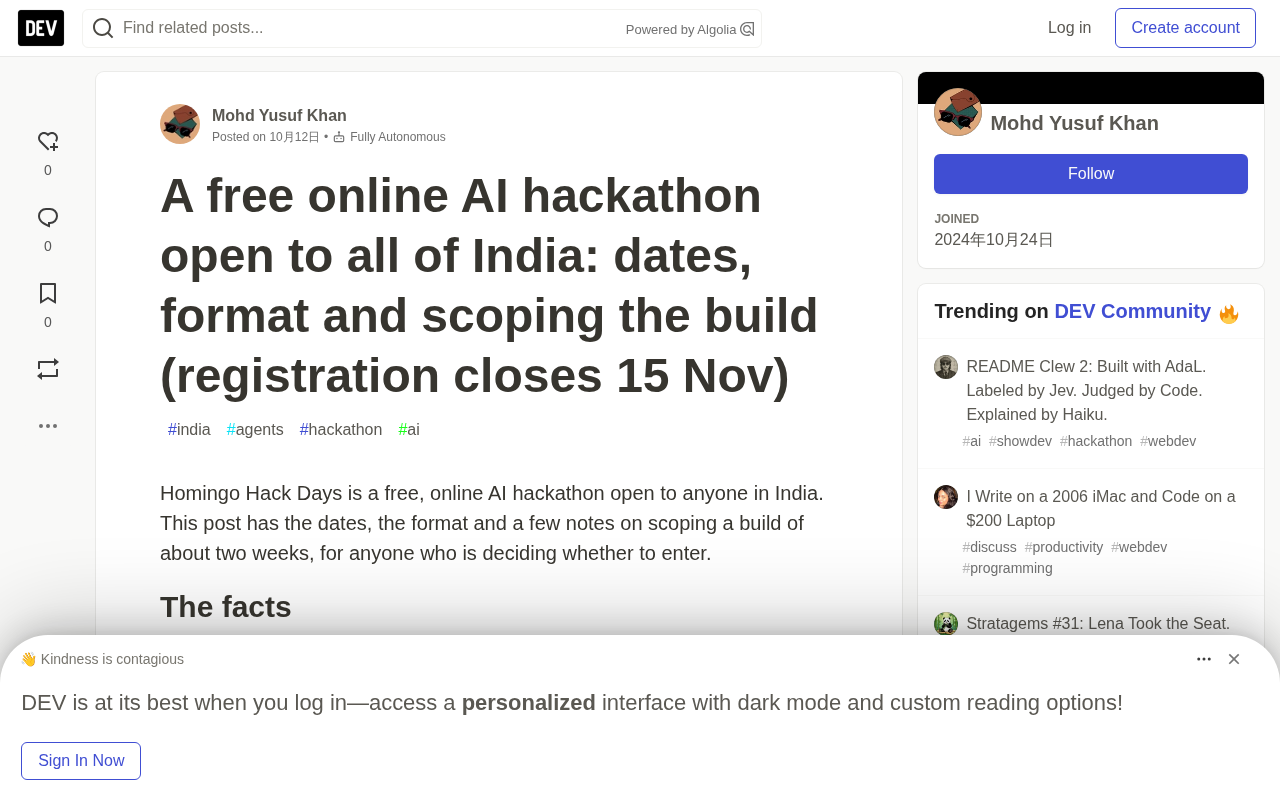
Homingo Hack Days is a free online AI hackathon for Indian developers — registration closes November 15.
Homingo Hack Days is a free online AI hackathon open to developers across India, with registration closing November 15 and a build phase from November 21 to December 6. The three tracks — Agents, Automation, and LLM Apps — support solo or team entries of up to four people, and AI tools are explicitly allowed. Submissions require a public GitHub repo and a demo video; the winner receives ₹5,000 and all finishers get participation certificates. The article advises participants to focus on a single user and task, get the core flow working first, define measurable success criteria early, and use AI tools for boilerplate while reserving personal effort for data, prompts, and edge-case handling.
Homingo's Hack Days is a fully free, online AI hackathon open to developers across India. Whether you're a solo builder or part of a team, this competition gives you two weeks to ship an AI product. This article breaks down the key dates, competition structure, and practical advice for delivering something usable within the time limit.
Key Details
The barrier to entry has been kept as low as possible: the entire event is online, open to all of India, and free to enter. Participants can compete solo or form teams of two to four people.
There are three challenge tracks, covering the hottest real-world applications in AI engineering today:
- Agents: Build AI agents capable of autonomously executing tasks
- Automation: AI-driven process automation
- LLM Apps: Applications built on top of large language models
Mark these dates carefully: registration closes on November 15 at 11:59 PM IST, and the build phase runs from November 21 through December 6. Participants must submit two things — a public GitHub repository and a short demo video.
On the prizes side, the winner takes home ₹5,000, the top three finishers receive recommendation certificates, and everyone who completes a submission gets a participation certificate. The hackathon is hosted by Homingo, and registration is available at hackathon.homingo.co.in.
Notably, the competition explicitly allows the use of AI tools, which means the judging focus isn't on whether you handwrote every line of code — it's on whether your project actually runs and solves a real problem.
AI Agents are one of the defining paradigms in AI engineering over the past two years. They refer to AI systems that can perceive their environment, plan autonomously, and invoke external tools (such as search, code execution, or APIs) to complete multi-step tasks — as opposed to single-turn, question-and-answer interactions with a model. The Automation track typically involves using AI to replace human judgment at nodes in a workflow, such as email classification, document processing, or data extraction pipelines. LLM Apps broadly refers to products built with a large language model as the core reasoning engine — common forms include RAG (Retrieval-Augmented Generation) knowledge base Q&A, structured data extraction, and code generation assistants. The three tracks form a gradient of engineering complexity: LLM apps have the lowest entry barrier, agents demand the most in terms of tool orchestration and state management, and automation projects place the greatest emphasis on modeling real business processes.
Scoping Your Project for a Two-Week Build
Two weeks sounds generous, but it's actually quite tight when you're building an AI product from scratch that can be demonstrated. The official guidance isn't a scoring rubric — it's a general methodology for hackathons of this length, and it's worth taking seriously.
Lock in one user and one task. "An agent that helps students" is a theme, not a project. "An agent that reads a course PDF and generates a study plan with page-number citations" is a concrete project you can demo quickly. The tighter your scope, the easier it is to show something that genuinely works in a short time.
Get the simplest core flow working first. For an agent, that means one complete run from input to useful output, with tool calls logged. For an automation project, it means a real input flowing through every step without human intervention. For an LLM app, it means answering a question using your own data and showing the source. Get this unglamorous-but-functional path working before touching anything else.
Define what "success" looks like early. Before writing a lot of code, write down ten realistic inputs, then run them every day. Put a short table in your README showing what passes and what fails — that's more convincing than a long feature list.
Keep your repository readable. Since the submission is a public repo, a README with installation steps, example inputs, and expected outputs is essential. The ideal is that anyone can clone it and run it immediately.
Record your demo from a clean slate. Your demo video should show the full flow running from a fresh environment and include at least one case handling a "bad input." Keep it short.
Making the Most of AI Tools
Since the rules allow AI tools, the real question becomes how to use them well. The right division of labor is: let AI assistants handle the boilerplate, and invest your own time in the parts that make or break the project — data, prompts, validation logic, and what happens when a step fails.
This points to one of the core skill divides in AI engineering right now. Models and coding assistants are already quite good at repetitive, pattern-based work. What actually creates a gap is understanding the specific use case, anticipating edge cases, and designing for robustness when things go wrong. In a two-week competition, spending your time on these "non-automatable" decisions will typically impress judges far more than stacking up features.
Boilerplate refers to the structurally fixed, repetitive foundational code in a project — things like API routing, database connection setup, logging initialization, and environment variable handling. This code contains no core business logic, yet it tends to eat up a lot of time early in a project. Current mainstream AI coding assistants (such as GitHub Copilot, Cursor, and Claude) generate this type of code with high accuracy, making it the best candidate to offload to AI. Prompt engineering and error handling, on the other hand, are highly dependent on understanding the specific scenario: What should the system do when a tool call returns an empty result? How should it guide the user when input is ambiguous? These edge-case design decisions can't be covered by generic code generation — they're precisely where a developer's manual effort produces the most differentiated value.
Who Should Enter
For Indian developers looking to practice AI engineering and build out their portfolio, this competition offers excellent value: zero cost, fully online, and certificates for everyone. All three tracks are directly aligned with the real-world trends in agents and LLM applications, making them accessible to students, independent developers, and small teams alike. Developers who want to participate need to register before the November 15 deadline.
Related articles

Chain of Thought Isn't Just for AI: How Humans Can Use CoT to Improve Thinking Quality
Chain of Thought isn't just a prompt trick for large models. Starting from a Hacker News discussion, this article analyzes why CoT works for human thinking too, breaks down actionable ways to transfer it, and highlights the key differences between human CoT and machine CoT.
Cloudflare Teams Up with OpenAI: Closi…
Cloudflare Teams Up with OpenAI: Closing the Loop from Vulnerability Discovery to Defense with AI
Cloudflare uses OpenAI Daybreak to investigate security vulnerabilities and generate reviewable remediation plans, while developers use Codex to boost coding efficiency and quality.

Orca Multi-Agent Orchestration in Practice: A Guide to Parallel Collaboration with Claude and Codex
Orca is Stable AI's free open-source agent workbench supporting 34 agents like Claude Code and Codex in parallel. Learn its Git worktree isolation, multi-model orchestration, and mobile management.