Hookest: Turning Viral Video Hooks Into a Searchable Swipe File

Hookest turns viral short video openings into a searchable, data-backed library with native LLM integration via MCP.
Hookest is a hook swipe file tool for short-form video creators and marketing teams, focusing on the opening seconds of TikTok, Instagram Reels, and YouTube Shorts. It systematically collects high-performing openings with real performance data, supports filtering by niche and competitor monitoring, and natively integrates with Claude, ChatGPT, and Gemini via MCP — so researched hooks can be fed directly into LLMs as context for new script generation. The product launched on Product Hunt with 106 upvotes at #6, though data sourcing, pricing, and other details are yet to be disclosed.
The fate of a short video is often decided in the first three seconds. When someone scrolls past a TikTok, Reel, or Short, they make a near-instant decision about whether to keep watching — and that opening moment is what's known as a "hook." Hookest, a newly launched product on Product Hunt, is built entirely around this insight. It systematically collects the opening seconds of viral videos, pairs them with real performance data, and lets creators search, study, and reuse them at any time.
What Problem Does Hookest Solve?
For content creators and marketing teams, hunting for inspiration usually means scattered screenshots and disorganized saved folders. Hookest positions itself as a "swipe file" for viral video hooks — bringing all those great openings together in one searchable library.
It tracks the opening seconds of content across TikTok, Instagram Reels, and YouTube Shorts, turning those clips into indexed, retrievable entries. More importantly, each hook comes with real performance data — meaning creators don't just see "this opening is compelling," they can also see how it actually performed in the wild.
On Product Hunt, Hookest earned 106 upvotes and 8 comments, landing at #6 on the daily leaderboard, with tags spanning social media, marketing, and artificial intelligence.
Core Features: Research, Monitor, and Search
Based on the official description, Hookest's capabilities center on three key areas.
Research What's Working in Your Niche
Creators can filter by their specific vertical to study which types of openings are currently performing well. This data-driven approach is far more reliable than copying by gut feel. You can see which hooks appear repeatedly in your content category and which structural patterns tend to drive virality.
Note on "niche": In content creation, a niche refers to a specific topic vertical — fitness, personal finance, beauty tutorials, SaaS reviews, and so on. Audience psychology and attention triggers vary significantly across niches: finance videos often open with numeric suspense ("I used this one method to pay off $20K in three months"), educational content tends to lead with counterintuitive claims, and product reviews typically open with visual impact. Hook effectiveness is therefore highly niche-dependent — a structure that goes viral in one category won't necessarily work in another. Hookest's niche filtering directly addresses this, surfacing data-validated hooks from within your content category rather than cross-niche noise.
Monitor Competitors
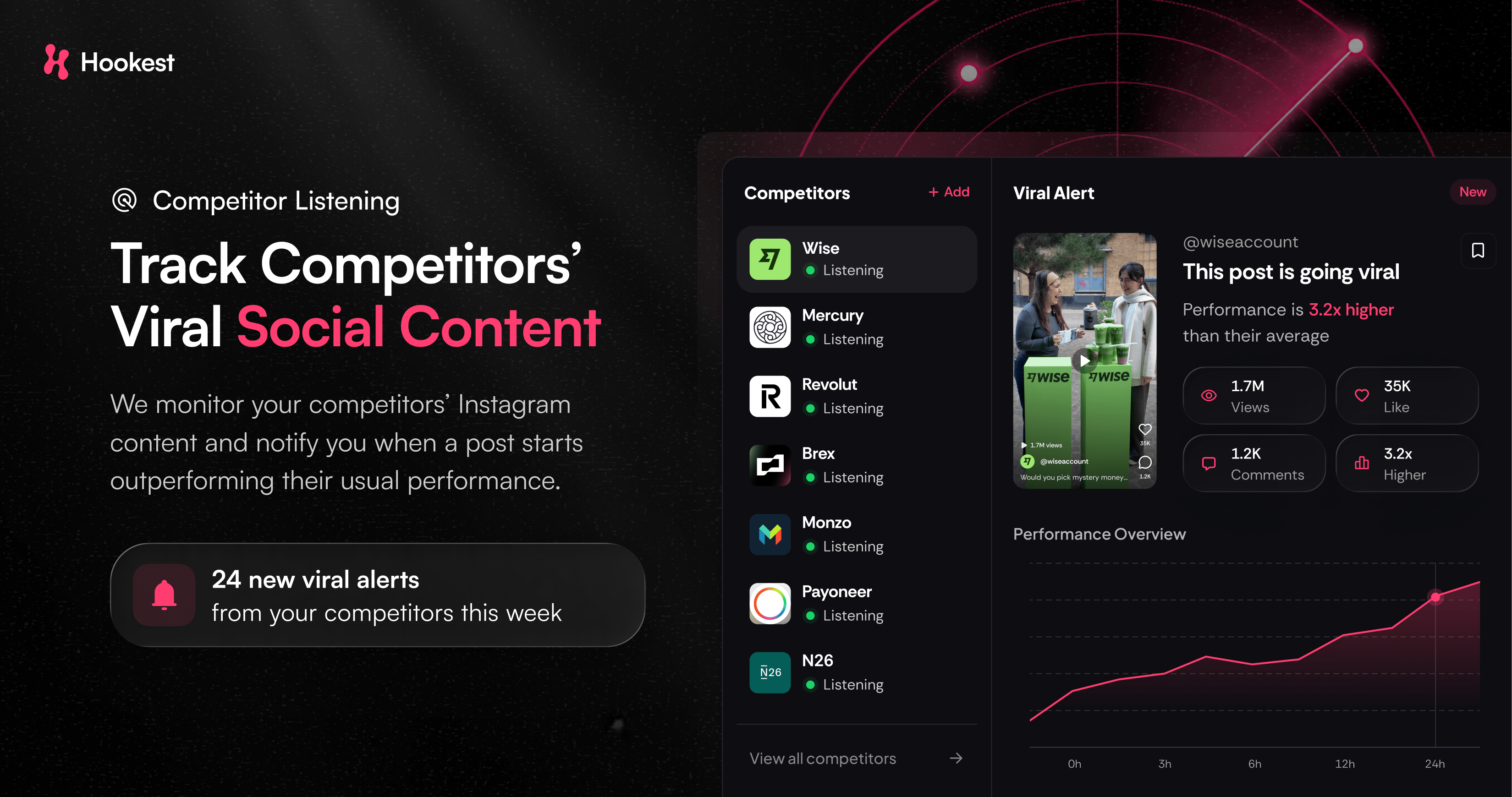
Hookest lets you "watch competitors." For brands and MCN agencies, continuously tracking how benchmark accounts open their videos is a low-cost competitive intelligence tactic. Instead of manually scrolling through video after video, the tool automatically captures and organizes those opening moments for you.
Connect with AI Assistants
The most technically distinctive feature of Hookest is its support for MCP (Model Context Protocol), which lets you bring your saved hooks directly into Claude, ChatGPT, or Gemini. This means your collected viral openings are no longer just isolated references — they can be fed directly into a large language model as contextual material for generating new scripts.
MCP is a protocol that enables AI assistants to connect with external data sources, and it's being adopted by a growing number of tools. Hookest uses it to bridge two previously separate steps — researching hooks and AI-assisted creation — so that the effective openings you discover can immediately inform new content generation.
Note on MCP: MCP (Model Context Protocol) is a standardized, open-source protocol introduced by Anthropic in late 2024. It was designed to solve the integration problem between large AI models and external data sources or tools. Previously, developers who wanted Claude or ChatGPT to access a specific database had to write custom integration code for every use case — a costly maintenance burden. MCP establishes a universal "plug standard" for AI assistants: once a data source or tool implements an MCP server, any MCP-compatible AI client can connect to it directly, with no redundant development required. This design allows third-party tools like Hookest to expose their databases as MCP servers, making them directly callable from clients like Claude Desktop — enabling workflows like "pass saved hooks from my library as context to an LLM." Cursor, Zed, Claude Desktop, and other tools have already added MCP support, and the ecosystem is expanding rapidly.
Real Value for Creators
Taken together, these features reflect Hookest's attempt to close a complete workflow loop: from studying viral content and building a swipe file, to using AI to generate new scripts. Traditionally, creators have relied on personal experience or manually juggled multiple platforms to record what they found — an inefficient process that's hard to quantify.
Hookest's differentiation lies in the combination of three elements: data, searchability, and AI integration. Standalone inspiration-saving tools are already plentiful, but products that attach real performance data to every hook and natively support major LLMs are comparatively rare. For brands and individual creators who depend on short-form video as a primary acquisition channel, this kind of tool offers a clear path to saving time and improving output quality.
Limitations Worth Noting
It's worth flagging that most of the available information comes from Hookest's Product Hunt listing, and key details — including data sourcing, update frequency, breadth of platform coverage, and pricing — have not been disclosed in depth. How "real performance data" is collected and quantified is central to the tool's credibility, and the official description doesn't elaborate on this.
There are also potential compliance and copyright considerations around tracking and archiving short video content across platforms — something users should keep in mind. As a product that just launched on Product Hunt, its real-world effectiveness is still waiting to be validated by a broader user base.
Summary
Hookest zeroes in on the most critical element of short-form video — the first three seconds — and turns the practice of "studying viral hooks" into a product: a searchable swipe file backed by real data, with a production pipeline connected to major AI assistants via MCP. For marketers and creators who live and breathe short-form video, it offers a clear path from inspiration gathering to content generation. Whether it delivers will ultimately depend on data quality and the actual user experience.
Related articles

Chain of Thought Isn't Just for AI: How Humans Can Use CoT to Improve Thinking Quality
Chain of Thought isn't just a prompt trick for large models. Starting from a Hacker News discussion, this article analyzes why CoT works for human thinking too, breaks down actionable ways to transfer it, and highlights the key differences between human CoT and machine CoT.
Cloudflare Teams Up with OpenAI: Closi…
Cloudflare Teams Up with OpenAI: Closing the Loop from Vulnerability Discovery to Defense with AI
Cloudflare uses OpenAI Daybreak to investigate security vulnerabilities and generate reviewable remediation plans, while developers use Codex to boost coding efficiency and quality.

Orca Multi-Agent Orchestration in Practice: A Guide to Parallel Collaboration with Claude and Codex
Orca is Stable AI's free open-source agent workbench supporting 34 agents like Claude Code and Codex in parallel. Learn its Git worktree isolation, multi-model orchestration, and mobile management.