Hopscotch AI: One API to Access 500+ Leading AI Models

Hopscotch AI unifies 500+ AI models under one zero-markup API with comparison and fallback features.
Hopscotch AI is an AI model aggregation platform that consolidates 500+ models from OpenAI, Anthropic, Google, and other leading providers under a single API, eliminating the need to manage separate accounts, keys, and billing systems. Core features include cross-model comparison with real prompts, configurable fallback for production reliability, and a unified usage and cost dashboard. It charges at original provider rates with no platform fees or token markup — differentiating it from most aggregation services that profit on margins. While it lowers the overhead of multi-model strategies, teams should carefully weigh API stability, data privacy compliance, and third-party dependency risks before committing.
In AI application development, integrating models from different providers usually means repetitive work — creating separate accounts for OpenAI, Anthropic, and Google, managing individual API keys, and juggling multiple billing systems. Hopscotch AI aims to solve this fragmentation problem with a single unified API, giving developers access to over 500 AI models through one entry point.
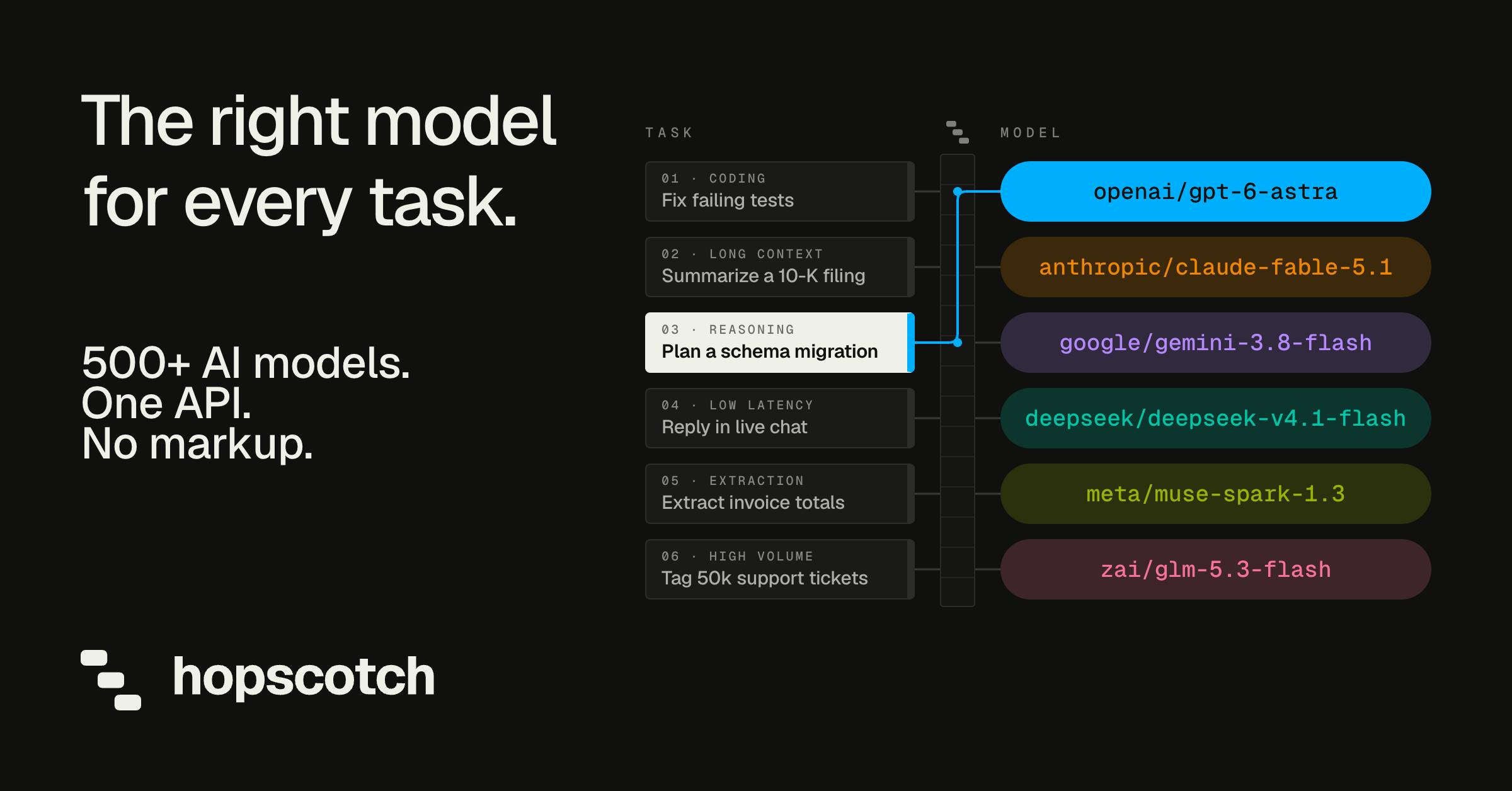
Core Positioning: A Unified API Aggregation Layer
Hopscotch AI positions itself as an aggregation middleware layer for AI models. It consolidates models from leading providers like OpenAI, Anthropic, and Google under a single API interface, eliminating the need for developers to manage separate integrations, accounts, and payment channels for each provider. One integration gives you access to everything.
This kind of aggregation service addresses a real engineering pain point. As the number of available models keeps growing, teams frequently need to compare and switch between models like GPT, Claude, and Gemini. If every switch requires modifying integration code and changing billing systems, the engineering overhead adds up quickly. By consolidating that complexity into a unified interface, Hopscotch makes switching models — in theory — a matter of changing a single parameter.
Three Key Features
Based on the official documentation, Hopscotch AI offers several capabilities tailored to developers' real-world needs.
Model Comparison
Developers can run side-by-side comparisons across different models using their own actual prompts. This is particularly valuable during the model selection phase — rather than relying on vendor-published benchmark scores, you can test directly with real prompts from your own use case and see which model's output best meets your expectations.
Fallback Support
The platform supports configurable fallback mechanisms. When the primary model becomes unavailable or returns unexpected errors, requests can automatically be rerouted to a backup model. For production applications, this redundancy design significantly improves service availability and prevents a single provider's outage from taking down your entire application.
Fallback is a classic fault-tolerance design pattern in distributed systems. In the context of AI API calls, it's typically implemented via a priority list: developers pre-configure a set of backup models (e.g., GPT-4o as primary, followed by Claude 3.5 and Gemini 1.5 as fallbacks), and when the primary model returns a timeout, rate limit (429 error), or service interruption (503 error), the request automatically retries against the next available node. The engineering complexity here is non-trivial — it requires handling differences in prompt formats, context length limits, and response structures across models. One of the core values of an aggregation layer is abstracting away these heterogeneous details, making fallback switching completely transparent to the application layer.
Unified Usage and Spend Tracking
Call volume and costs across all models are consolidated in a single dashboard. For teams using multiple providers simultaneously, this solves the problem of scattered cost attribution and monitoring, giving both finance and engineering teams a clearer picture of AI spending.
Pricing Strategy: No Platform Fees, No Token Markup
Hopscotch AI takes a developer-friendly approach to pricing: charges are passed through at each provider's original rates, with no additional platform fees and no markup on token prices.
This is worth paying attention to. Many aggregation services build their revenue model on the margin from reselling tokens, but Hopscotch claims to forgo that markup. If true, their business model likely relies more on value-added services or future premium features rather than taking a cut from every API call. For high-volume teams, avoiding token markups can eliminate a substantial hidden cost.
As an exclusive Product Hunt launch offer, the first 250 users to sign up can redeem the promo code HOPSCOTCH50OFF on the Billing tab to receive $50 in free model credits. The product received 87 upvotes on Product Hunt, ranking 8th on the daily leaderboard, categorized under Developer Tools and Artificial Intelligence.
The Value and Concerns of an Aggregation Layer
AI model aggregation APIs are not a new concept — several competing services with similar positioning already exist in the market. Hopscotch's differentiation lies primarily in its no-markup pricing combined with engineering-focused features like fallback and model comparison.
For developers, the core appeal of tools like this is lowering the barrier to a multi-model strategy. When model capabilities are rapidly evolving and prices shift frequently, avoiding lock-in to a single provider means significantly more flexibility. However, introducing an aggregation layer also brings new considerations: API stability, privacy compliance implications of routing data through a third party, and the risk of dependency on the aggregation service itself — all of these are factors that need to be weighed during evaluation.
For teams assessing a multi-model architecture, Hopscotch AI offers a worthwhile starting point — especially since the free credits lower the cost of initial experimentation. Whether to adopt it long-term will depend on its service reliability and how its feature set evolves.
Data privacy compliance is the area that deserves the most careful scrutiny when adopting an aggregation middleware layer. When requests are forwarded through a third-party aggregation service, the content of user prompts passes through that service's servers. This can trigger compliance requirements under regulations like GDPR or HIPAA when handling personal information, trade secrets, or regulated data (such as in healthcare or financial contexts). Developers need to confirm whether the aggregation service retains logs, whether data is used for model training, and whether a complete Data Processing Agreement (DPA) is in place. Compared to calling provider APIs directly, an aggregation layer introduces an additional data processor into the compliance chain — a common source of friction in enterprise procurement.
Related articles

Chain of Thought Isn't Just for AI: How Humans Can Use CoT to Improve Thinking Quality
Chain of Thought isn't just a prompt trick for large models. Starting from a Hacker News discussion, this article analyzes why CoT works for human thinking too, breaks down actionable ways to transfer it, and highlights the key differences between human CoT and machine CoT.
Cloudflare Teams Up with OpenAI: Closi…
Cloudflare Teams Up with OpenAI: Closing the Loop from Vulnerability Discovery to Defense with AI
Cloudflare uses OpenAI Daybreak to investigate security vulnerabilities and generate reviewable remediation plans, while developers use Codex to boost coding efficiency and quality.

Orca Multi-Agent Orchestration in Practice: A Guide to Parallel Collaboration with Claude and Codex
Orca is Stable AI's free open-source agent workbench supporting 34 agents like Claude Code and Codex in parallel. Learn its Git worktree isolation, multi-model orchestration, and mobile management.