Horror IP as Big Tech-Entertainment Business: The Economics of Fear Through the Lens of Resident Evil

Horror content's emotional intensity and cross-media scalability make it one of the highest-ROI categories in the content industry.
Using the thirty-year arc of Resident Evil as a lens, this article examines how horror has evolved from a niche subculture into a core business within the content industry. Horror's commercial strength rests on three pillars: emotional intensity that drives social sharing, expansive world-building that supports cross-media adaptation, and a loyal audience with high willingness to pay. In the streaming and social platform era, horror's algorithm-friendly nature — high engagement, high shareability — makes it a favored asset for platforms. The article also highlights transmedia deployment as the key path to amplifying IP value, while noting that intensifying competition and homogenization will be the defining challenge ahead.
Horror Is Becoming a Core Business in Tech Entertainment
Horror is no longer a niche hobby. From gaming to streaming, from film to cross-media adaptations, horror content is emerging as a stable and steadily expanding business at the intersection of tech and entertainment. Franchises like Resident Evil have traversed three decades, evolving from a single game into a sprawling commercial empire that spans multiple platforms.
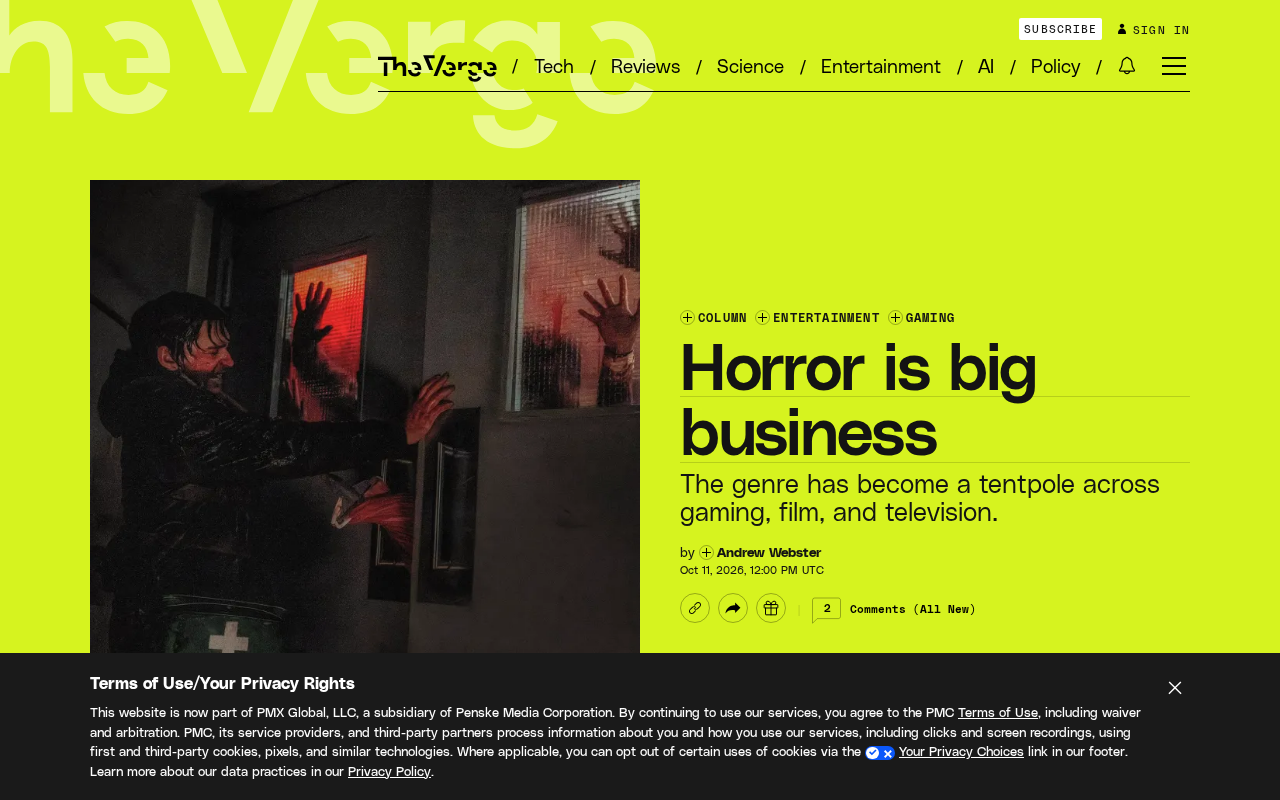
This phenomenon reflects more than a shift in consumer taste — it reveals the deeper logic driving the content industry around IP management, platform distribution, and user engagement.
The Long-Cycle Value of IP, Through the Lens of Resident Evil
The Resident Evil series has a thirty-year history — and that number alone tells a story. Very few IPs manage to sustain continuous output and commercial vitality across three decades, and horror franchises have proven uniquely resilient.
Why Horror IPs Have Staying Power
Horror content carries a set of distinctive industry advantages. Its emotional impact is intense, making it highly shareable on social media and video platforms. Its world-building tends to be expansive, supporting a steady stream of sequels, spin-offs, and cross-media adaptations. And horror audiences typically demonstrate strong loyalty and willingness to pay, returning reliably for new content.
These traits make horror IPs attractive assets for both platform operators and content creators. Game publishers and streaming services alike are competing for the rights to content that can generate long-term cash flows.
From a neuroscience perspective, fear activates the amygdala and triggers adrenaline release — a physiological response that is itself habit-forming. The experience of "encountering danger in a safe environment" delivers intense emotional gratification, a mechanism researchers call "benign masochism." This is the core hook that sets horror apart from other entertainment genres. Unlike romance or comedy, horror experiences often prompt users to revisit, discuss, and re-consume afterward, generating strong repeat engagement. It also explains why horror gamers contribute a disproportionately large share of content creation on streaming and video platforms — Fear FOMO (the anxiety of missing out on a horror experience) is a powerful social distribution driver in its own right.
The Platform-Driven Expansion of Horror Content
Horror's reach has long since exceeded its traditional boundaries. As the original author notes, horror content has become "pervasive" — a defining trend in today's entertainment landscape.
The Amplification Effect of Cross-Media Adaptation
A successful horror IP tends to radiate outward from its original medium: games become films, films spawn TV series, and series feed back into games and merchandise. This cross-media synergy not only extends an IP's commercial lifespan but exponentially expands the audience base for each individual property.
For platforms, horror content also has an algorithm-friendly quality. High-intensity emotional content is more likely to trigger user interactions, comments, and shares — earning it higher visibility weights in recommendation systems. This is a key reason why streaming platforms continue to invest heavily in original horror content.
In industry terminology, cross-media adaptation is often framed as "Transmedia Storytelling," a concept systematically defined by media scholar Henry Jenkins: each media platform carries a distinct piece of a story universe, with each piece able to stand alone while together forming a larger narrative system. Unlike simple "licensed adaptations," mature transmedia operations require that content across platforms complement — rather than repeat — each other's world-building. Resident Evil illustrates this logic precisely: the games provide core gameplay-driven narrative; the film series (including the Anderson films and the 2021 reboot) targets mainstream entertainment audiences; and the Netflix series reaches streaming-native viewers. Each track operates independently within its platform's recommendation algorithm while serving as an entry point for the other tracks' new audiences.
Industry Takeaways from the Economics of Horror
Horror's rise as big business is, at its core, a reflection of a broader content industry principle: content with strong emotional impact, rich world-building, and active community engagement is naturally suited to long-term monetization on digital platforms.
For content creators and platform operators, this trend offers several takeaways: the value of a quality IP lies in sustained management, not one-time consumption; emotionally charged content has a natural advantage in the social distribution era; and cross-media deployment is the critical path to maximizing IP value.
That said, the boom in horror content also brings growing concerns about commodification and homogenization. As more players crowd into the space, the ability to innovate while preserving horror's essential core will determine which IPs are still standing thirty years from now.
From a capital markets perspective, horror's appeal also lies in its favorable ratio of production cost to box office or viewership returns. Hollywood data has long shown that horror is among the highest-ROI genres across all film categories — production budgets typically range from $10 million to $50 million, yet often generate global box office returns of several times to dozens of times that figure. In the streaming era, this logic extends to subscriber acquisition: a low-budget original horror series that ignites social conversation can sometimes drive hundreds of thousands of new subscriptions, with a user acquisition efficiency that far outpaces similarly budgeted content in other genres. This is the financial rationale behind Netflix, Paramount+, and others continuing to double down on original horror.
Conclusion
The thirty-year journey of Resident Evil stands as a case study in how horror has moved from subculture to mainstream commerce. In the attention economy shaped by streaming and social platforms, horror as a "big business" shows no signs of cooling — and may expand further still as technology and distribution models continue to evolve.
Related articles

Workbuddy for Absolute Beginners: How a Desktop AI Agent Fits Into Real Workflows
A beginner's guide to the Workbuddy desktop AI agent: installation, claiming credits, file management, and building automated workflows—compared with CodeX for fit and cost, helping professionals shift from AI question-askers to AI managers.

OpenAI's New Agent Stack: Computer Use, Decisions API, and Ultra-Fast Workflows
OpenAI Dev Day unveiled a new agent stack: Computer Use outperforms humans, Decisions API delivers ultra-low-latency classification via Luna, Agents API opens the same Computer Use capabilities, and GPT-6.1 Sol costs only one-seventh of Astra. Core updates, benchmark data, and developer insights.

Liang Wenfeng Open-Sources DeepInfo Inference Framework, Takes On U.S. Ban
DeepSeek open-sources its DeepInfo inference framework after its models, featuring GPU/CPU cross-pipelining, small-model prediction with large-model verification, and full Huawei Ascend and NVIDIA chip support—facing the U.S. federal ban head-on. This article analyzes its significance for AI deployment and open-source strategy.