How 11 AI Agents Help Account Executives Handle Research, Quotes, and Contracts

Grokbot demo shows how 11 AI agents can automate sales prep work for account executives in 5 minutes.
This article covers a product demo by AI agent platform Grokbot: account executives simply state their role in natural language, and the system automatically deploys 11 specialized agents (covering research, quoting, contracts, and more) plus a coordinator bot — all in a claimed 5 minutes, no technical background required. Agents communicate via MCP (Model Context Protocol), while the coordinator handles cross-agent orchestration to prevent siloed outputs. The article maintains a measured perspective, noting this is vendor marketing and that output quality and compliance remain unverified — real-world deployment requires human review mechanisms.
When Account Executives Hand Off the Grunt Work to AI Agents
For any account executive, the hours in a week that actually drive value are constantly buried under prep work — research, quoting, contract drafting. The demos and closes that actually move deals forward get squeezed into the margins. A YouTube demo video puts forward an idea: hand off the prep work to AI agents, and let people focus on the high-value, face-to-face moments.

The idea itself isn't new, but it reflects a clear trend in sales workflow automation — not replacing individual steps with a single tool, but assembling a "virtual team" of specialized agents, each responsible for a different stage of the sales funnel.
Grokbot's Core Logic: Build an Agent Team in 5 Minutes
The product featured in the video is Grokbot (grokbot.com). It's positioned as "an AI agent anyone can configure in 5 minutes" — no development background required. The setup process is broken down into a few clear steps.
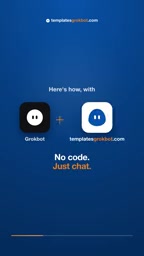
Step one is installing Grokbot and adding a template creator bot. Step two is connecting it to the corresponding Grokbot MCP server. MCP (Model Context Protocol) plays the role here of enabling standardized communication between different agents, and between agents and external data sources or tools.

This protocol-based connection approach is a direction worth watching in the current AI agent ecosystem. It means agents are no longer isolated point solutions — they can be orchestrated and coordinated through a unified interface.
MCP (Model Context Protocol) is an open standard proposed by Anthropic in late 2024, designed to solve the fragmentation problem of AI models and external tools each "speaking their own language." Previously, every AI application that needed to connect to search engines, databases, or third-party services had to build custom integrations from scratch — expensive and hard to reuse. MCP's approach is to define a universal "plug and socket" for these connections: tool providers (MCP Servers) expose their capabilities via the protocol, and models or agents (MCP Clients) call them via the same protocol, with neither side needing to understand the other's internal implementation. For multi-agent platforms like Grokbot, MCP's significance is that each specialized agent can read shared context and call the same tool set in a standardized way — providing the technical foundation for an orchestration architecture where a coordinator manages the overall workflow and individual agents handle their own domains.
One Prompt, Eleven Specialized Agents Plus One Coordinator
The most striking feature is using natural language to assemble the team. A user simply types "I'm an account executive — find and install all relevant bots," and the system automatically matches and deploys the agents needed for that role.

According to the video, this operation generates 11 specialized agents covering different tasks including research, quoting, and contracts. A coordinator bot is also added to keep the entire agent team working in sync, rather than operating in silos.
The coordinator's existence is the most fundamental difference between this approach and "a bunch of independent tools." In a real sales context, research findings need to feed into quoting logic, which in turn feeds contract generation. Without a coordination layer, a multi-agent setup easily becomes a collection of disconnected information silos.
The "Orchestrator" pattern in multi-agent systems is one of the dominant paradigms in current AI agent architecture design. The basic logic: break a complex task into subtasks, with the orchestrator handling task distribution, result aggregation, and error handling, while each specialized agent focuses solely on its own domain. This parallels the "microservices architecture" pattern in software engineering — each service (agent) has clear boundaries and can be iterated independently, while the coordination layer handles service orchestration and state management. In a sales context, the advantage of this architecture is that when one component (such as the quoting logic) needs to be updated, only that agent needs to be replaced without disrupting the overall workflow. The coordinator can also dynamically decide whether to trigger downstream contract generation based on upstream research results, rather than mechanically executing a fixed sequence.
Beyond Account Executives: Role-Based Templates
The video emphasizes that this mechanism isn't designed exclusively for sales roles. Grokbot offers a template library for various job functions, and users can find agent combinations suited to their own profession at templates.grokbot.com/for-my-job.
This "bundle templates by job role" product approach lowers the barrier for everyday professionals to use AI agents — users don't need to understand the technical details of each agent. They simply declare their role, and the system handles the matching and orchestration.
A Rational Perspective
It's worth noting that this material is fundamentally a product demo. The "11 agents in 5 minutes" claim exists within a vendor marketing context. The video provides no validation data on whether the research quality, quoting accuracy, or contract compliance generated by these agents would hold up to real-world sales requirements.
For account executives, the real value of tools like this isn't "replacement" — it's front-loading the automation of repetitive prep work, freeing up more time for demos and negotiations that depend on human judgment. Whether it's worth the investment depends on whether a team can establish review and error-correction processes for agent-generated outputs.
Related articles

DeepCell: One-Click AI Generation of Documents, Spreadsheets, and Slides
DeepCell tops Product Hunt with one-click generation of documents, spreadsheets, and slides, using the .deepcell format for linked updates, designed for System 2 tasks like modeling and sales reviews.

Doneas: 15-Minute Daily Accountability Calls That Keep Indie Developers From Procrastinating
Doneas is a daily accountability tool for indie developers: plan tasks on Monday, join a 15-minute call with five builders each day, and log deliveries on a public progress page. This article analyzes its core mechanics, effectiveness, and potential issues around retention and matching.

Fastlane 2.0: Fully Automated AI Ad Campaigns, From Creative to Optimization
Fastlane 2.0 is an AI ad automation tool: enter your website and it learns your brand, generates video and image ads, and runs and optimizes them on Meta, TikTok, Instagram, and YouTube.