How AI Agents Are Reshaping Compute Loads and Performance Challenges

AI agents turn one-question-one-answer inference into multi-round autonomous execution workflows, forcing infrastructure upgrades.
The article argues that AI inference is shifting from the traditional "one question, one answer" mode to agentic workflows, where AI systems no longer just answer questions but actually execute work. An agent's core loop includes reasoning, planning, tool calling, code execution, and result iteration, repeating until the task is complete, which multiplies compute overhead. This autonomy introduces new compute challenges: unpredictable iteration counts, external dependencies in tool calls, dynamically changing resource demands, and complex multi-round state management. The article contends this is forcing AI infrastructure to shift from single-inference optimization to task-level orchestration, with optimization targets changing from throughput and latency to task completion time and success rate.
From Traditional Inference to Agentic Workflows: A Fundamental Shift in the AI Compute Paradigm
For the past few years, most people's understanding of AI inference has remained stuck in the "one question, one answer" mode — you input a prompt, the model returns an answer, and the whole process is as simple as a game of catch. According to an analysis video on YouTube about AI agents, this traditional form of inference is essentially a "simple game of catch: one prompt in, one answer out."
But the emergence of AI agents has completely changed this landscape. As the video emphasizes, "an agent doesn't just answer questions — it actually does work." This means the nature of the compute load has fundamentally changed: the AI system is no longer a passive question-answering machine, but an entity that actively executes tasks.

The significance of this shift goes far beyond a surface-level feature upgrade. When AI moves from "responder" to "executor," the entire tech stack needs to be rethought: How should compute resources be allocated? How should latency be controlled? How can system throughput be guaranteed? These questions weren't prominent in the era of traditional inference, but they become critical in agentic workflows.
The Agent's Work Loop: Reasoning, Planning, Tool Calling, and Iteration
To understand the performance challenges that AI agents introduce, you first need to understand what they're actually doing. According to the video's breakdown, the process by which an agent completes a task is far more complex than a single inference pass.

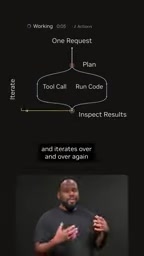
The core work loop of an agent includes the following stages:
- Reasoning: Analyzing and breaking down the task, understanding goals and constraints
- Planning: Formulating execution steps and strategies, deciding what to do first and what comes next
- Tool Calling: Invoking external APIs, search engines, databases, and other tools to gather information
- Running Code: Executing code in a sandbox or runtime environment to perform specific operations
- Interpreting & Iterating: Analyzing execution results, determining whether the goal has been met, and if not, returning to the reasoning stage to re-plan

The key characteristic of this loop is "iteration" — the agent will "repeat over and over until the task is complete." This is completely different from the one-shot output of traditional inference. Each iteration means a new round of model inference, tool calls, and result processing, multiplying the compute overhead.
The Brand-New Compute Load Challenges Brought by Autonomy
An agent's autonomy is its greatest value — and also its greatest technical challenge. The video clearly points out that "this autonomy introduces entirely new types of compute loads, along with a whole new set of performance challenges."
Specifically, these challenges manifest across several dimensions:
Unpredictable iteration counts. Traditional inference latency is relatively deterministic — you know how long a single forward pass takes. But an agent's iteration count depends on task complexity, the quality of tool-returned results, and the model's own judgment. It might finish in two rounds, or it might still be looping after ten.
External dependencies of tool calls. Every tool call involves network requests, API response times, and possible retries on failure. These external factors can significantly impact end-to-end latency.
Dynamic compute resource demands. A single agent task may simultaneously involve reasoning (GPU-intensive), code execution (CPU-intensive), tool orchestration (IO-intensive), and other workload types, placing higher demands on the infrastructure's elastic scheduling capabilities.
Complexity of state management. Multi-round iteration means maintaining context state, intermediate results, execution history, and other information, with memory and storage overhead far exceeding stateless traditional inference.
The difference between stateful inference and traditional stateless inference. Traditional one-question-one-answer inference can be viewed as a stateless service: each request carries the full context, the model performs a single forward computation and returns a result, and the system needs to retain no information between requests. An agent's work loop, however, is inherently stateful — the planning results, tool returns, and code execution outputs from multiple rounds of iteration all need to be continuously maintained and injected into the context of the next inference round. This stateful characteristic has two direct consequences: first, the context window keeps expanding with each iteration, causing the input token count per inference round to grow, with attention computation overhead increasing superlinearly; second, session state needs to be managed hierarchically across GPU VRAM, host memory, and even external storage — otherwise you either blow out VRAM or cripple latency through frequent swapping. This is precisely why techniques like KV Cache reuse and prefix caching become especially critical in agent scenarios.
The Profound Impact on AI Infrastructure
The rise of agentic workflows is forcing the entire AI infrastructure layer to upgrade. From inference engines to orchestration frameworks, from latency optimization to cost control, every link in the chain needs to be redesigned for the agent's unique working patterns.
Traditional inference optimization focuses on the throughput and latency of a single request. But in agent scenarios, the optimization targets become "task completion time" and "task success rate." This requires the system not only to be fast, but also to intelligently schedule various resources across multiple iteration rounds, finding the optimal orchestration strategy among inference, tool calling, and code execution.
For developers and enterprises, understanding this paradigm shift is a prerequisite for building reliable AI agent applications. An agent's capability boundary depends not only on the intelligence level of the model itself, but even more on whether the underlying infrastructure can support its complex execution loop.
The difference between task-level orchestration and traditional request-level scheduling. The scheduling unit of traditional inference services is a single request. The scheduler focuses on how to maximize throughput and minimize P99 latency under a given concurrency, with typical strategies like continuous batching. But in agent scenarios, the scheduling unit becomes a task spanning tens of seconds or even minutes, containing multiple model calls and external IO. This means the scheduler needs a cross-round global perspective: which agents are waiting for tool returns, which can immediately proceed with inference, and which are stuck in futile loops and need to be cut off. At the same time, the cost accounting metric shifts from "how much per thousand tokens" to "how much per successful task," because a single agent task may consume tens of thousands of tokens and trigger multiple API calls. This shift in perspective from request-level to task-level is precisely the most fundamental requirement that agentic workflows impose on infrastructure.
One-line Summary
AI agents turn one-question-one-answer inference into multi-round autonomous execution workflows, forcing infrastructure upgrades.
Paragraph Summary
The article points out that AI inference is shifting from the traditional "one question, one answer" mode to agentic workflows, where AI systems no longer just answer questions but actually execute work. An agent's core loop includes reasoning, planning, tool calling, code execution, and result iteration, repeating until the task is complete — multiplying compute overhead. This autonomy introduces entirely new compute load challenges: unpredictable iteration counts, external dependencies in tool calls, dynamically changing compute resource demands, and complex multi-round state management. The article argues that this is forcing AI infrastructure to shift from single-inference optimization to task-level orchestration optimization, with optimization targets changing from throughput and latency to task completion time and success rate.
Related articles

DeepCell: One-Click AI Generation of Documents, Spreadsheets, and Slides
DeepCell tops Product Hunt with one-click generation of documents, spreadsheets, and slides, using the .deepcell format for linked updates, designed for System 2 tasks like modeling and sales reviews.

Doneas: 15-Minute Daily Accountability Calls That Keep Indie Developers From Procrastinating
Doneas is a daily accountability tool for indie developers: plan tasks on Monday, join a 15-minute call with five builders each day, and log deliveries on a public progress page. This article analyzes its core mechanics, effectiveness, and potential issues around retention and matching.

Fastlane 2.0: Fully Automated AI Ad Campaigns, From Creative to Optimization
Fastlane 2.0 is an AI ad automation tool: enter your website and it learns your brand, generates video and image ads, and runs and optimizes them on Meta, TikTok, Instagram, and YouTube.