How AI Agents Are Reshaping Vulnerability Hunting: From Traditional Three-Step Methods to Automated Practice

AI Agents are transforming vulnerability hunting from experience-heavy manual work into an efficient human-AI collaboration.
This article breaks down the limitations of the traditional SRC vulnerability hunting "three-step method" — fully manual, experience-dependent, and high-barrier for newcomers — and examines how AI changes each stage. The core argument: what actually participates in bug hunting isn't a chat AI, but an AI Agent capable of tool execution and sequential decision-making. Agents can automate asset mapping, filter false positives, orchestrate tools, and draft reports — scaling output from hundreds of vulnerabilities per year to potentially thousands. However, final reproduction, impact verification, and report submission must always involve human review.
The era of purely manual vulnerability hunting is being rewritten. A growing number of high-output bug bounty hunters have already incorporated AI as their secret weapon, turning work that once required years of experience into something far more accessible. This article, based on a cybersecurity tutorial published on Bilibili, breaks down the core differences between traditional vulnerability hunting and AI-assisted approaches — and examines where AI Agents truly deliver value.
Traditional Vulnerability Hunting: A Manual Three-Step Process
Traditional SRC vulnerability hunting can be summarized as a "universal three-step method" — and all three steps rely almost entirely on human effort.
Step one is reconnaissance: fully visiting the target site to map out its functional structure, underlying tech stack, and data interfaces, covering all business flows such as registration, login, payment, refunds, and returns. Step two is packet capture, analysis, and testing: intercepting traffic to understand every path and parameter involved in each request, identifying potential risk points, then tampering with the relevant parameters and submitting them to the target to verify which vulnerabilities actually exist. Step three is validation and report writing: once a vulnerability is confirmed, writing a report following the four key elements (vulnerability URL, reproduction steps, impact assessment, and remediation recommendations) and submitting it.
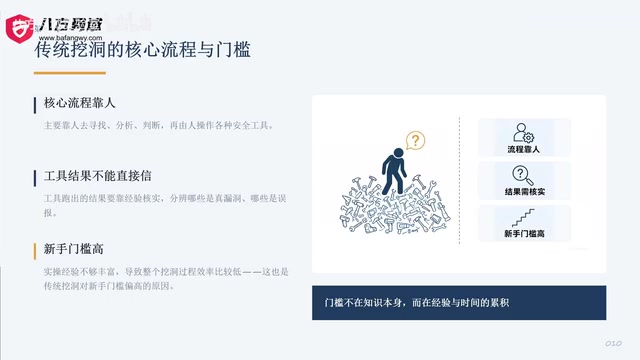
The problem is that all three steps are driven entirely by human effort — efficiency is tightly coupled with hands-on experience. The more experience you have, the more efficient you are; the less experience, the less efficient. The process also requires manually operating a wide range of tools — NMAP, Telnet, NC, Burp Suite, and more. Even after a tool produces results (say, detecting that a server has ports 22 or 3306 open), a human still needs to determine whether that's a real vulnerability, a false positive, or simply a normal configuration.
This explains why the barrier to entry is so high for newcomers: the real wall isn't the knowledge itself — it's accumulated experience and time invested. Many people complete training courses and still can't get into an effective vulnerability-hunting workflow, because that's exactly where they get stuck.
What is an SRC? SRC (Security Response Center) is a vulnerability reward platform set up by major internet companies. White-hat hackers can submit security vulnerabilities they discover, and after vendor review, receive points or cash rewards. Well-known SRCs in China include the Alibaba Cloud Vulnerability Response Center, Tencent Security Response Center, and ByteDance Security Center. SRCs are essentially a crowdsourced security testing mechanism — helping companies continuously discover security issues after product launch, while also providing security researchers with a legal channel for vulnerability hunting and monetization. Vulnerability severity is typically classified into four tiers: critical, high, medium, and low, with rewards directly tied to severity. Critical vulnerabilities can sometimes earn tens of thousands of RMB.
How the Three Steps Change When AI Gets Involved
Introducing AI into the vulnerability hunting workflow reshapes every stage of the traditional three-step process.
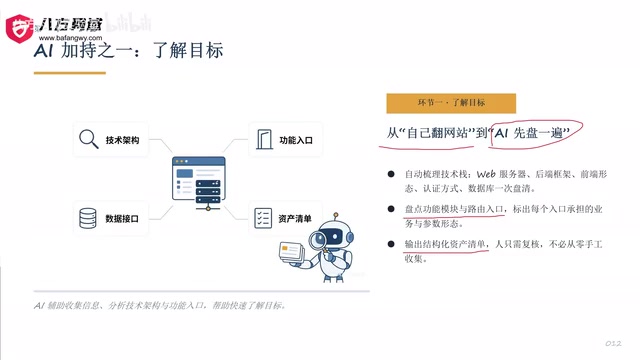
In the reconnaissance phase, AI can do an initial sweep — automatically visiting the target and cataloging the backend architecture, frontend structure, authentication mechanisms, database types, and more. It marks each functional module and routing entry point, explains what each endpoint handles and what parameters it accepts, and ultimately outputs a structured asset inventory where functions, corresponding interfaces, and verification methods are all laid out clearly. The human only needs to review, rather than collecting everything from scratch.
In the packet analysis phase, AI takes on intelligent analysis and filtering: providing testing ideas, explaining unfamiliar code, and filtering out false positives. Vulnerability hunting often generates a flood of results and false positives; AI can eliminate most of them, letting the researcher focus on critical, high, and medium-severity risks that actually need immediate attention — rather than wasting time on low-severity or low-value issues.
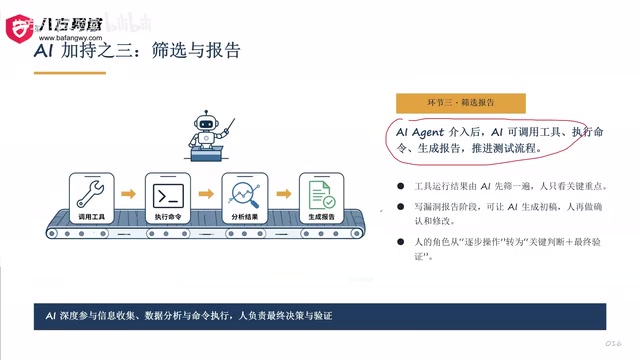
In the tool execution and reporting phase, AI can directly invoke tools, run commands, and generate draft reports. Kali Linux comes loaded with tools, and it's unrealistic to expect any one person to be proficient with all of them. AI can conveniently orchestrate these tools and surface the key findings. For reports, AI can generate an initial draft following the four key elements — but this absolutely must go through careful human review. Reproducing the vulnerability, verifying the impact, and final sign-off must all be done by a person. Submitting an AI-generated report directly without review is a fast track to getting blacklisted.
The Key Distinction: An Agent, Not a Chatbot
There's an easy-to-miss but critical point here: what actually makes a difference in vulnerability hunting isn't a web-based chat AI answering questions — it's an AI Agent.
The fundamental difference between an Agent and a standard conversational AI is that an Agent can execute tools, make sequential decisions, plan out the steps of a vulnerability hunt, and actually carry those steps out. Tools mentioned in this context — Codex, Claude, Cline, Trae, OpenHands, Amos Agent — all fall into the category of tools capable of participating directly in a real hunting workflow.
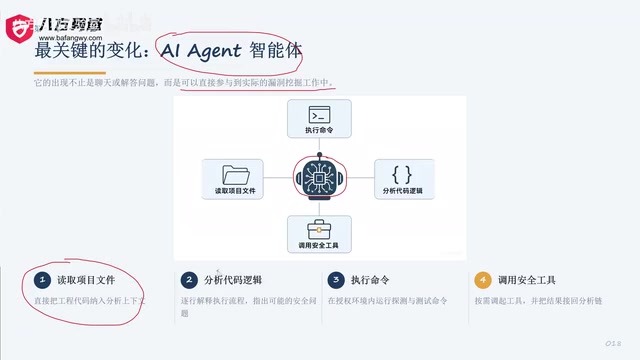
These agents can read project files, analyze code logic and flag security issues, run reconnaissance or testing commands, and invoke security tools to conduct penetration testing against a target. In other words, what AI brings to the table isn't a question-and-answer window — it's a "digital assistant" that can actually take action. A tool that only answers questions cannot handle real vulnerability hunting.
AI Agents vs. standard LLM chat interfaces: The core difference lies in the "perceive–plan–act" loop. A standard chat AI can only output text in a conversation window. An Agent is given access to external tool-calling interfaces, enabling it to run terminal commands, read and write local files, call APIs, control browsers, and more — and then autonomously decide the next action based on the results, forming a multi-step automated chain. Cline and OpenHands, mentioned in this article, are typical code agent frameworks that can directly operate file systems and command lines in a local development environment. Codex is OpenAI's code understanding and generation model; Claude is Anthropic's large language model, whose extended context window makes it especially well-suited for analyzing large codebases. What these tools share is that they don't just "say" what should be done — they can actually "do" it.
The Core Value of AI-Assisted Hunting: Lower Barriers, Higher Efficiency
Cybersecurity is a field that demands breadth, involves a vast array of tools, and has a steep learning curve. Without enough hands-on experience, the cost of trial and error is extremely high — it typically takes three to six months just to build up a foundation.
The introduction of AI Agents shifts vulnerability hunting from a model that is "human-led with tool assistance" to one where "AI deeply participates in reconnaissance, data analysis, and command execution while humans handle decision-making and validation." This brings two core benefits:
First, it lowers the learning barrier, breaking down knowledge walls so that people without years of accumulated experience can still make meaningful progress. Second, it dramatically boosts efficiency. The article cites a striking comparison: using traditional methods, one person might submit a few dozen to over a hundred vulnerabilities per year; with AI-assisted hunting, some researchers have submitted more than 14,000 vulnerabilities in a single year — a leap in productivity made possible by AI Agents.
It's worth emphasizing: AI-assisted hunting doesn't mean letting the agent hunt for you. Rather, it lowers barriers and raises efficiency, making work that once depended heavily on experience and time far more achievable. Final decision-making, reproduction, and report submission must still be handled by a human. This is both a matter of accountability and a practical safeguard against platform blacklisting.
A note on the "14,000 vulnerabilities in a year" figure: This reflects the degree to which AI automates reconnaissance and initial triage — not that every vulnerability carries the same severity or technical depth. In real SRC contexts, bulk submissions tend to skew toward low and medium severity; high-severity and above still require deep human analysis and exploitation validation. It's also worth noting that some platforms have explicit rules against automated bulk submissions. Submitting large volumes of low-quality or duplicate reports won't earn rewards and may trigger anti-abuse mechanisms. The real value of AI-driven efficiency lies in freeing researchers from repetitive grunt work so they can concentrate their limited energy on hunting for genuinely high-value vulnerabilities — not simply chasing submission counts.
Final Thoughts
From reconnaissance to report generation, AI Agents are reshaping every stage of the vulnerability hunting process. They don't change the fundamental nature of vulnerabilities, and they don't replace the judgment of security engineers. What they do is make high-barrier, time-intensive work more accessible and more efficient. For newcomers, understanding the distinction between using an Agent versus a conversational AI is the first step into the world of AI-assisted vulnerability hunting.
Related articles

How Big Can Stars Really Get? The Physical Limits of the Largest Stars
Red supergiants are the largest stars by volume, with radii up to 2,000 times the Sun, engulfing the inner solar system. But there is no precise upper limit on stellar size—models predict up to 15,000 solar radii. The most massive blue stars are far smaller than red supergiants—biggest and heaviest are two different things.

Apple HomeView Smart Display Full Feature Breakdown: Wall-Mount or Desktop, $299
Apple launches HomeView, a $299 smart display with wall-mount and desktop options, 12MP camera for facial recognition, smart home control, music playback, and recipe step-by-step cooking. Full breakdown of watch faces, apps, privacy, and cooking integration.

Where Did the Promised New Studio Go? Craft Computing Answers After Five Years
Craft Computing's host responds to viewer questions: the new studio promised five years ago was shelved as construction costs soared from $30,000 to $75,000, and was replaced by a 168-square-foot garage conversion.