How AI Becomes the "Eureka Machine" of Scientific Discovery

AI is shifting from a chat tool to a scientific discovery engine; the Eureka machine outlines a vision of programmable biology and autonomous research.
The article argues that AI's true historical value is shifting from text generation to hard scientific discovery, with protein folding and physical modeling already earning Nobel-level recognition. Salesforce's ProGen treats biology as a programmable language, generating millions of artificial proteins, most of which fold correctly and have antibacterial activity—an analogy to calculus's role in physics. AI can also identify "undiscovered public knowledge," linking separately published but never-connected research findings. The article proposes the "Eureka machine" framework, consisting of four pillars: a map of all human knowledge, a unified model of physical reality, high-fidelity digital twins, and fully autonomous laboratories, supported by million-scale AI agent collaboration. Machine intelligence is not limited by biological perception; its theoretical limit is only the speed of light. The author cautiously notes that this vision is currently a directional research agenda, not an engineering blueprint with a clear timetable.
Artificial intelligence is shifting from a chat tool to a core engine of scientific discovery. Salesforce's ProGen project uses language models to generate artificial proteins with antibacterial activity, a case that reveals a larger trend: when AI learns the "language of nature," it may do for biology what calculus did for physics—turn it into a predictive, exact science.
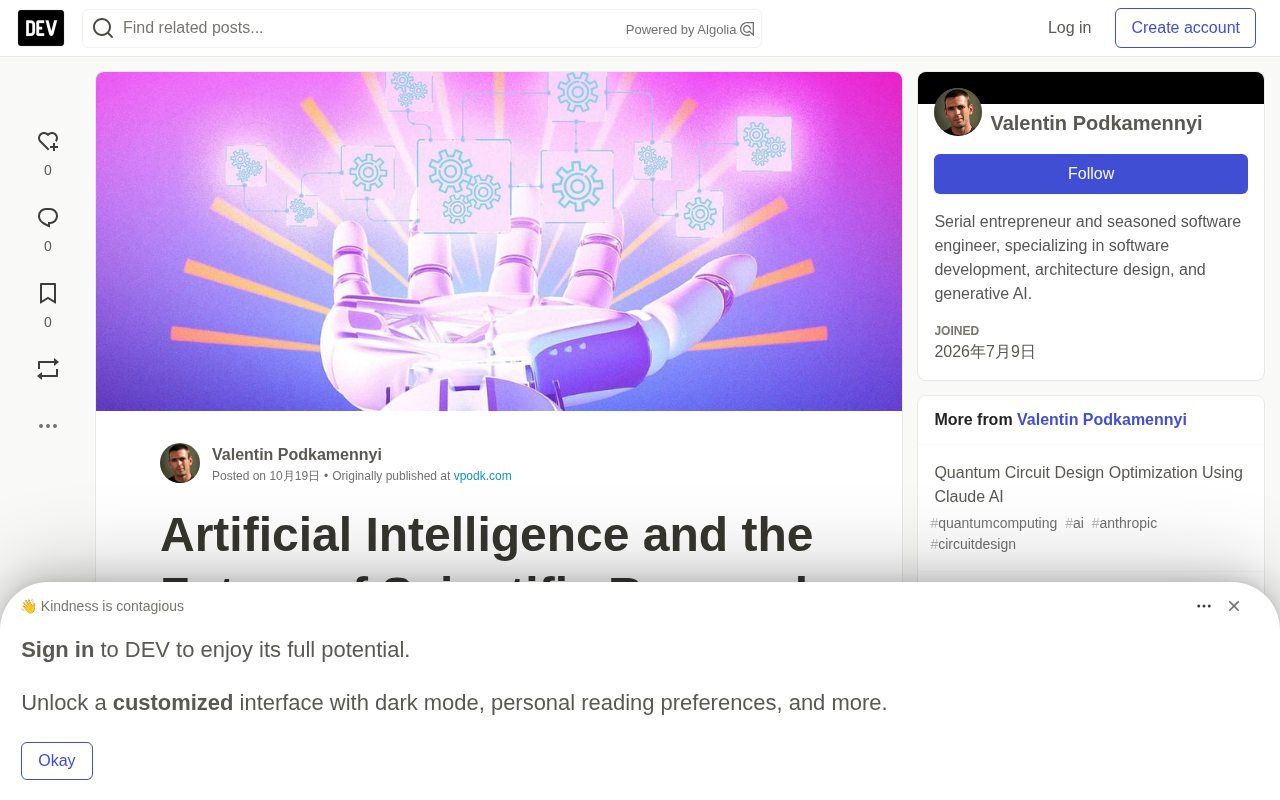
From Conversational Tool to Discovery Engine: AI's Value Anchor Is Shifting
The true historical value of AI lies in the hard sciences, not in generating text or images. The original article notes that the scientific community has already seen AI pioneers win the Nobel Prize in Physics and Chemistry, honoring neural networks' contributions to protein folding and physical modeling. Public discussion is often dominated by speculative risks, but AI's practical gains in research are already advancing human welfare.
The urgency behind this comes from the scale of data. The global output of scientific research has exceeded the upper limit of human processing capacity, making automation a necessary means of managing data and extracting hidden insights. Science is the foundation of technology, and technology is the engine of social progress—when AI amplifies human intelligence, what accelerates is the pace at which we understand the natural world.
Learning the Language of Nature: From Proteins to Programmable Biology
Everything in the physical world follows some kind of language-like structure. When a large language model learns to predict the next word in a sentence, it is also learning the concepts behind the words: a model that predicts geographic text must internalize an "internal map" of cities and distances to be accurate. The same logic applies to biological systems—amino acids are the alphabet.
Salesforce's research team trained the ProGen model on hundreds of millions of protein sequences, treating biology as a programmable language and generating millions of entirely new artificial proteins. A substantial proportion of them fold correctly and exhibit the expected antibacterial properties. The original article draws a powerful analogy from this: AI may be to biology what calculus was to physics—turning a discipline dependent on observation into an exact, predictive science.
The protein folding problem is the key background for understanding the significance of ProGen. Proteins are made up of amino acid chains, but their function depends on how the chain folds into a three-dimensional structure. Because the number of possible folding conformations is astronomically large, predicting structure from sequence was a fifty-year problem in biology. DeepMind's AlphaFold reached near-experimental accuracy in the 2020 CASP assessment, and it was precisely this breakthrough that led to the related pioneers receiving the 2024 Nobel Prize in Chemistry. ProGen goes in the opposite direction: given a target function (such as antibacterial activity), it generates entirely new sequences that can fold into the corresponding structure. This forms a complementary "predict–generate" loop with AlphaFold, and it is also the technical basis for the article's analogy between AI and calculus.
Mining "Undiscovered Public Knowledge"
The next medical or energy breakthrough may already be hidden in the existing literature. Historically, many major discoveries have arisen from accidental cross-domain connections: researchers at Bell Labs discovered evidence of the Big Bang while investigating antenna noise, but did not realize the significance of their data until they spoke with theorists who had made predictions decades earlier.
Today millions of researchers publish in tens of thousands of journals, and such accidental connections are increasingly difficult to make. AI's value lies in simultaneously digesting all published knowledge and identifying "undiscovered public knowledge"—two discoveries each published separately but never linked. By mapping these connections, AI helps scientists focus their attention on the blank areas most likely to yield new discoveries.
The "sleeping beauty" phenomenon in bibliometrics provides empirical support for this argument. A sleeping beauty is a paper that receives few citations for a long time after publication and then suddenly is heavily cited years later—a classic example being Mendel's genetics manuscript, which was neglected for more than thirty years. Research shows that such papers are not isolated cases in the scientific literature, and their delayed recognition often stems from misalignment of interdisciplinary context. AI's value lies precisely in systematically scanning the citation networks and semantic similarity of tens of millions of papers, pairing discoveries that were "published separately yet logically connected"—equivalent to turning accidental flashes of insight into an engineerable retrieval process.
Building the Eureka Machine: Four Pillars
The "Eureka machine" proposed in the original article is a discovery framework integrating multiple technologies, composed of four pillars:
A map of all human knowledge. Current language models, trained on the internet and books, have already approached this goal initially, providing a starting point for any inquiry.
A unified model of physical reality. A text map alone is not enough; satellite, sensor, and microscope data must also be integrated to perceive a world beyond human senses.
High-fidelity digital twins. Run billions of experiments in virtual environments, systematically exploring every possibility and screening out the most promising options before physical experiments—real-world testing is too expensive, too dangerous, or too time-consuming.
Fully autonomous physical laboratories. Robotic systems with AI vision perform chemical and biological experiments, connecting virtual predictions with real results to form a continuously learning loop that dramatically shortens the time to market for new technologies.
Collaborative AI Agents
Within this framework, millions of AI agents collaborate like a professional scientific community. One agent proposes a molecular structure, another points out stability flaws, and through evolutionary mutual criticism and screening, only the most viable theories enter the testing phase. This round-the-clock, interdisciplinary collaboration exceeds the capacity of any human organization, and it also changes the role of scientists—from manual laborers to high-level strategists.
Digital Twin in this article's context is not the conventional industrial usage. A traditional digital twin refers to a real-time virtual mirror of a physical entity, used for monitoring and predictive maintenance; here the meaning is closer to a "high-fidelity computable experimental environment"—a virtual laboratory built with first-principles models of physics and chemistry, in which AI executes billions of computer-simulated experiments. Its feasibility depends on improvements in the accuracy of computational chemistry methods such as density functional theory and molecular dynamics, as well as falling costs of GPU cluster computing power. Currently this direction is still limited by systematic deviations between simulation accuracy and real experiments, which is why the author classifies it as an early stage.
Multi-Agent System is the technical framework for understanding this subsection. Unlike a conversation with a single model, a multi-agent system lets several AI instances with different role settings communicate, debate, and correct one another; typical mechanisms include "generate–critique" loops and consensus-based voting screening. Academic "AI scientist" prototypes have appeared in 2023–2024, capable of automatically proposing hypotheses, retrieving literature, and designing experimental plans, but the quality of their output still depends on human review. The million-scale agent collaboration described in the article is a scaled-up imagination of this paradigm, and its engineering bottlenecks lie in communication costs, error accumulation, and the reliability of evaluation standards.
Breaking Through the Boundaries of Human Perception
Humanity is still far from the upper limit of intelligence. Most current AI systems imitate human perception, such as vision based on the visible spectrum, which is a narrow constraint. Machines are not limited by biological eyes or brains: in theory, AI could connect to trillions of sensors covering the entire electromagnetic spectrum, perceiving gravitational waves or quantum distributions as naturally as humans see color. The only physical limit to this kind of perception is the speed of light.
Intelligence is also more than vision and pattern recognition; it includes communication, social intelligence, and the ability to survive and adapt in complex environments. Every direction has a vast frontier waiting to be explored. The original article cites a classic view: humans cannot truly understand what they cannot create. When we build machines capable of invention and creation, we also deepen our understanding of intelligence itself, forming a feedback loop in which humans and machines drive each other.
A More Humane Future: Solving Scarcity and Disease
The ultimate goal of the Eureka machine is a more humane and sustainable world. Solving scarcity and disease means humanity can gradually shed the competitive mindset that has run through history; clean energy and advanced medicine allow human potential to be fully realized. AI's integration into the core of scientific research is not just a technological upgrade but a fundamental shift in our ability to shape reality.
The original article remains restrained about specific predictions, but the trend points toward a healthier, more prosperous society. The Eureka machine sits at the center of this transformation, as a catalyst for a new round of progress.
A note: this vision is currently more of a framework-level discussion than a verified engineering blueprint—the autonomous laboratories and digital twins among the four pillars are still at an early stage, while achievements such as ProGen are concrete evidence supporting its feasibility. Readers may understand the Eureka machine as a directional research agenda rather than a prophecy with a clear timetable.
Related articles

DeepCell: One-Click AI Generation of Documents, Spreadsheets, and Slides
DeepCell tops Product Hunt with one-click generation of documents, spreadsheets, and slides, using the .deepcell format for linked updates, designed for System 2 tasks like modeling and sales reviews.

Doneas: 15-Minute Daily Accountability Calls That Keep Indie Developers From Procrastinating
Doneas is a daily accountability tool for indie developers: plan tasks on Monday, join a 15-minute call with five builders each day, and log deliveries on a public progress page. This article analyzes its core mechanics, effectiveness, and potential issues around retention and matching.

Fastlane 2.0: Fully Automated AI Ad Campaigns, From Creative to Optimization
Fastlane 2.0 is an AI ad automation tool: enter your website and it learns your brand, generates video and image ads, and runs and optimizes them on Meta, TikTok, Instagram, and YouTube.