How an AI "Copilot" Is Reshaping Structural Engineering Design

An AI structural design copilot embeds engineer feedback into the design loop, using trust mechanisms to drive engineering AI adoption.
The article introduces an AI copilot system for structural engineering whose core design is to actively request engineer feedback after generating a design proposal rather than outputting a black-box answer. This human-in-the-loop paradigm turns engineers from passive reviewers into collaborators in the proposal's evolution, aiming to increase trust in machine-generated designs. It notes that structural design has an extremely low tolerance for error, and that the trust mechanism, not technical capability, is the key threshold for AI to enter the engineering industry. The system expands AI's role from proposal generator to a collaborative partner throughout the design process, though practical deployment still faces constraints such as code compliance, responsibility attribution, and limited disclosure.
When AI Becomes a Structural Engineer's "Copilot"
Structural design for buildings and bridges has long relied on engineers' experience and repeated trial calculations. The arrival of generative AI is changing this workflow, but a core tension has emerged: would engineers dare to use the designs a machine produces?
According to an RSS source report, a new AI "copilot" system is attempting to answer this question. Its design philosophy is not to let AI replace engineers in making decisions, but to increase trust in machine-generated designs by actively soliciting human feedback.
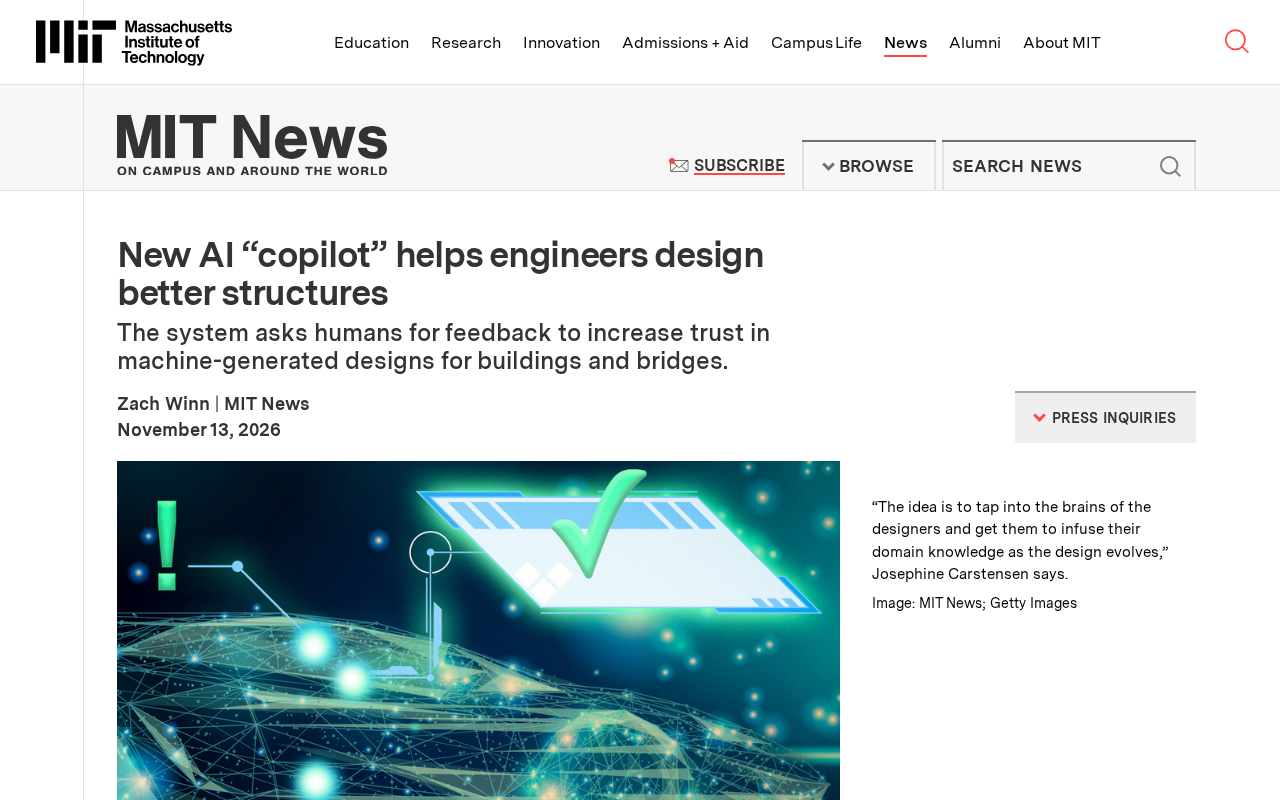
What's notable about this approach is its direction: most AI design tools pursue "less human intervention," whereas this system does the opposite, embedding human feedback into the core of the design loop.
The Feedback Loop: Writing Trust into the Design Process
Structural engineering is a field with an extremely low tolerance for error. In the force analysis of a bridge or the load paths of a building, any misjudgment can have serious consequences. Engineers' natural wariness of AI proposals is therefore not conservatism but professional instinct.
The system's response is to turn that wariness into part of the design process. After generating a structural proposal, the system requests feedback from the engineer rather than directly outputting a "black-box answer." The practical significance of this mechanism is that engineers are no longer passive reviewers of a proposal but collaborators who continuously participate in its evolution.
From a human-computer interaction perspective, this is the "human-in-the-loop" paradigm being implemented in engineering. Its value lies not only in improving proposal quality but also in enabling engineers to gradually build a basis for judging AI output—trust comes from understanding, not blind acceptance.
Human-in-the-loop (HITL) is a core paradigm in artificial intelligence and machine learning, referring to retaining human participation in a system's decision-making or generation process so that humans can provide annotations, corrections, preference feedback, or final confirmation. Unlike the fully automated "human-out-of-the-loop" mode, HITL emphasizes human-machine collaboration: machines handle large-scale generation and computation, while humans handle judgment, correction, and value trade-offs. The concept was first widely applied in autonomous driving, medical image diagnosis, and active learning, and its theoretical value lies in embedding human prior knowledge into model iteration, thereby mitigating data bias and improving output reliability. In the context of generative AI, HITL is often combined with preference alignment, that is, using human feedback (such as rankings or ratings in RLHF) to adjust model behavior so that its output better conforms to domain norms and user expectations. For high-risk scenarios like structural engineering, HITL is not merely a technical means but also a responsibility-allocation mechanism.
Why Structural Design Especially Needs "Explainable Collaboration"
Different industries vary greatly in their acceptance of AI. In content generation, users have a relatively high tolerance for AI output; in structural design, the feasibility of a proposal is directly linked to public safety.
The report emphasizes that the system aims to "increase trust in machine-generated designs," which precisely hits the real threshold for generative AI to enter the engineering industry. Beyond technical capability, the trust mechanism is the key variable determining whether AI can be adopted.
Having AI actively request feedback is essentially sending engineers a signal: the system does not claim to have the final answer. This stance lowers the psychological resistance to introducing AI at the organizational level and preserves room for engineers' professional judgment.
Interpretability/Explainability refers to humans' ability to understand the basis and logic by which an AI system makes a decision or generates an output. In structural design, interpretability is not an academic nicety but a prerequisite for engineering review and accountability. Engineers need to know why a proposal adopts a certain beam-column layout, how the load-transfer path is derived, and what assumptions the safety factors are based on, in order to judge whether it meets codes and to sign off on it. Even if a black-box model outputs a seemingly reasonable proposal, it will struggle to pass internal review and external approval if it cannot explain its reasoning process. Current research on the interpretability of generative AI falls roughly into two categories: post-hoc explanation (such as saliency maps and attention visualization) and intrinsic interpretability (such as rule-based or physics-constrained models). The ideal path for engineering AI is to embed domain knowledge (such as mechanics principles and design codes) into the model as constraints, so that generated results carry a traceable chain of logic and "trust" is built on verifiable evidence rather than blind faith in model performance.
The Paradigm Shift from "Generation" to "Co-creation"
Most current AI design tools concentrate their capabilities at the generation stage: given constraints, output candidate proposals. But engineering design is an iterative process, and the merits of a proposal often become apparent only after multiple rounds of revision and evaluation.
The difference in the "copilot" positioning is that it expands AI's role from proposal generator to a collaborative partner running through the design process. Human feedback is used to adjust subsequent generation, meaning the system should in theory, as interaction deepens, better fit the needs of a specific project and the engineer's preferences.
This model also places higher demands on the AI system itself: it needs to understand the semantics of feedback, not merely receive a binary "good/bad" label. The report does not disclose specific technical implementation details, but this direction is consistent with current AI research on interactive generation and preference alignment.
Interactive Generation, unlike traditional "one-shot generation," emphasizes that a model gradually refines its output through multiple rounds of human-machine dialogue or feedback. Its technical foundations typically include conditional generative models, reinforcement learning from human feedback (RLHF), and context-based preference modeling. In engineering design, interactive generation means the system not only receives initial constraints (such as span, materials, and loads) but also understands modification suggestions raised by engineers in subsequent rounds—for example, "increase lateral stiffness" or "reduce the number of nodes"—and translates this semantic feedback into adjustments to the generation strategy. This is connected to current research on preference alignment in the large language model field: the model learns through human feedback "what kind of output is more acceptable" rather than merely imitating training data. The challenge is that engineering feedback often involves complex physical semantics and code provisions, and how to formalize it into signals the model can understand remains an open problem.
The Realistic Constraints on Deploying Engineering AI
It should be viewed soberly that there is still considerable distance between a "copilot" tool and engineering practice from a research prototype. Structural design involves complex processes such as code compliance, multi-party approval, and responsibility attribution, and the place of AI-generated proposals within these processes still needs to be clarified.
In addition, the information disclosed about the system so far is limited, and its performance in actual projects, its specific impact on design efficiency, and changes in engineers' trust after long-term use all remain to be seen. The report itself provides only a directional description, without performance data or pilot results.
Nevertheless, its core design philosophy—trading human feedback for trust—provides a reference framework for AI tools in the engineering field. In industries with low tolerance for error, the value of AI may lie not in replacing experts' judgment but in making experts' judgment more efficient and better grounded.
Related articles

Gemini 4 Neon Released: A Balance Between Frontier Intelligence and Efficient Task Execution
Google DeepMind releases Gemini 4 Neon, focused on frontier intelligence and fast end-to-end task execution. This article breaks down its benchmark performance in coding, enterprise analysis, scientific reasoning, and cybersecurity, its four thinking levels, pricing, and safety alignment data.

Is AI the Culprit Behind Global Outages? The Trust Crisis Behind the NSA and FAA Failures
Fourth major failure in five days hits NSA classified network. Microsoft blames a software bug, FAA denies its new AI system, NSA says routine maintenance. Senator Warner suggests AI accelerates vulnerability discovery, leading to rushed fixes — while 39% of Americans already view AI negatively, exposing a deepening trust crisis.

Robot Developer Builds Custom B-rep Kernel with 3,487 Tests
A robot developer builds a custom B-rep geometry kernel with 3,487 tests, exploring why robotics needs dedicated CAD tools and the barriers to building one.