How Banks and Insurers Deploy LLMs in Production: Compliance Auditing Is the Critical Hurdle

Financial institutions must prove audit trails, PII redaction, and access controls before deploying LLMs in production.
A real insurance company LLM pilot reveals the core logic of AI adoption in regulated industries: governance comes before model performance. Compliance teams require three non-negotiable conditions — complete audit trails, PII redaction before data reaches the model, and per-team access controls. Organizations face a dilemma: Azure AI Foundry offers low friction via Microsoft's existing ecosystem but risks vendor lock-in, while vertical compliance tools like Orqai are purpose-built but less proven. What earns compliance approval is not a single feature, but a complete, demonstrable governance framework.
The First Barrier to LLM Adoption in Financial Institutions: Compliance
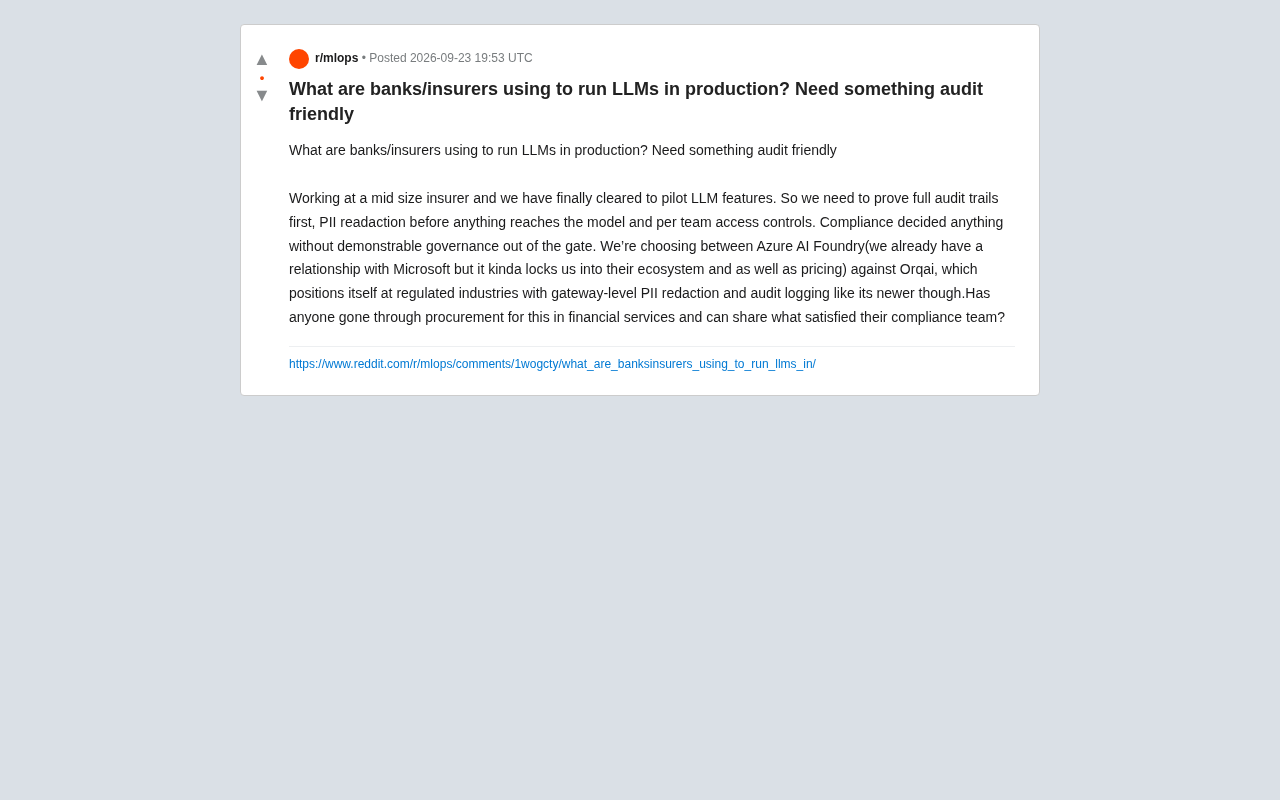
When a mid-sized insurance company finally gets approval to pilot LLM capabilities, the first question facing the technical team is rarely about model performance — it's about compliance. A financial services professional laid out this real-world dilemma on Reddit: the compliance department made it clear that any solution lacking "demonstrable governance capabilities" would be disqualified from the start.
That requirement sounds simple, but it defines the core boundaries of AI adoption in the financial industry. Unlike internet companies that operate on a "ship it and iterate" philosophy, banks and insurers must prove three things before introducing a large language model: a complete audit trail, PII redaction before data reaches the model, and per-team access controls.
In other words, whether the model performs well is secondary. The primary question is: "Can you clearly explain what it did, what it saw, and who was using it?" This is the most fundamental difference between regulated industries and ordinary enterprises when it comes to AI procurement.
Breaking Down the Three Hard Compliance Requirements
Complete Audit Trail
For banks and insurance companies, any automated decision-making system may face post-hoc regulatory review. This means every model invocation — what was input, what was returned, and who triggered it — must be traceable through logged records. Without audit logs, there's no way to account for the system to compliance teams or external auditors. The system becomes a "black box," which makes it nearly impossible to pass review in regulated environments.
The audit trail has clear regulatory backing in financial compliance contexts. In the US, SEC Rule 17a-4 requires broker-dealers to store electronic records in a tamper-proof format; the EU's MiFID II and GDPR impose mandatory requirements on the explainability of automated decision systems and data processing records. In China, the CBIRC generally requires financial institutions to retain operational logs for IT systems for no less than six months, with some scenarios requiring longer. For novel systems like LLMs, regulators care not just about whether logs exist, but whether they are immutable, whether they contain sufficient context (such as caller identity, timestamps, and input/output hash digests), and whether the log data itself is protected by access controls — otherwise the audit logs can become a data breach vector in their own right.
PII Redaction Before Data Reaches the Model
Insurance and banking operations naturally involve large volumes of personally identifiable information — ID numbers, account details, health records, and more. This sensitive data must be identified and redacted before it reaches the LLM. The original post specifically emphasized "PII redaction before anything reaches the model," noting that redaction must happen upstream in the data flow, not as a post-hoc cleanup. This is why "gateway-level redaction" has become a key selling point for solutions in this space.
PII (Personally Identifiable Information) redaction is technically implemented in two main ways: rule-based regex matching (suited for fixed-format fields like ID numbers and phone numbers) and NLP/NER model-based entity recognition (suited for sensitive information in unstructured text like names and addresses). "Gateway-level redaction" means a dedicated proxy layer identifies and replaces sensitive content before the request reaches the LLM API — for example, replacing "John Smith, ID 410***" with "[NAME], ID [ID]", so the LLM always processes redacted text. The advantage is decoupling from the model: regardless of which backend model is used, the redaction policy remains consistent. The drawback is that substitutions may affect the model's semantic understanding. In scenarios requiring precise customer information matching, an additional de-tokenization mechanism may be needed — and that de-tokenization step itself requires strict access controls, or it introduces a new security vulnerability.
Per-Team Access Controls
Different teams and roles need fine-grained management of their access to models and data. The capabilities that underwriting, claims, and customer service teams can invoke — and the data they can access — differ significantly. The granularity of permissions is directly tied to implementing the principle of data minimization.
Two Mainstream Paths: Ecosystem Lock-in vs. Vertical Compliance
The author of the original post was weighing two options that neatly represent two typical approaches financial institutions take when selecting solutions.
Azure AI Foundry: Leveraging an Existing Ecosystem
The first option is Microsoft's Azure AI Foundry. The author's company already has a relationship with Microsoft, so this path allows them to reuse existing enterprise agreements, identity systems, and procurement processes, reducing friction. But the trade-off is clear: deeper lock-in to the Microsoft ecosystem, with both the technology stack and pricing subject to a single vendor. This vendor lock-in carries risks that need careful evaluation in terms of long-term costs and negotiating leverage.
Azure AI Foundry (the integrated successor to Azure Machine Learning Studio and the Azure OpenAI Service) is Microsoft's enterprise AI development and deployment platform, offering model fine-tuning, prompt flow orchestration, content filtering, and monitoring — all deeply integrated with Azure Active Directory (Entra ID) to support role-based access control (RBAC) and conditional access policies. For financial institutions that have already purchased Microsoft 365 or Azure enterprise agreements, using Foundry means operating within an existing data processing agreement (DPA) and compliance certification framework (such as SOC 2, ISO 27001, and FedRAMP), avoiding the cost of re-running vendor security assessments. The vendor lock-in risk manifests as follows: once core business processes are tightly coupled with specific Azure APIs, the migration cost of switching platforms in the future becomes extremely high, and negotiating leverage during contract renewals diminishes accordingly.
Orqai: Positioned for Regulated Industries
The second option, Orqai, explicitly positions itself for regulated industries, with gateway-level PII redaction and audit logging as its headline features. Its advantage is that compliance capabilities are available out of the box — directly addressing the hard requirements from compliance teams. However, the author also candidly noted that such solutions are "relatively newer," and their maturity and long-term reliability still need to be validated. For conservative financial institutions, vendor stability is itself an evaluation criterion.
The Practical Realities of AI Procurement in Financial Services
This discussion reflects a dilemma common across financial institutions when procuring AI solutions: on one side is deep but reliable integration with a major vendor's ecosystem; on the other is a vertical solution with targeted features but a shorter track record.
What actually gets compliance teams to sign off is rarely a single feature — it's a complete governance framework that is demonstrable, auditable, and defensible. Technology selection is just one piece of the puzzle. Equally important is whether the vendor can provide compliance documentation, cooperate with audits, and supply supporting materials when regulators come asking.
For teams going through a similar process, several areas are worth close attention: whether redaction is implemented at the gateway or application layer; whether audit log granularity and retention periods meet regulatory requirements; whether access controls can integrate with existing enterprise identity systems; and whether the vendor has proven deployments in the financial industry.
It's worth noting that the original post was itself a request for help — the author was seeking peers to share "what solutions actually passed their compliance team's review." This illustrates that LLM deployment in the financial industry has yet to produce a standard playbook. It's largely case-by-case exploration within compliance constraints. Rather than the arms race over model capabilities, the more pressing challenge for these institutions right now is articulating and solidifying the governance framework itself.
Related articles

Workbuddy for Absolute Beginners: How a Desktop AI Agent Fits Into Real Workflows
A beginner's guide to the Workbuddy desktop AI agent: installation, claiming credits, file management, and building automated workflows—compared with CodeX for fit and cost, helping professionals shift from AI question-askers to AI managers.

OpenAI's New Agent Stack: Computer Use, Decisions API, and Ultra-Fast Workflows
OpenAI Dev Day unveiled a new agent stack: Computer Use outperforms humans, Decisions API delivers ultra-low-latency classification via Luna, Agents API opens the same Computer Use capabilities, and GPT-6.1 Sol costs only one-seventh of Astra. Core updates, benchmark data, and developer insights.

Liang Wenfeng Open-Sources DeepInfo Inference Framework, Takes On U.S. Ban
DeepSeek open-sources its DeepInfo inference framework after its models, featuring GPU/CPU cross-pipelining, small-model prediction with large-model verification, and full Huawei Ascend and NVIDIA chip support—facing the U.S. federal ban head-on. This article analyzes its significance for AI deployment and open-source strategy.