How Bug Bounties Sharpen Security Research Skills: GitHub Interviews Researcher r31n
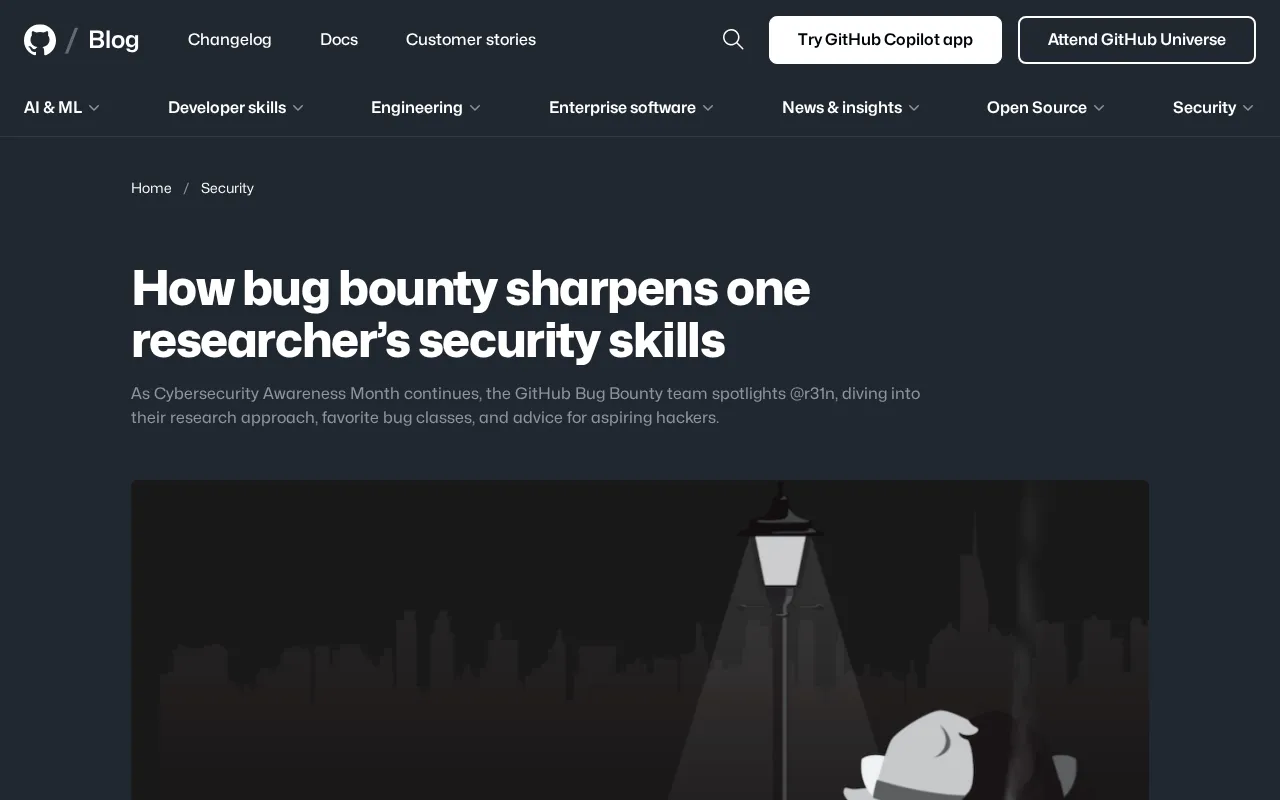
GitHub interviews bug bounty researcher @r31n on his methodology, specialization, and advice for newcomers.
During Cybersecurity Awareness Month, the GitHub Bug Bounty team interviewed researcher @r31n about his research methodology, preferred vulnerability types, and advice for newcomers. The article notes that @r31n's approach centers on hypothesis and verification in real production environments, and that bounty review and feedback mechanisms push researchers to improve report accuracy and reproduction rigor. Most successful researchers specialize in specific vulnerability types after broad exploration to produce high-value reports in a competitive market. Key advice for newcomers includes starting with authorized projects, valuing report quality and reproduction steps, and maintaining continuous learning. The article highlights the two-way value of bounty programs: companies gain an external security perspective, and researchers gain a channel for practical skill accumulation.
Bug bounties are not only a channel for companies to discover security vulnerabilities, but also a training ground for security researchers to hone practical skills. During Cybersecurity Awareness Month, the GitHub Bug Bounty team interviewed researcher @r31n about his research methodology, preferred vulnerability types, and advice for newcomers. Although the original source provides limited information, the insights revealed are worth considering for security practitioners.
Learning from Bounty Programs: A Practice-Driven Research Methodology
@r31n's research approach does not rely on a single tool or fixed process, but rather revolves around continuous hypothesis and verification focused on the target system. The real production environments offered by bug bounty programs give researchers access to complex code and configurations within authorized scope—an environment far closer to the real attack surface than local labs.
For security researchers, the feedback mechanism of bounty programs is equally critical—submitted reports are reviewed, triaged, and even challenged, a process that forces researchers to improve the accuracy of vulnerability descriptions and the rigor of reproduction steps. According to the GitHub blog, @r31n gradually established his own research rhythm through this cycle of repeated submission and revision.
Preferred Vulnerability Types and Areas of Focus
In the interview, @r31n shared his preferred vulnerability categories. Although the original material does not elaborate on specific technical details, this information itself reveals a reality of bounty research: most successful researchers converge on a few areas of expertise after broad exploration, developing reusable pattern recognition capabilities.
This specialization strategy is related to the competitive landscape of the bounty market. Popular projects tend to attract large numbers of researchers, and generic scanning rarely produces effective reports; by contrast, deep understanding of specific vulnerability types (such as access control flaws and logic bugs) makes it easier to locate high-value issues in complex business contexts. The GitHub security team emphasized in the blog post that understanding researchers' preferences helps project owners appreciate the diversity of the bounty ecosystem.
Broken Access Control ranks first in the OWASP Top 10 and refers to a system's failure to properly restrict users to resources within their permission scope. Common forms include: horizontal privilege escalation (a regular user accessing others' data by modifying IDs), vertical privilege escalation (a low-privilege user performing administrator actions), and context-based missing authorization checks (e.g., buttons hidden only on the frontend without backend verification). These vulnerabilities are difficult for automated scanners to detect and require researchers to understand the business role model and request flow, making them more dependent on manual reasoning and more likely to yield high-value reports in complex business contexts.
Business Logic Flaws refer to defects in business process design or implementation that allow attackers to complete operations in unintended ways—for example, bypassing payment, repeatedly claiming coupons, tampering with order amounts, or skipping verification steps. Such vulnerabilities have no fixed pattern and cannot be covered by generic scanning tools; researchers must understand business rules like a product manager and construct abnormal state sequences to test system responses. This is precisely why specialization strategies are competitive in the bounty market.
Advice for Aspiring Hackers
Another focus of the interview is @r31n's advice for those interested in vulnerability hunting. Drawing on the framework of the GitHub blog post, such advice typically centers on three points: start with authorized projects, value report quality, and maintain continuous learning.
For newcomers, the most common mistakes are skipping project rules and testing directly, or providing reports without clear reproduction paths. The quality requirements of bounty platforms actually serve as a forcing mechanism—researchers must learn to think like developers and understand code intent and boundary conditions. @r31n's experience shows that bounties are not one-off transactions but a vehicle for long-term skill accumulation.
Bug bounty programs typically specify on their platform pages the scope (authorized testing scope) and out-of-scope (assets prohibited from testing), along with testing rules such as prohibiting denial-of-service attacks, prohibiting access to or modification of real user data, and prohibiting high-frequency scanning with automated tools. Only when researchers conduct testing in strict compliance with these rules are their actions protected by law and project authorization; out-of-scope testing may not only result in rejected reports but also legal risk. Therefore, before beginning any testing, newcomers should first read project policies and platform rules to confirm asset boundaries and testing restrictions.
The Value of Bounty Programs to the Security Ecosystem
GitHub chose to release this interview during Cybersecurity Awareness Month to emphasize the two-way value of bug bounty programs: companies gain an external security perspective, and researchers gain a growth path. @r31n's case shows that bounty programs are becoming a practical talent development channel for security professionals.
It should be noted, however, that this blog post is a character spotlight with limited technical detail. Readers who wish to dive deeper into specific research methods are encouraged to read it alongside other technical articles from GitHub Security Lab and publicly available bounty reports for a more complete picture.
Related articles

Coinbase Engineer: How to Determine Whether an AI Agent Can Operate Unattended
Coinbase engineer Evan Kormos shares an engineering method for judging whether an AI agent can run unattended: model processes with DAG/DCG, replace output comparison with statistical evaluation, and hand over control in three phases—supervision, sampling, and exception handling.

WorkBuddy Beginner's Guide: How AI Agents Automate Office Tasks
WorkBuddy tutorial: learn how this desktop AI agent workbench automates files, organizes data, and generates documents, compared with LLMs and Codex, plus a beginner path and cost analysis.

Doubao Work in Practice: Three Modes That Let AI Actually Get Work Done
Doubao Work practical tutorial: from chat mode to Work Mode Lite and Pro, explaining the logic for choosing among three modes with real office task demonstrations. Even complete beginners can learn to use an AI agent to handle local files, organize materials, and generate documents.