How Can LLM Agents Automate Scientific Reproduction and Robustness Analysis? A SEER Database Case Study

LLM agents reproduce 77.4% of atomic claims on SEER data and automatically test analytical robustness.
This study explores whether LLM agents can automate scientific reproduction and robustness analysis, using the US SEER cancer database as a case study. The team built the SEER-Repro benchmark with 20 published papers and decomposed conclusions into 2,190 atomic claims. The AI agent reproduced 77.4% of claims, and an analysis pipeline flagged 9.5% of fully reproduced findings with potentially impactful analytical choices for expert review. The authors position AI as an auxiliary tool for scientific review but note limitations such as incomplete reproduction rates.
Title
How Can LLM Agents Automate Scientific Reproduction and Robustness Analysis? A SEER Database Case Study
Meta Description
A new study builds the SEER-Repro benchmark, using LLM agents to automatically reproduce 2,190 atomic claims from medical papers with a 77.4% success rate, and develops an analysis pipeline to test robustness, identifying 9.5% of analytical choices that may affect conclusions.
Article Content
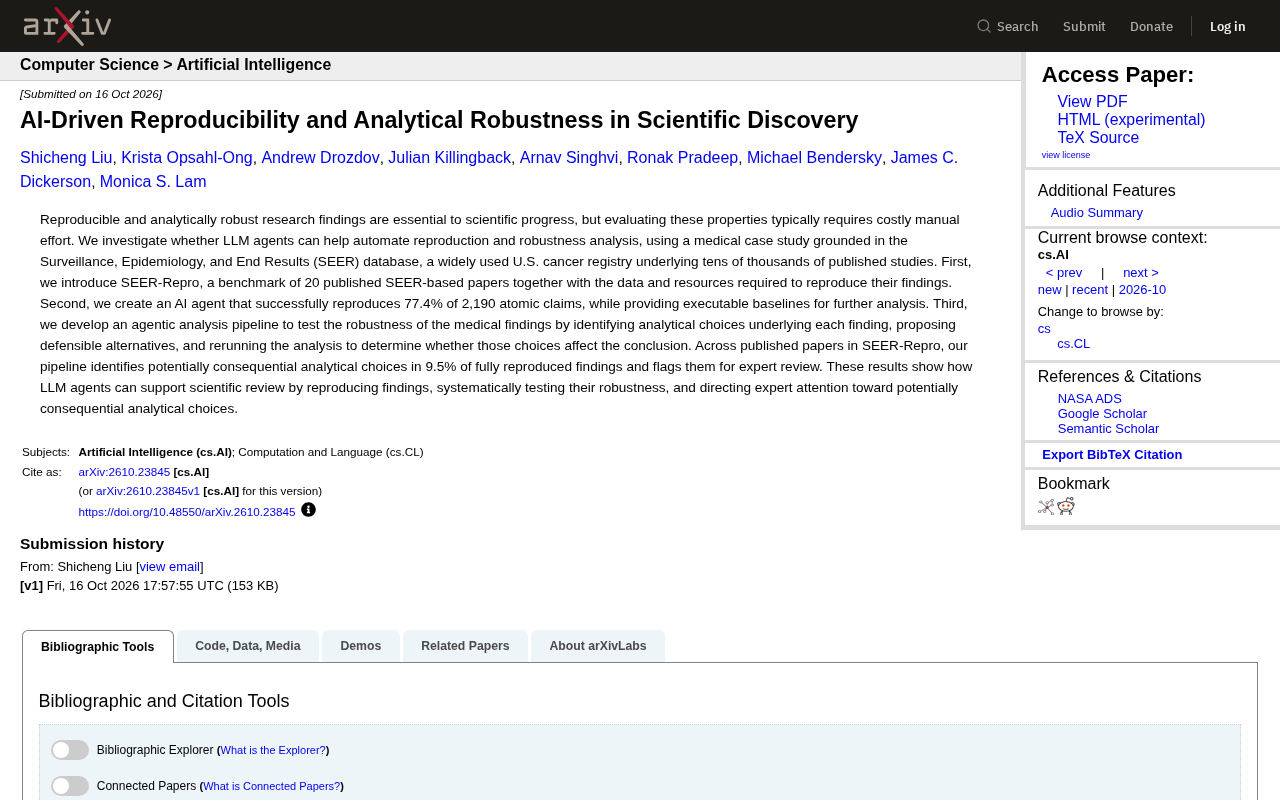
Reproducibility and analytical robustness are cornerstones of scientific progress, but manually evaluating these properties is often costly. A new study explored whether LLM agents can help automate reproduction and robustness analysis, using the US SEER cancer database as an empirical case.
Research Background: The Reproducibility Crisis and Automation Opportunities
Reproducibility is core to scientific validation, yet in fields such as medicine and social sciences, many published studies are difficult to independently reproduce. Traditionally, reproducing a study requires researchers to manually obtain data and recreate the analysis pipeline—time-consuming, labor-intensive, and dependent on expert experience. With advances in large language models (LLMs) in code generation and reasoning, a natural question arises: can LLM agents take on part of the reproduction and robustness testing work?
This study focuses on the SEER database—a cancer registry maintained by the US National Cancer Institute that underpins tens of thousands of published studies. The researchers built the SEER-Repro benchmark and developed an AI agent to reproduce atomic claims from papers, then systematically tested the robustness of analytical choices.
Reproducibility in computational science typically means: using the original authors' data and code to regenerate the main results in a paper; the adjacent concept of replicability refers to independent researchers obtaining consistent conclusions using new data. The "reproducibility crisis" often discussed in medicine and social sciences largely stems from incomplete method descriptions, limited data sharing, and analysis pipelines that rely on researchers' tacit decisions. LLM agents are seen as a potential solution because they can read methods sections, generate and debug analysis code, and iteratively correct errors—compressing manual reproduction that once took graduate students days into a batch-executable process. However, an agent's success depends heavily on the granularity of the paper's methods section and whether data can be accessed programmatically.
The SEER-Repro Benchmark: 20 Papers and 2,190 Atomic Claims
The research team first built the SEER-Repro benchmark, comprising 20 published papers based on the SEER database, along with the data and resources needed to reproduce their findings. They decomposed each paper's conclusions into "atomic claims"—indivisible specific statements—yielding a total of 2,190 atomic claims. This provides a quantifiable evaluation basis for automated reproduction.
According to the paper, the developed AI agent successfully reproduced 77.4% of the atomic claims, providing an executable baseline for subsequent analysis. This reproduction rate indicates that LLM agents already possess considerable capability in structured data analysis and code generation, but about 22.6% of claims remained unreproduced, possibly due to data access restrictions, incomplete method descriptions, or analysis complexity beyond the agent's capabilities.
Atomic claims refer to indivisible, independently verifiable specific statements in a study, such as "the five-year survival rate for patients at a certain stage is X%" or "variable A is significantly associated with outcome B after adjusting for C." Decomposing papers into atomic claims transforms the vague question "can this paper be reproduced?" into fine-grained units that can be judged true or false individually, enabling calculation of reproduction rates and localization of failure points. This approach draws on ideas from fact-checking and claim detection: once composite conclusions are broken apart, it becomes possible to distinguish which parts depend on data and which depend on model assumptions, and to facilitate independent scoring of the same claim by different agents or human reviewers. The quality of atomic claim extraction itself constitutes part of the benchmark's validity; splitting too coarsely may mask partial failures, while splitting too finely may introduce inferences not explicitly expressed in the original text.
Agent Analysis Pipeline: Identifying Key Analytical Choices
Building on reproduction, the study further developed an agent analysis pipeline to test the robustness of medical findings. The pipeline's workflow includes: identifying the analytical choices behind each finding (e.g., variable definitions, statistical models, covariate adjustments), proposing defensible alternatives, and re-running analyses to determine whether these choices affect the final conclusions.
This "multiverse"-style robustness testing approach aims to reveal which analytical decisions have a substantive impact on conclusions. Results show that among fully reproduced findings, the pipeline identified 9.5% with potentially important analytical choices, flagging these findings for expert review. This means automated robustness analysis can effectively narrow the scope experts need to focus on, concentrating limited human effort on the studies with the highest potential risk.
Multiverse analysis is a systematic framework for robustness testing: researchers enumerate a series of reasonable analytical choices from data cleaning to model specification (e.g., missing value handling, variable cutpoints, covariate sets, statistical model families), estimate results for each combination, and observe the distribution of conclusions across the "analysis universe" rather than reporting only a single path. It differs from traditional sensitivity analysis in that it simultaneously examines the joint impact of multiple decision dimensions. The agent pipeline in this study can be viewed as an automated implementation of the multiverse idea: the model identifies and generates alternative analytical choices, then re-runs them in batch. It is worth noting that interpreting multiverse analysis results depends on the reasonableness of the choice set—including unreasonable options artificially creates uncertainty, while omitting key choices underestimates fragility.
Implications and Limitations for Scientific Review
This study demonstrates the auxiliary value of LLM agents in scientific review: they can reproduce findings, systematically test robustness, and direct expert attention to analytical choices that may have important impacts. However, the authors also note limitations of the current approach—the reproduction rate is not 100%, and robustness analysis depends on accurate identification of analytical choices, which may be constrained by the level of detail in the paper's methods section.
From a broader perspective, this study provides a concrete foothold for "AI for Science": not replacing scientists, but taking on repetitive, systematic validation work so experts can focus on judgment and innovation. As LLM reasoning capabilities improve and benchmarks mature, automated reproduction and robustness analysis are expected to become routine components of the scientific publishing process.
Key Points
- The study built the SEER-Repro benchmark, containing 20 SEER papers and 2,190 atomic claims, to evaluate automated reproduction capabilities.
- LLM agents successfully reproduced 77.4% of atomic claims, demonstrating potential in structured medical data analysis.
- The agent analysis pipeline identified 9.5% of fully reproduced findings with analytical choices that may affect conclusions, flagging them for expert review.
- The approach positions AI as an auxiliary tool for scientific review, optimizing the allocation of expert resources through automated reproduction and robustness testing.
One-line Summary
LLM agents reproduce 77.4% of atomic claims on SEER data and automatically test analytical robustness.
Paragraph Summary
This study explores whether large language model agents can automate scientific reproduction and robustness analysis, using the US SEER cancer database as a case study. The team built the SEER-Repro benchmark, covering 20 published papers and the data and resources needed for reproduction, and decomposed paper conclusions into 2,190 atomic claims as quantifiable evaluation units. The developed AI agent successfully reproduced 77.4% of atomic claims, forming an executable baseline; on this basis, the agent analysis pipeline further identified the analytical choices behind each finding, proposed defensible alternatives, and re-ran analyses, flagging 9.5% of fully reproduced findings with analytical choices that may affect conclusions for expert review. The authors argue this approach can position AI as an auxiliary tool for scientific review and optimize expert attention allocation, but also note limitations such as the reproduction rate not being 100% and robustness analysis being constrained by the level of detail in methods descriptions.
Related articles

JobRunner MCP Server: AI Agents Can Now Fix Failed Java Jobs
JobRunner launches an open-source MCP server enabling AI agents to view cluster status, diagnose failures, and recover Java jobs—incident response from any cloud coding environment or existing agent.

MLAI Digital Launches 9 Security Agents: MCP Server Safeguards the Full Lifecycle of Agentic AI
MLAI Digital launches Security MCP Server with nine built-in specialized security agents covering vulnerability discovery, attack simulation, prompt injection detection, API and infrastructure assessment, and accelerated remediation—embedding security validation across the full Agentic AI lifecycle from development to production.

Running Isaac Lab on H100 GPUs: Exploring Better Approaches
Exploring optimization methods for running Isaac Lab on NVIDIA H100 GPUs, including MIG configuration, mixed precision, TensorRT acceleration, and community experience to improve robotics simulation and reinforcement learning efficiency.