How Can Test Engineers Avoid Being Replaced in the AI Era? Three Layers of Core Cognition That Determine Your Career Ceiling
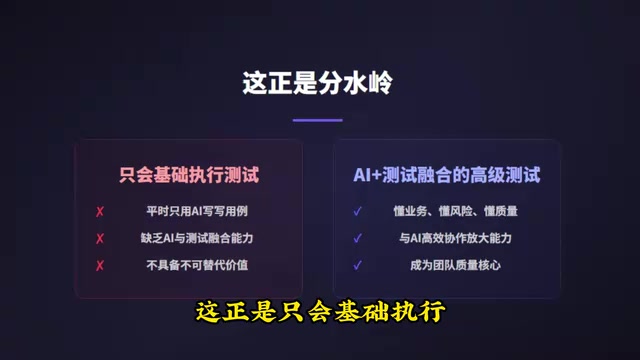
Test engineers in the AI era must transform from executors to quality owners with irreplaceable core competencies.
Through an interview scenario, this article reveals a critical dividing line in the testing industry: AI can replace basic execution work (generating cases, writing scripts, creating data) but cannot replace people who understand business, risks, and quality decisions. Test engineers should establish AI collaboration workflows, master Prompt Engineering to command AI effectively, while focusing on advancing high-level capabilities like business analysis, risk prediction, and quality system construction — upgrading from executors to quality owners.
An Interview Question That Exposes Career Awareness Gaps
A software test engineer with four years of experience was asked in an interview: "AI can write test cases, run automation, and find bugs — will test engineers be replaced?" He blurted out, "No, AI is just a tool." But when the interviewer pressed further — asking specifically what AI can and can't do, and how to build core competitiveness through transformation — he could only offer vague answers like "learn more technology, do more automation."
The interview ended right there.
This scenario reveals a critical dividing line in today's testing industry: the enormous gap between basic execution-level test engineers and senior test engineers who understand AI integration and possess irreplaceable core capabilities. This question doesn't assess tool proficiency — it evaluates career awareness, competitive thinking, and long-term development direction in an AI-driven environment.
AI's Capability Boundaries: What It Can and Can't Do
To stand firm in the AI era, you must first clearly understand AI's capability boundaries — what it excels at and where its shortcomings lie.
The Technical Nature of AI's Capabilities
Current mainstream AI testing tools (such as GitHub Copilot, Testim, Applitools, etc.) are fundamentally built on code generation and pattern recognition powered by Large Language Models (LLMs). These models are trained on massive code corpora, enabling them to identify common testing patterns and rapidly generate syntactically correct test code. However, LLMs are essentially statistical probability models — they predict "the most likely next token" rather than truly understanding business semantics. This is why AI tends to generate cases that are syntactically correct but business-invalid — it lacks genuine understanding of domain knowledge and can only simulate surface-level text patterns. Understanding this underlying mechanism is the starting point for test engineers to build correct AI cognition.
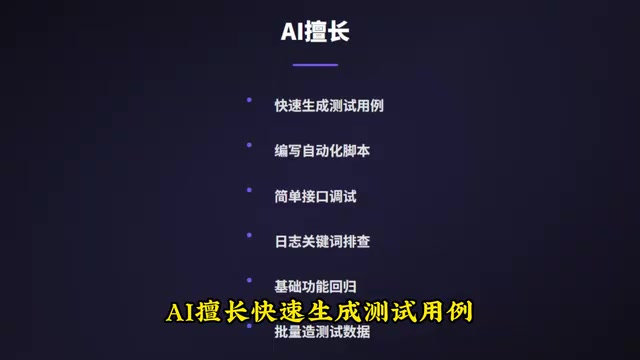
What AI Is Good At
- Rapidly generating test cases
- Writing automation scripts
- Simple API debugging
- Log keyword investigation
- Basic functional regression testing
- Batch generation of test data
What AI Cannot Do
- Doesn't understand real business logic
- Doesn't understand hidden risks
- Doesn't understand real user scenarios
- Cannot conduct requirements reviews
- Cannot control production quality
- Doesn't understand complex permission and security scenarios
- Tends to fabricate invalid test cases
- Cannot make judgment calls or decisions
Simple summary: AI can replace basic execution, but it cannot replace people who understand business, risks, and quality.
Many test engineers only worry about "AI stealing their jobs" but don't know how to leverage AI for efficiency gains — ultimately getting eliminated by those who are skilled at using AI. The real threat isn't AI itself, but peers who know how to use AI.
How Test Engineers Can Collaborate Efficiently with AI
Once AI's capability boundaries are clear, the next step is establishing a human-AI collaboration workflow.
AI Handles Repetitive Execution
- Generating initial test case drafts
- Writing automation code
- Batch creating test data
- Organizing test documentation
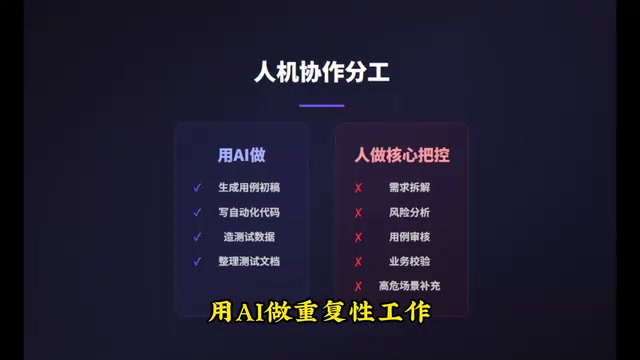
Humans Handle Core Decision-Making
- Requirements decomposition and risk analysis
- Test case review and business validation
- High-risk scenario supplementation
- Optimizing AI prompts to precisely control output quality
Key Techniques to Prevent AI Hallucination: Prompt Engineering in Practice
The key to getting reliable AI output is: Feed AI your historical bugs and business rules so it adapts to your project's business context. Behind this lies a rapidly maturing engineering discipline — Prompt Engineering — the practice of carefully designing input instructions to guide AI models toward high-quality outputs.
In testing scenarios, this means injecting structured information such as historical bug records, business rule documents, API contracts, and user stories as context into prompts, transforming AI output from generic templates into project-specific, high-quality test cases. Advanced techniques include: Few-shot examples (providing 2-3 high-quality case samples for AI to imitate), Chain-of-Thought (requiring AI to reason through test scenarios step by step), and RAG (Retrieval-Augmented Generation) technology that injects internal knowledge bases into AI context in real-time, significantly improving business relevance of generated cases. Mastering this methodology is the core skill that separates test engineers who command AI from those commanded by it.
The core principle: AI handles execution; humans handle analysis, decision-making, and driving the quality feedback loop.
Core Competitiveness Directions for Test Engineers in the AI Era
You can't just do "click-click-click" execution work anymore. Test engineers need to focus on developing these capabilities:
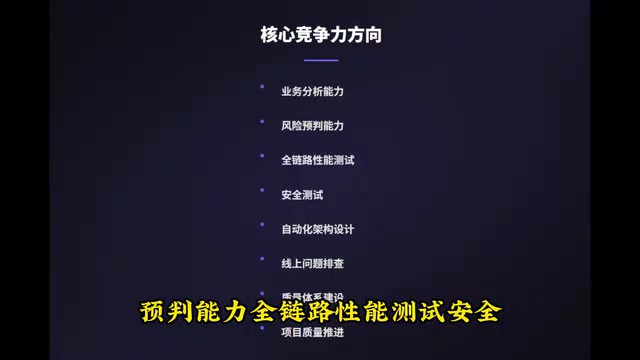
Essential Core Capabilities to Develop
- Business Analysis Ability — Deeply understand business logic and discover hidden risks that AI cannot identify
- Risk Prediction Ability — Proactively identify potential issues based on experience and business understanding
- Full-Link Performance Testing — Full-link Performance Testing originated from e-commerce industry practices for handling major promotional events, systematically proposed by Alibaba during Singles' Day preparations. Unlike traditional performance testing that stress-tests single services, full-link testing uses techniques like traffic coloring and shadow databases to simulate real user behavior in production environments, covering the complete call chain from frontend to database. This requires test engineers to possess distributed system architecture understanding, proficiency with distributed tracing tools (such as SkyWalking, Jaeger), and the ability to precisely model business peak patterns — all professional barriers requiring long-term accumulation, far beyond AI's current capabilities.
- Security Testing — Test design for complex permission and security scenarios
- Automation Architecture Design — Not just writing scripts, but designing maintainable test frameworks
- Production Issue Investigation — Rapidly locating and resolving production environment problems
- Quality System Construction — Quality Engineering is the core philosophy behind the software industry's recent shift from "testing equals finding bugs" to "quality built-in." This transformation stems from the rise of DevOps and continuous delivery — when deployment frequency increases from once a month to dozens of times per day, traditional testing models relying on manual execution can no longer support delivery cadence. Modern quality systems encompass shift-left testing (intervening at the requirements stage), shift-right testing (production monitoring and chaos engineering), test layering strategies (proper ratios of unit/integration/E2E tests), and quality metrics systems (defect escape rate, test coverage, MTTR, etc.). These systematic efforts require deep business understanding and cross-team collaboration capabilities — high-level responsibilities that AI currently cannot undertake.
- Project Quality Advancement — Cross-team collaboration to drive overall quality improvement
Future Role Positioning for Test Engineers
The core role of future testing is quality owner, not merely an executor. AI frees your hands; you're responsible for maintaining the quality baseline.
Summary: The Upgrade Path from Executor to Quality Core
What this interview question truly assesses is: Can you upgrade from a basic functional executor to a senior test engineer who understands AI tools, business risks, and possesses irreplaceable core value?
The contrast between two types of test engineers is stark:
| Ordinary Test Engineer | Senior Test Engineer |
|---|---|
| Worries about being replaced by AI | Leverages AI to amplify capabilities |
| Only does basic execution | Controls quality holistically |
| Passively learns tools | Proactively builds AI collaboration systems |
| Anxious about the future | Becomes the team's quality core |
Competition in the AI era is essentially competition at the cognitive level. Test engineers who can clearly position their value, skillfully leverage AI for efficiency, and continuously enhance their irreplaceable capabilities will not only avoid elimination — they'll become even more powerful with AI's support.
Key Takeaways
- AI can replace basic execution work (generating cases, writing scripts, creating data), but cannot replace people who understand business, risks, and quality decisions
- The efficient human-AI collaboration model for test engineers: AI handles repetitive execution, humans handle analysis, decisions, and quality control
- Core competitiveness in the AI era lies in advanced capabilities like business analysis, risk prediction, and quality system construction
- Future test engineers are positioned as quality owners, not mere executors
- The real threat isn't AI itself, but peers who know how to use AI
Related articles
 Expert Opinions
Rethinking Scaling Laws: Parameters Are Not the Only Answer
Deep analysis of Scaling Law evolution from Kaplan to Chinchilla to the MoE era, exploring why blindly stacking parameters is a mistake, and how GLM-5.3 proves scaling has multiple knobs.
When AI Treats Humans as Subagents: Ro…
When AI Treats Humans as Subagents: Role Reversal and Hidden Risks in Human-AI Collaboration
Exploring the paradigm shift where humans become "subagents" in AI Agent architectures. Analyzes human node design in LangChain and AutoGen, and the risks of ceding control and cognitive atrophy.
 Expert Opinions
The Lazy Person's Productivity Theory: Why Being 'Lazy' Actually Drives Peak Performance
Explore the engineering philosophy behind 'lazy people are most productive': how constructive laziness drives automation, AI tools amplify efficiency, and systems thinking eliminates wasted effort.