How ChatGPT Third-Party Subscription Services Work in China — and Why You Should Be Careful

How China's ChatGPT third-party subscription services work — and the security, ban, and financial risks they carry.
Because OpenAI's official payment channels are restricted for users in China, a gray market of third-party subscription services has emerged, covering ChatGPT and other AI tools like Claude. These services rely on users sharing their Session Token — a login credential equivalent to a temporary account key — allowing the platform to activate a plan without needing the account password. The article explains that Session Tokens can be used to access conversation history and account settings while valid, making them a serious security risk when shared with strangers. Additional risks include OpenAI bans triggered by irregular payment patterns, platforms disappearing with user funds, and a lack of legal protection in this regulatory gray zone. The author recommends using official payment channels or enterprise API services instead.
Observations on ChatGPT Third-Party Subscription Services in China
As ChatGPT has grown in popularity among users in China, more and more people want to activate paid plans like Plus or Pro to access more powerful models and higher usage limits. Because OpenAI's official payment channels restrict domestic Chinese credit cards and IP addresses, a large number of third-party subscription services have emerged on the market. This article is based on a tutorial from Bilibili and breaks down how these services operate, offering a technical and security-focused perspective.
Note that this article is purely informational and analytical — it does not constitute a recommendation for any subscription channel. Third-party services carry real account security and compliance risks, and readers should make their own informed decisions.
Three Common Types of Third-Party Subscription Services
Based on the source material, there are three main approaches currently used to activate ChatGPT memberships:
- Self-service via third-party website: Completing the process through an online platform — described as the most mainstream method today;
- Credit card payment: Using a credit card that supports international payments to pay directly through official channels;
- Mobile in-app purchase: Completing activation through an in-app purchase on a mobile device.
The tutorial focuses primarily on the first method — the self-service website approach. These platforms typically claim that users "don't need a credit card, don't need an overseas ID, and don't need to hand your username and password to a stranger." They usually support multiple tiers such as GPT Go (everyday chat), GPT Plus (standard plan), and GPT Pro (higher usage limits).
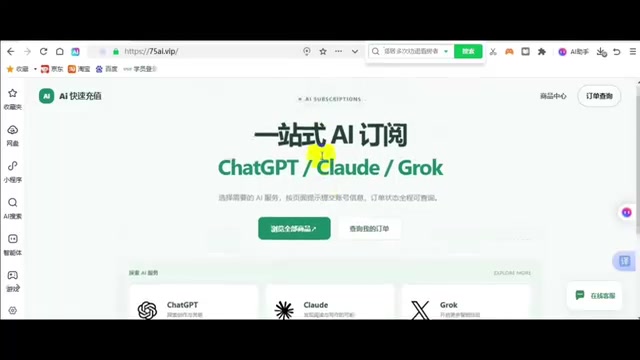
Notably, beyond ChatGPT, these platforms often offer subscription packages for other AI tools like Claude as well — forming a gray market that covers multiple mainstream AI services.
The Session Mechanism: How These Services Work Technically
The most critical — and most concerning — step in the subscription flow demonstrated in the tutorial is "obtaining your Session." The process goes like this: the user logs into their ChatGPT account in a browser, then visits a specific URL to retrieve a string of code (the Session Token), and copies and pastes that code into the third-party platform.

From a technical standpoint, a Session Token is the credential that represents your logged-in state. Once the platform has this token, it can operate your account as if it were you — completing the plan activation on your behalf. This is why these platforms claim you don't need to share your password: the Session Token is effectively a temporary key to your account.
This presents a clear security risk. While the token is valid, it can be used to access your conversation history, view linked account information, and perform other actions. Handing it to a third party essentially means relinquishing control of your account for a period of time. The tutorial makes no mention of this risk.
In web authentication systems, a Session Token is a type of "session credential." After a user completes username/password login, the server issues a time-limited token that is stored in the browser's cookies or LocalStorage. Every subsequent request from the browser includes this token, allowing the server to identify the requester without requiring the password again. In OpenAI's implementation, this token is typically formatted as a JWT (JSON Web Token), containing fields like user ID, issuance time, and expiration time — all signed with a server-side private key.
This is why a Session Token carries nearly the same security weight as a password: anyone holding a valid token can call OpenAI's API, read conversation history, modify account settings, and even change subscriptions before the token expires. Unlike a password, token leakage often goes unnoticed by the user — and changing your password doesn't necessarily invalidate tokens that have already been issued, depending on how the platform implements its auth system. Submitting your Session Token to a third party is therefore no less risky than handing over your password directly.
The Subscription Flow and Promotional Claims
As demonstrated in the tutorial, the full process is: select a plan → enter your email (for order tracking) → submit your Session Token → confirm your account → choose a payment method → submit the order. Once the platform shows "subscription successful," the user can refresh the ChatGPT page to see the Plus badge take effect.
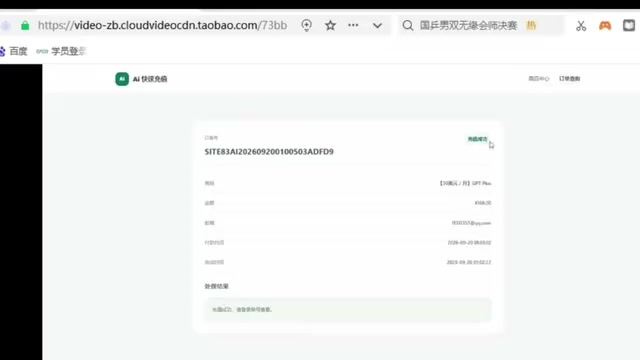
These platforms typically emphasize several selling points in their marketing: 24-hour automated fulfillment, live customer support, post-purchase service guarantees, and the ability to issue invoices. These claims are designed to lower the barrier to trust. But from a compliance standpoint, there are serious questions about where those "invoices" actually come from, and whether any "guarantee" holds up if an account gets banned.
A Realistic Assessment: The Risks Behind the Convenience
Third-party subscription services do address a genuine pain point for users in China who struggle to pay through official channels — but the cost of that convenience shouldn't be overlooked:
- Account security risk: Handing over your Session Token means your account is exposed to an unknown party for some period of time;
- Ban risk: OpenAI has risk control mechanisms targeting irregular payment behavior and account sharing. Accounts activated through third-party services can be suspended, and so-called "guarantees" may not hold up;
- Financial risk: In gray markets, prepaid-model platforms disappearing or shutting down without notice is not uncommon;
- Compliance risk: These services operate in a regulatory gray zone, leaving users with little to no legal recourse if something goes wrong.
For users who genuinely need these capabilities, the safer route is to use officially supported payment channels or legitimate enterprise API services — and to avoid handing account credentials to unknown third-party platforms whenever possible.
OpenAI's risk control system evaluates multiple signals at once: the geographic location of login IPs, the issuing country of payment cards, subscription behavior patterns, and more. When an account shows signs of rapid IP region-switching (for example, logging in from a Chinese IP but completing payment from a US IP), or when the payment method doesn't match the account's registration information, the system may trigger an automatic review or immediately suspend the subscription. Multiple waves of mass account bans in the past have been closely correlated with third-party subscription activity. Even if the initial activation succeeds and the account works normally for a while, failed renewals at the end of the billing cycle or retroactive account action are known to occur. Any "replacement guarantee" offered by these platforms ultimately depends on the platform continuing to operate — once it shuts down, those promises are worthless.
Conclusion
This tutorial reflects the real landscape of the AI subscription gray market in China: strong demand, diverse methods, polished sales tactics — and equally significant risks. Technically, the Session Token mechanism is both the core of how these services function and the root of their security vulnerabilities. Users seeking convenient access should stay clear-eyed about both account security and financial safety before proceeding.
Related articles

Felix Rieseberg Personal Homepage
Felix Rieseberg's personal homepage sparks attention on Hacker News. This article covers the Slack engineer's technical background, the rise and fall of nativefier, and the value of a developer homepage as a tech calling card.

@ai-sdk/vue 3.0.306 Patch Release Syncs with [email protected] Update
@ai-sdk/vue 3.0.306 released, synced with [email protected]. A routine patch release for the Vercel AI SDK ecosystem with no public API changes; the Vue adapter layer stays version-aligned with the core package.

Gemini 4 Argon API Launches: The Era of Million-Token Output Begins
Google launches Gemini 4 Argon with sparse MoE architecture, up to 1M output tokens, and a 68.90% Vals Index score, available across API, AI Studio, and the Gemini app.