How Claude Code Autonomously Created an Explainer Video for ~$4: An Unattended Real-World Test

Claude Code autonomously produced a full explainer video in ~2 hours for just $4, with no human intervention.
A Reddit user copied a prompt nearly verbatim and let Claude Code run unattended for roughly two hours, autonomously completing an entire explainer video pipeline: scripting, collage-style art generation, voiceover and music, frame-by-frame JavaScript Canvas animation, precise audio-animation sync, and self-review via a second model — all for about $4 on OpenRouter. The author called the result "not Pixar, but 100% usable." The case highlights how multi-model generate-and-critique workflows are maturing, how AI is collapsing content production costs, and how the human role is shifting toward prompt design.
An Unattended AI Creative Experiment
A Reddit user shared a real-world test of Claude Code's capabilities — and admitted it left him "absolutely floored." The premise was simple: after seeing a post titled "Made entirely with Opus 5.5," he wanted to know whether the workflow could be replicated. So he decided to run it himself.
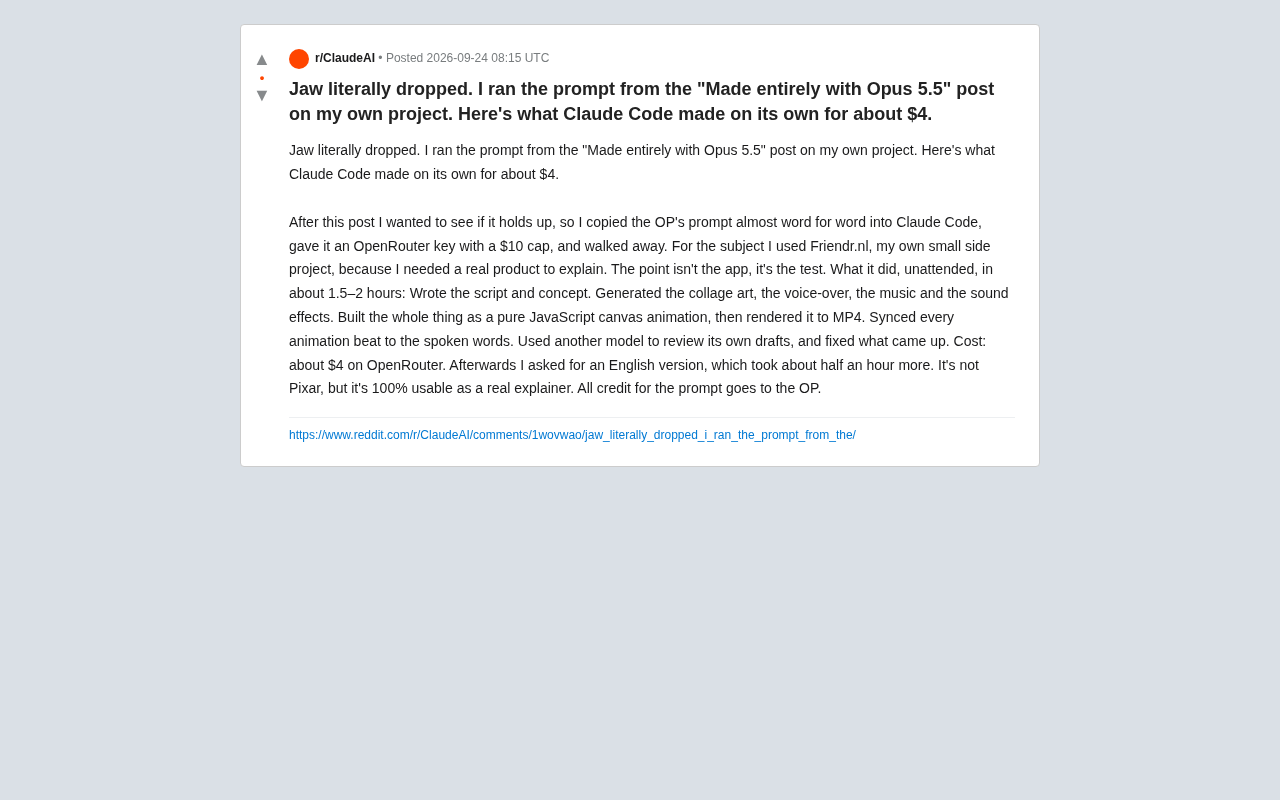
He copied the original poster's prompt nearly word-for-word, fed it into Claude Code, attached an OpenRouter API key with a $10 spending cap, and walked away — letting the AI do its thing. He chose his own small side project, Friendr.nl, as the subject: a real product to explain, not a contrived demo.
As he put it: "The point isn't the app — it's the experiment."
What the AI Accomplished in 1.5–2 Hours, Unattended
What was truly surprising was how complete the pipeline turned out to be. Over roughly 1.5 to 2 hours of unattended operation, Claude Code autonomously handled the entire video production chain — covering nearly every step from concept to final output:
- Writing the script and concept: figuring out what to say and how to say it;
- Generating collage-style visual assets: all artwork produced by the AI itself;
- Creating voiceover, music, and sound effects: the full audio layer, handled end-to-end;
- Building the entire video as a pure JavaScript canvas animation, then rendering and exporting it as an MP4;
- Syncing every animation beat to the narration line by line — the most detail-intensive step;
- Calling a second model to review its own draft, identifying issues and fixing them autonomously.
The two most technically impressive aspects: precisely aligning animation timing with speech (something that normally requires painstaking human tweaking), and the self-review mechanism — using one AI model as a quality checker for another, then iterating based on the feedback. No human intervention required throughout.
JavaScript Canvas animation refers to a 2D graphics API built on HTML5's <canvas> element, where developers use JavaScript to draw graphics, text, and images frame by frame, generating smooth animation sequences via mechanisms like requestAnimationFrame. Unlike traditional video production tools such as After Effects, canvas animations are entirely code-driven — the AI can output JavaScript files directly, with precise control over the content and timing of every frame, then export the rendered result as a standard MP4 using tools like Puppeteer or FFmpeg. This "code as animation" paradigm is precisely what enables AI to take over video production end-to-end: text, graphics, and timing all exist as structured data, which happens to be exactly what AI excels at processing and generating.
The Cost: About $4
The most attention-grabbing number in this experiment is the price. Despite the $10 spending cap, the actual cost on OpenRouter came to roughly $4. The author also requested an additional localized version after the initial run, adding about half an hour.
Put that in context against traditional content production: a product explainer video with an original script, custom artwork, voiceover, music, sound effects, and frame-synced animation would cost considerably more — in both time and money — through conventional channels. Here: four dollars, two hours, zero human intervention.
The author's assessment of the final output was measured and honest: "It's not Pixar, but as an actual explainer video, it's 100% usable." That framing captures the current positioning of this kind of autonomous AI creation — it may not reach the artistic heights of a top-tier studio, but it has clearly crossed the threshold of being genuinely deployable.
What This Case Actually Demonstrates
Setting aside the one-off nature of a single experiment, the real value here is what it reveals about how far AI Agent orchestration of complex, multi-modal tasks has come. This isn't a single-point generation of an image or a paragraph — it's a fully connected pipeline: script → visuals → audio → animation → rendering → self-review → revision, with autonomous decision-making and self-correction throughout.
A few signals worth noting:
Multi-model collaboration is becoming the norm. Having one model generate and another review — a "generate-and-critique" division of labor — meaningfully improves output reliability and is one of the hallmarks of a maturing Agent workflow.
The cost structure has been fundamentally disrupted. A marginal cost of four dollars means this kind of content can be produced at scale with a very low barrier to entry — a major advantage for indie developers and small teams.
The human role has shifted upstream. In this workflow, the human's core contribution was writing the right prompt — and the author himself credited all the success to the original poster who wrote it. Prompt quality is increasingly the critical lever that determines final output quality.
As a single community experiment, the results still need broader replication to assess reliability, and output quality will vary by project and source material. But it clearly signals a trend: AI autonomously completing end-to-end creative tasks has moved from proof-of-concept to practical reality.
OpenRouter is a unified API gateway that aggregates models from multiple AI providers — including Anthropic, OpenAI, Google, and others — so developers can access models from different vendors through a single API key and a consistent interface, paying only for actual usage. Its per-token billing model, combined with configurable spending caps, makes cost control transparent and predictable — exactly the mechanism the author used when setting his $10 limit. For Agent applications that need to coordinate multiple models within a single workflow (such as the "generation model + review model" combination in this case), OpenRouter reduces the engineering complexity of cross-model orchestration while keeping costs clearly visible.
Related articles

FastAPI: A High-Performance Python Framework and a Production-Ready API Development Powerhouse
FastAPI is a high-performance web framework based on Python type hints, supporting async and automatic OpenAPI docs. With over 100k GitHub stars, this article analyzes its core strengths, production readiness, and selection advice.

Tesla Optimus Begins Mass Production: Can the Goal of 20,000 Units Per Week Be Achieved?
Tesla Optimus officially begins mass production as Musk sets a target of 20,000 units per week. This article analyzes the supply chain challenges behind mass production, the real gap in capacity ramp-up, and the competitive landscape for humanoid robots.

PCL: A Minecraft Launcher with 8.5k Stars — Why Was It Written in VB.NET?
An in-depth analysis of PCL, the GitHub Minecraft launcher with 8,500+ stars: why it chose VB.NET, its features and China network advantages, and the limits of Windows-only.