How Close Can Humans Get to the Sun? The Science Behind Parker Solar Probe's Journey Through the Corona

Parker Solar Probe survives the million-degree corona because temperature ≠ heat — the real threat is sunlight 475× stronger than on Earth.
NASA's Parker Solar Probe flew to within roughly 3.8 million miles of the Sun's photosphere, deep into a corona reaching millions of degrees — yet it wasn't vaporized. The reason: temperature and heat are different concepts. The corona is so sparse that very little heat is actually transferred to the probe, much like hot oven air won't burn you the way a hot pan will. The real danger is sunlight — 475 times more intense than on Earth at closest approach. A carbon composite heat shield handles this, running at ~1,370°C on its sun-facing side while keeping instruments near room temperature in its shadow. As depth increases, rising particle density will eventually make any shielding strategy futile, defining the hard physical limit of how close we can get.
Flying Into the Sun's "Atmosphere"
How close can humans actually get to the Sun? The answer might surprise you — close enough to fly directly through the Sun's atmosphere. NASA's Parker Solar Probe once skimmed to within roughly 3.8 million miles above the Sun's visible surface (the photosphere), venturing deep into the corona. And the corona can reach temperatures of several million degrees.

An intuitive question immediately follows: if the surrounding environment is millions of degrees, why wasn't the probe instantly vaporized? The answer lies in a commonly misunderstood physics concept.
The corona is the outermost layer of the Sun's atmosphere, extending millions of kilometers beyond the photosphere. It's typically only visible to the naked eye during a total solar eclipse, appearing as a white halo around the Sun's edge. The corona presents a famous "heating mystery": by all logic, temperature should decrease with distance from a heat source, yet while the photosphere surface sits at around 5,500°C, temperatures in the corona paradoxically soar to 1–3 million degrees Celsius — and even higher in some regions. Scientists currently attribute this to magnetohydrodynamic processes such as Alfvén waves and magnetic reconnection. One of Parker Solar Probe's core scientific objectives is to solve this mystery through close-up measurements.
Temperature Is Not the Same as Heat
The key to Parker Solar Probe's survival in the corona lies in the fact that temperature and heat are not the same thing. Although the corona is extremely hot, it is also incredibly thin — the number of particles there is vanishingly small. Temperature measures the average kinetic energy of individual particles, while heat depends on how many particles actually transfer energy to an object.

Think of it this way: quickly passing your hand through the hot air inside an oven versus touching a scorching metal baking pan. Both are at similar temperatures, but the pan will burn you instantly while the hot air won't. The sparse particles in the corona can transfer only a very limited amount of heat to the spacecraft — so the probe doesn't get "cooked."
This phenomenon can be precisely described in thermodynamics using "heat flux." The rate of heat transfer depends not only on the temperature difference, but also on the particle density and thermal conductivity of the medium. The corona contains roughly 10⁶ to 10⁸ particles per cubic centimeter, compared to approximately 2.7×10¹⁹ molecules per cubic centimeter in Earth's atmosphere at sea level — a difference of more than ten orders of magnitude. So even though corona particles move at extremely high speeds (corresponding to extreme temperatures), very few actually collide with and heat the probe's surface, meaning the heat transferred per unit of time is minimal. This is the same principle behind vacuum insulation: a thermos keeps liquids hot precisely because the high-vacuum space between its walls dramatically cuts off heat conduction.
The Real Threat Is Sunlight
For Parker Solar Probe, the thin but scorching corona isn't actually the biggest threat — the intensity of sunlight is. At its closest approach to the Sun, the probe experiences sunlight roughly 475 times more intense than what we receive on Earth.
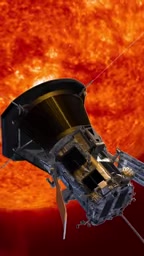
To handle this ferocious radiation, Parker Solar Probe is equipped with a heat shield made of carbon composite material. The sun-facing side of this shield can reach temperatures of about 2,500°F (approximately 1,370°C), while the spacecraft body sheltered in its shadow remains near room temperature. This clever "blazing on one side, cool on the other" design is what allows sensitive instruments to function normally in such an extreme environment.
Solar radiation intensity decreases with the square of the distance (the inverse-square law). Parker Solar Probe's perihelion is about 6.9 million kilometers from the Sun, while Earth is about 150 million kilometers away. That reduction in distance by a factor of roughly 1/21.7 means radiation intensity increases by approximately 21.7² ≈ 475 times — consistent with the figures cited here. The carbon composite Thermal Protection System (TPS), about 11.4 centimeters thick, consists of carbon foam sandwiched between two carbon-fiber panels, offering extremely low thermal conductivity and a very high melting point. The radiation flux hitting the sun-facing side is equivalent to concentrating the heat of a large household oven onto less than two square meters of surface area. Through careful thermal design, nearly all of this heat is radiated back into space rather than conducted into the spacecraft's interior.
Can We Get Even Closer?
So could our probes go even closer? In theory, yes — as long as we keep building increasingly "heroic" heat shielding and cooling systems.
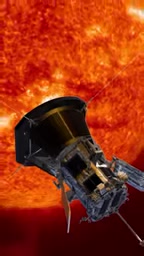
But there is a physical limit to this approach. As you venture deeper, you eventually reach the Sun's denser inner layers. There, particle density rises sharply, and the engineering strategy of "bring a better sunshade" completely breaks down — no heat shield, no matter how thick, can withstand the enormous thermal energy conducted directly by dense matter. In other words, the distance at which we can approach the Sun is not infinitely reducible; the laws of physics draw a clear red line.
The Exploration Continues
The Parker Solar Probe mission has given us our first opportunity to observe the Sun's corona up close and understand how a stellar atmosphere operates. It is both an engineering triumph and a vivid physics lesson: survival in extreme environments often comes down to whether we truly understand the subtle differences between temperature, heat, and radiation. And when it comes to the Sun, many stranger phenomena remain far from fully explained.
Related articles

Workbuddy for Absolute Beginners: How a Desktop AI Agent Fits Into Real Workflows
A beginner's guide to the Workbuddy desktop AI agent: installation, claiming credits, file management, and building automated workflows—compared with CodeX for fit and cost, helping professionals shift from AI question-askers to AI managers.

OpenAI's New Agent Stack: Computer Use, Decisions API, and Ultra-Fast Workflows
OpenAI Dev Day unveiled a new agent stack: Computer Use outperforms humans, Decisions API delivers ultra-low-latency classification via Luna, Agents API opens the same Computer Use capabilities, and GPT-6.1 Sol costs only one-seventh of Astra. Core updates, benchmark data, and developer insights.

Liang Wenfeng Open-Sources DeepInfo Inference Framework, Takes On U.S. Ban
DeepSeek open-sources its DeepInfo inference framework after its models, featuring GPU/CPU cross-pipelining, small-model prediction with large-model verification, and full Huawei Ascend and NVIDIA chip support—facing the U.S. federal ban head-on. This article analyzes its significance for AI deployment and open-source strategy.