How DeepSeek Harness Moves AI Testing from Standalone Tools to Team Platforms

DeepSeek Harness drives AI testing from personal assistants to team platforms via web services and plugins.
Based on a Bilibili livestream, this article analyzes three dilemmas of traditional AI coding assistants in testing: local-only memory, hard-to-unify Skill versions, and scattered documents causing low review efficiency. DeepSeek Harness achieves team-wide AI capabilities via unified web deployment and an 'everything is a plugin' mechanism. It also proposes a decoupled architecture: independent testing platform connected via plugins, avoiding engine lock-in. Testers' competitiveness shifts to Skill encapsulation and platform design.
In an era where AI coding assistants are everywhere, most tools remain positioned as "personal assistants": they're installed on your computer, memory is stored locally, skills are updated manually, and team collaboration is often problematic. Bilibili creator "华测教育三方老师" (a testing education channel) dissected DeepSeek Harness's plugin mechanism and web service architecture in a livestream, pointing out that this tool is pushing AI testing toward platformization.
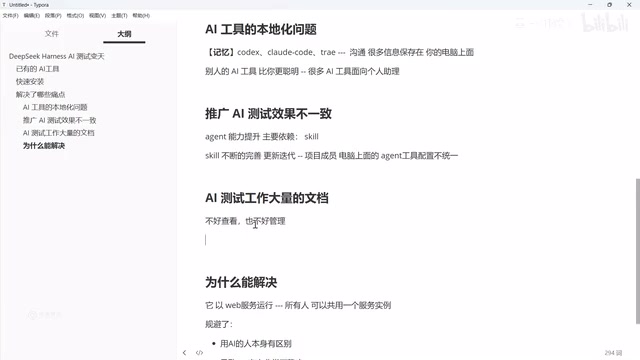
Three Dilemmas of Traditional AI Agent Tools in Testing Scenarios
Whether it's Codex, Claude Code, or WorkBody, the core logic of these tools is to serve individual users. The creator repeatedly mentioned a phenomenon during the livestream: with the same AI tool, some people use it well while others make a mess of it.
Memory and Configuration Can't Sync Across Devices
All chat records and rule files are saved on the local computer. Switch to another machine, and the AI knows nothing about your project rules, coding habits, or business context. The creator put it bluntly: "Others use it well on their computers because they've fed the AI tool a large amount of correct rules. Does your computer have these things? No."
Skill Versions Are Hard to Unify
When testing teams use AI to generate test cases and do API automation, they often rely on encapsulated Skills. But Skills need continuous iteration, and once updated, everyone must be notified to manually upgrade. Some forget to update, some fail to update without knowing, and the final output quality varies.
Skill is a key concept in the AI Agent field, referring to encapsulating the processing flow, prompt templates, tool invocation rules, and knowledge base for specific tasks into reusable capability modules. For example, an "API automation testing Skill" might include: how to parse Swagger documents, how to generate test cases, how to call Postman or Pytest to execute tests, how to assert results—the complete chain. Skill is essentially the constraint and orchestration of AI behavior, enabling AI to output stable, predictable results in specific scenarios rather than relying on users' ad-hoc descriptions each time. Precisely because of this, Skill quality directly determines AI output quality, and Skill version management becomes a core issue in team collaboration.
Generated Documents Are Scattered, Review Efficiency Is Low
AI-generated test cases and test point analysis documents are scattered in folders as Markdown or Excel files. The creator demonstrated the process of having AI generate three test cases—the files did look "presentable," but readability was poor. "AI can write tens of thousands of words in a minute. If you read through them slowly, isn't review efficiency low?"
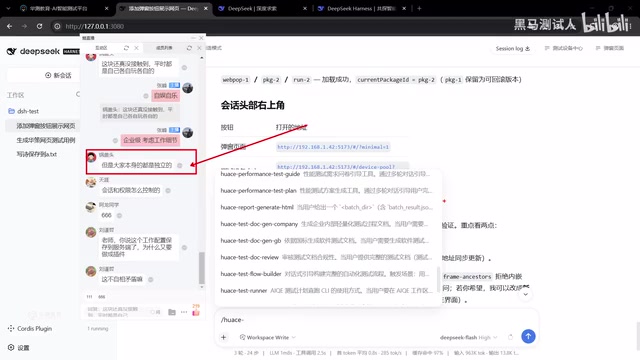
What DeepSeek Harness Changes: Web Service + Plugin Mechanism
The creator emphasized that DeepSeekAd Harness's fundamental difference from the above tools lies in two points: it runs as a web service, and everything is pluggable.
Unified Server-Side Deployment, Teams Share One Set of AI Capabilities
Once deployed on a public server, all members access the same instance through a browser. Unified models, unified Skills, unified rules. The creator did the math: update a Skill once on the server and it takes effect for everyone immediately—no need for each person to fiddle with their own environment.
Plugin Mechanism Lets the Testing Platform "Grow" on AI
The official description's "everything is a plugin" is what the creator values most. He demonstrated live how to embed a self-developed test management page, device center, and automation orchestration panel into the DeepSeek Harness interface—just describe the requirement in one sentence, and AI completes the interface integration.
"If you want to make it better, you can install plugins, or you can directly use DeepSeek Harness itself to write a plugin."
This contrasts sharply with closed extension points (only MCP and Skill) in Claude Code, Codex, and similar tools. The creator believes this openness allows test developers to seamlessly embed accumulated testing tools and platform interfaces into AI workflows.
MCP (Model Context Protocol) is an open protocol proposed by Anthropic, aimed at standardizing how AI models connect with external tools and data sources. Simply put, MCP defines an interface specification for "how AI calls external capabilities," allowing AI to securely and controllably access local files, databases, API services, and more. The "closed extension points (only MCP and Skill)" mentioned by the creator means that although tools like Claude Code and Codex support two extension methods—MCP and Skill—their extension capabilities are limited by the official interface boundaries. In contrast, DeepSeek Harness's plugin mechanism allows developers to directly modify or extend the interface layer, service layer, and even embed complete self-developed system pages, offering significantly greater flexibility.
Test Development Perspective: Decoupled Architecture Is More Pragmatic Than "Piling Features into Harness"
Many viewers asked during the livestream: since DeepSeek Harness can develop plugins itself, why not just build all testing features inside it?
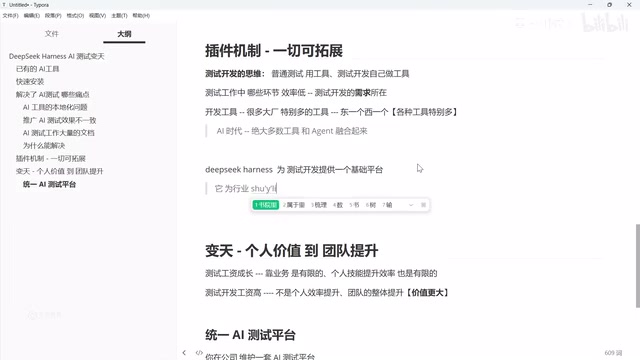
The creator's answer was clear: not recommended. The reason is that DeepSeek Harness itself is iterating rapidly. If you make extensive modifications directly on its core code, once the version upgrades, existing features may all become invalid. His proposed solution is "decoupling"—deploy the testing platform as an independent system and connect it to DeepSeek Harness through plugin integration.
The benefit of this architecture: the AI engine can be swapped at any time (Claude Code, Codex, OpenCode, or DeepSeek Harness), while core assets like test case management, test point analysis, and automation orchestration remain on your own platform, unaffected by engine upgrades.
The creator summarized this approach as "test development thinking": ordinary testers use tools; test developers, when they find tools inadequate, build their own. In the AI era, the value of this capability isn't improving personal efficiency but improving overall team efficiency.
Decoupled Architecture in software engineering refers to designing different modules of a system as low-dependency, independently evolvable structures. In the context of AI testing platforms, decoupling means separating the "AI reasoning engine" from "test asset management": the AI engine handles understanding requirements and generating content, while the testing platform handles case management, version control, review workflows, and automation orchestration. The two communicate through standard interfaces (such as MCP or plugin APIs). The core benefit is replaceability—when a better AI engine emerges, teams can switch at low cost without starting from scratch. This aligns with the "database-business logic separation" principle in microservices architecture, both reducing long-term maintenance costs by clarifying boundaries.
Practical Impact on Testing Professionals
The core viewpoint of this livestream can be summed up in one sentence: AI testing is moving from "personal assistant" to "team platform."
For individuals, knowing how to use AI to generate test cases is no longer a scarce skill. The creator was direct in the interview advice segment: "I use Claude to generate code—is that a capability? My ten-year-old daughter can just tell Claude to generate a whack-a-mole game for her." What truly sets people apart is understanding Skill encapsulation approaches, platform architecture design logic, and how to make AI output reviewable, manageable, and collaborative.
For teams, a unified AI testing platform lowers the barrier to entry, but it also means the competitive factors for entry-level testing positions are changing—those who can use the platform replace those who can't, while those who develop and maintain the platform gain greater bargaining power.
It should be noted that this article is based on a single livestream by Bilibili creator "华测教育三方老师," and any course promotion information mentioned does not represent the views of this article. The actual capability boundaries of DeepSeek Harness still need to be verified against official documentation and real projects.
Test Development differs from traditional testing roles in that traditional testing focuses on execution and defect discovery, while test development focuses on building testing infrastructure—including automation frameworks, testing platforms, and efficiency toolchains. In the AI era, this distinction becomes even more critical. The "test development thinking" mentioned by the creator is essentially tool-builder thinking: not passively using off-the-shelf AI tools, but actively designing how AI embeds into team processes, how to encapsulate Skills, and how to build reusable platform capabilities. This mindset requires practitioners to simultaneously possess testing business understanding, engineering architecture skills, and judgment about AI capability boundaries—all three are indispensable.
One-line Summary
DeepSeek Harness drives AI testing from personal assistants to team platforms through web services and plugin mechanisms.
Paragraph Summary
Based on the livestream content of Bilibili creator "华测教育三方老师," this article analyzes three major dilemmas of traditional AI coding assistants in testing scenarios: memory and configuration can't sync across devices, Skill versions are hard to unify, and scattered generated documents lead to low review efficiency. DeepSeek Harness achieves team-wide sharing of AI capabilities through unified web service deployment and an "everything is a plugin" mechanism, allowing self-developed testing platforms to be embedded into AI workflows. The creator further proposes a decoupled architecture approach: deploy the testing platform independently and connect it to AI engines through plugins, avoiding being tied to engine upgrades. The article concludes that AI testing is moving from personal assistants to team platforms, and testers' competitiveness will shift toward Skill encapsulation and platform architecture design capabilities.
Related articles

JobRunner MCP Server: AI Agents Can Now Fix Failed Java Jobs
JobRunner launches an open-source MCP server enabling AI agents to view cluster status, diagnose failures, and recover Java jobs—incident response from any cloud coding environment or existing agent.

MLAI Digital Launches 9 Security Agents: MCP Server Safeguards the Full Lifecycle of Agentic AI
MLAI Digital launches Security MCP Server with nine built-in specialized security agents covering vulnerability discovery, attack simulation, prompt injection detection, API and infrastructure assessment, and accelerated remediation—embedding security validation across the full Agentic AI lifecycle from development to production.

Running Isaac Lab on H100 GPUs: Exploring Better Approaches
Exploring optimization methods for running Isaac Lab on NVIDIA H100 GPUs, including MIG configuration, mixed precision, TensorRT acceleration, and community experience to improve robotics simulation and reinforcement learning efficiency.