How Did North Korea Become a Key Foreign Backer of Russia's War Machine? A Deep Dive from the Lex Fridman Podcast
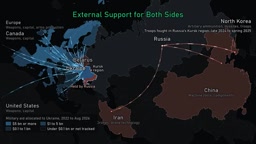
The Russia-Ukraine war of attrition hinges on foreign aid: North Korea supplies 40% of Russia's shells, Russia's economy struggles to last until 2027, and Ukraine depends on the West but is constrained by U.S. policy.
Based on military analysis from the Lex Fridman Podcast, the article breaks down the foreign support structures and economic endurance of both sides as the Russia-Ukraine war enters a phase of attrition. On Russia's side, North Korea once provided as much as 40% of its artillery ammunition and sent troops to fight in the Kursk direction, while China plays the primary role in economics, machine tools, and components; Russia directs 44% of government spending to the war, about 9%-10% of GDP, economic elites have questioned its sustainability, and military production creates no economic value, causing the economy to "slowly eat itself." Ukraine shows tenacious resistance but relies heavily on Western funding, military, and intelligence support, and is constrained by the volatility of U.S. policy. The article argues that both sides display symmetrical vulnerability, and the course of the attrition war depends on the sustainability of foreign aid and economic endurance.
The Russia-Ukraine war has entered a phase of attrition, and external support has become the key variable determining each side's staying power. In a military analysis episode of the Lex Fridman Podcast, the guest broke down in detail the foreign support structures of Russia and Ukraine, with North Korea's role drawing particular attention—at one point it supplied a substantial share of Russia's battlefield artillery ammunition and even sent troops to fight directly.
North Korea: From Ammunition Supplier to Direct Combat Participant
According to the episode, at one stage of the war, North Korea provided Russia with as much as 40% of its artillery ammunition. That share means North Korean arms supplies underpinned the firepower density of Russian forces to a significant extent. Beyond ammunition, North Korea also delivered artillery systems themselves to Russia.
Even more noteworthy is the direct involvement of North Korean troops. The episode mentioned that North Korean units fought alongside Russian forces in the Kursk direction. This marked an upgrade of North Korea's participation from logistical supply to frontline combat—limited in scale, but sending a strong political and military signal.
The guest emphasized in the analysis that Russia's external support sources are tiered: China plays the primary role in economics, machine tools, and component acquisition, North Korea comes second, and Iran's involvement is relatively lower. This layered structure reflects Russia's pragmatic strategy of building alternative supply chains under Western sanctions.
artillery in modern warfare generally refers to suppressive firepower equipment such as barrel artillery (howitzers, cannons) and multiple rocket launchers. The Russia-Ukraine conflict is widely seen as an "artillery-dominated" war of attrition, with each side firing thousands to tens of thousands of rounds per day, far exceeding Western countries' peacetime production capacity. Artillery's role is to suppress enemy positions with sustained fire, destroy fortifications, and cut off supplies, so the stability of ammunition supply directly determines frontline firepower density. North Korea inherited the Soviet-era large-scale artillery production system, with vast stockpiles and relatively low manufacturing costs, making it an important source for Russia to fill ammunition gaps under sanctions. When assessing foreign support structures, ammunition supply volumes often reflect actual battlefield impact better than equipment quantities, because ammunition is a high-frequency consumable that requires continuous replenishment.
The Two Faces of Russia's Economy: It Can Hold Out Until 2027, but Its Structure Is Deteriorating
From a resource perspective, Russia has the capacity to sustain the war until 2027. Citing data, the episode said Russia directs 44% of government spending to the war, amounting to roughly 9% to 10% of GDP. Such a high share of military spending is extremely rare in a peacetime economy.

But key economic elites began publicly stating in the spring of that year that this level of war spending was unsustainable. The guest pointed out that Russia's economy has structural chronic problems: large amounts of money flow into military production, yet military products do not create value economically. In his words, the economy is "slowly eating itself." This consumption-driven growth model supports battlefield needs in the short term but erodes the foundations of the civilian economy in the long term.
Military Keynesianism is a key concept for understanding Russia's wartime economy, referring to a policy model in which the government stimulates aggregate demand and maintains employment and output through large-scale military spending. In the short term, this model can boost GDP, lower unemployment, and keep defense enterprises running at full capacity, but it has a fundamental flaw: military products (such as shells and tanks) are consumed on the battlefield and do not re-enter the civilian reproduction cycle, creating no subsequent economic value while occupying scarce resources such as labor, capital, and components. In the long run, shifting resources from the civilian sector to the military sector squeezes consumption and investment, leading to shrinking civilian manufacturing and stalled technological upgrading, forming a distorted structure of "the more it produces, the poorer it gets." This is the economic meaning of what the episode calls an economy "slowly eating itself"—the higher the share of military spending, the more severely the long-term growth potential of the civilian economy is eroded.
Ukraine's Predicament: Battlefield Performance and the Cost of Survival
Ukraine has demonstrated tremendous will to resist, but the episode stated bluntly that without Western funding, military capability, and intelligence support, Ukraine could not have sustained the war to this day. Like Russia, Ukraine depends on external lifelines; the difference is that its support sources are more concentrated in Western countries.

The guest offered a cold judgment: no country becomes better off after hosting a conventional war on its own soil. Russia's military strategy targets Ukraine's economic viability and the sustainability of urban life, weakening its long-term resistance capacity by striking infrastructure. The war's destruction of Ukraine's economy and the outflow of population pose deeper challenges than battlefield wins or losses.

The Fragility of External Support: The Variable of U.S. Policy
One of the most candid observations in the episode is that Ukraine's dependence on external support is facing political risk. The guest noted that Ukraine is to a considerable extent subject to the policy volatility of certain countries—especially the United States. There are genuine concerns on the Ukrainian side: some people within the U.S. want to do business with Russia regardless of the impact on allies and Ukraine.
Such concerns are not unfounded. When one side's war effort is built on external aid that must be continually renewed, the donor country's political cycles and interest calculations translate directly into battlefield uncertainty. For Ukraine, the direction of the European security order is deeply bound up with the outcome of this conflict, yet its own control over that outcome is constrained by the willingness of external supporters.
The Essence of Attrition: Who Collapses First
Putting the two sides side by side, the episode presents a picture of symmetrical vulnerability. Russia can drag the war into 2027 relying on its own resources and external support, but its economic structure keeps distorting under the heavy pressure of militarization; Ukraine fights tenaciously on the battlefield but must constantly persuade partners to renew their support while bearing the cost of systematic destruction of its domestic economy.
North Korea's role is symbolic within this framework: it shows that Russia is willing and able to obtain key military resources from marginal states to make up for its own capacity gaps under sanctions. Whether this cooperation model will deepen as the war evolves, and how sustainable Western aid will be, will together determine the next phase of the war of attrition.
War of attrition is a strategic form that does not aim for rapid decisive victory; its core logic is to continuously exhaust the opponent's personnel, equipment, ammunition, and economic resources, forcing the opponent to lose the capacity or will to continue fighting before one's own side does. Unlike maneuver warfare, which emphasizes speed, surprise, and deep breakthroughs, attrition warfare tests both sides' industrial capacity, logistical supply, population mobilization potential, and the sustainability of external aid. In attrition warfare, tactical gains and losses on the battlefield often give way to calculations of "exchange ratios" and "endurance": even if one side advances slowly locally, as long as its resource replenishment outpaces consumption, it can maintain a long stalemate. The Russia-Ukraine conflict is regarded as a typical war of attrition precisely because neither side can achieve a decisive breakthrough in the short term, and the war's trajectory depends on which side's economy, society, and foreign aid system first suffer irreversible exhaustion.
Related articles
OpenAI Doubles Down on Healthcare: Cha…
OpenAI Doubles Down on Healthcare: ChatGPT Healthcare Adds Computer-Use Agents and Clinical Plugins
OpenAI updates ChatGPT for Healthcare with computer-use agents, improved clinical answers, and cross-software plugins—moving AI from answering questions to completing real clinical workflows.
How Could a Single Router Failure Cripple US Air Traffic Control?
A single router failure caused a nationwide FAA communications outage, exposing the fragility of air traffic control redundancy. We analyze the failure chain, aging systems, and what resilience really means.

Google Maps New Feature: Real-Time Itinerary Generation Turns Navigation into a Travel Assistant
Google Maps launches Ask Maps, which auto-generates multi-day itineraries from natural-language descriptions with real-time info for each stop. This article analyzes the shift from navigation to itinerary planning and its impact on travel planning products.