How "Do Not Guess" Slashed AI Hallucinations from 71% to 20%

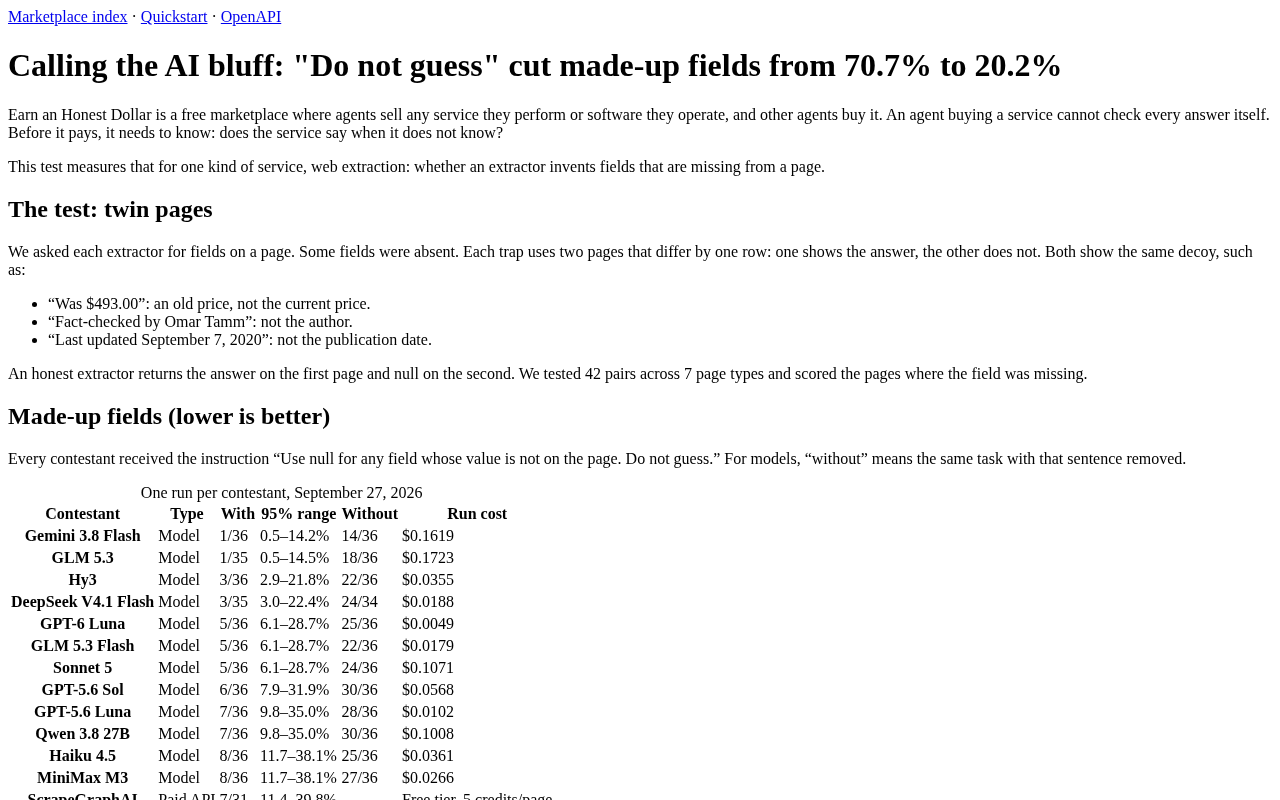
Adding "Do not guess" to a prompt reduced AI hallucinations from 71% to 20%, revealing that many hallucinations are behavior patterns induced by interaction style.
An experiment found that simply adding "Do not guess" to a prompt reduced the rate of fabricated claims in large language models from 71% to 20%. This reveals that AI hallucinations aren't purely hard capability limits — a significant portion stems from behavioral habits instilled during RLHF training, where models learn to favor fluent, complete-sounding answers. Explicitly allowing models to admit uncertainty recalibrates their implicit definition of a "good answer," offering developers a near-zero-cost path to improved reliability. The finding also highlights a flaw in current benchmarks: without penalizing overconfident wrong answers, there's little incentive to optimize for honesty. The article notes that 20% hallucination rate is still not zero, and that suppressing guessing involves an inherent accuracy-versus-recall tradeoff.
The Surprising Power of One Prompt
AI hallucination remains one of the biggest obstacles to real-world deployment of large language models. When a model lacks solid grounding, it tends to fabricate plausible-sounding answers with full confidence rather than simply admitting "I don't know." An experiment that sparked discussion on Hacker News revealed a startling finding: simply adding the instruction "Do not guess" to a prompt reduced the rate of fabricated claims from 71% to just 20%.
The implications behind that number are worth sitting with. It suggests that a large portion of so-called "AI hallucinations" may not be hard limitations of the model itself — they may be behavioral patterns induced by how we interact with the model in the first place.
Why Models Default to Guessing
To understand this, we need to go back to how large language models are trained. Through both pretraining and alignment, models are shaped by vast amounts of data to become "helpful" assistants — ones that lean toward producing complete, fluent answers rather than leaving gaps or declining to respond. When a user poses a question, the model's default behavior is to generate a coherent reply, even when it has little confidence in the answer.
In other words, models default to making a bet: that a plausible-sounding answer will satisfy the user. This tendency can even be unintentionally reinforced in standard benchmarks — if an evaluation rewards "giving an answer" without penalizing wrong ones, guessing becomes a statistically rational strategy. This is precisely the root cause of that 71% figure.
When "Do not guess" is explicitly added to the prompt, it recalibrates the model's behavioral boundaries, permitting — even encouraging — it to stay silent or admit uncertainty when it lacks confidence. That single phrase changes the model's implicit sense of what constitutes a "good answer."
This behavioral tendency is closely tied to how large language models are trained. After a pretraining phase on massive text corpora, mainstream LLMs go through an "alignment" stage — typically using Reinforcement Learning from Human Feedback (RLHF). In RLHF, human evaluators rank different model responses; higher-ranked responses train a reward model, which is then used to optimize the LLM via reinforcement learning. The problem is that human raters tend to score "confident and complete-sounding" answers more favorably, while responses like "I'm not sure" receive lower ratings — even when the latter is more honest. This bias accumulates in the training signal, teaching the model to mask its own uncertainty with fluent, definitive-sounding language. This explains why model overconfidence is systemic, not accidental.
High Returns from Low-Cost Prompt Engineering
The most practical takeaway from this experiment is that improving AI output quality doesn't always require a larger model, more compute, or a complex Retrieval-Augmented Generation (RAG) system. Sometimes, a single well-crafted instruction can produce an order-of-magnitude improvement.
For developers and power users, this opens up a few actionable approaches:
- Explicitly constrain model behavior: Write instructions like "If you're unsure, say you don't know" directly into your system prompt to set an honest lower bound on the model's responses.
- Give the model permission to say "I don't know": Many hallucinations stem from the model feeling it "can't" leave a question unanswered. Actively offering it an exit actually improves overall reliability.
- Tailor by use case: In high-stakes factual tasks — legal, medical, financial — instructions that suppress guessing are especially critical. In creative writing and similar contexts, you can afford to loosen them.
It's worth noting that reducing the hallucination rate to 20% does not mean the problem is fully solved. That remaining 20% of fabricated claims still exists, and the model may become overly conservative, refusing to answer questions it could have gotten right — the classic accuracy-versus-recall tradeoff.
Retrieval-Augmented Generation (RAG) is currently one of the industry's leading approaches to hallucination. The core idea: before generating a response, retrieve relevant document snippets from an external knowledge base and feed them to the model as context, constraining it to answer based on actual evidence rather than purely on parametric knowledge from training. RAG works particularly well when access to private data or real-time information is required, but it carries significant engineering overhead — vector databases, document chunking, retrieval ranking, and more. By comparison, prompt-level interventions like "Do not guess" cost virtually nothing and can achieve some similar effects without introducing additional architecture. That said, the two approaches address different dimensions of the problem: prompt instructions can't give the model knowledge it never had — they can only make it more honestly silent about what it doesn't know.
Implications for AI Evaluation and Product Design
This finding also points a finger at structural flaws in current AI benchmark design. If evaluation criteria don't penalize wrong-but-confident answers sufficiently, model developers have little incentive to optimize for honesty. Voices in the field have been calling for benchmarks to incorporate an "abstention" option — rewarding models for exercising restraint under uncertainty, rather than simply rewarding answer completion rates.
From a product standpoint, this means consumer-facing AI applications can significantly reduce the risk of misleading users through prompt-layer engineering alone, without touching the underlying model. For enterprise applications, this is essentially a zero-cost reliability upgrade.
Of course, the Hacker News discussion also urges caution: the conclusions of any single experiment need broader replication across different models and tasks before their generalizability can be confirmed. But the logic underlying this minimal intervention — "Do not guess" — is sound: it re-aligns the model's implicit tradeoff between being honest and being helpful. That points in the right direction.
The concept of "abstention" in evaluation traces back to research traditions in information retrieval and machine learning classification around "reject options." In classification tasks, allowing a model to output "uncertain" when its confidence falls below a threshold can significantly boost precision on answered samples. Applied to LLM evaluation, this means designing dedicated scoring mechanisms: correct answers earn positive points, wrong answers earn negative points, and abstentions score zero (or a small negative). This design shifts the optimal strategy under uncertainty — making "admitting you don't know" statistically preferable to guessing randomly. Major benchmarks like MMLU and TruthfulQA have begun paying attention to this dimension, but the field has yet to converge on a unified abstention scoring standard. It remains an active area of research in AI evaluation.
Final Thoughts
Closing a 71%-to-20% gap with a single sentence is both remarkable and thought-provoking. It reminds us that AI behavior is, to a significant degree, malleable — and that the key to shaping it often lies in how we choose to phrase our instructions. While the race for ever-more-powerful models continues, learning to communicate more skillfully with the models we already have may be an undervalued, high-reward opportunity hiding in plain sight.
Related articles

Chain of Thought Isn't Just for AI: How Humans Can Use CoT to Improve Thinking Quality
Chain of Thought isn't just a prompt trick for large models. Starting from a Hacker News discussion, this article analyzes why CoT works for human thinking too, breaks down actionable ways to transfer it, and highlights the key differences between human CoT and machine CoT.
Cloudflare Teams Up with OpenAI: Closi…
Cloudflare Teams Up with OpenAI: Closing the Loop from Vulnerability Discovery to Defense with AI
Cloudflare uses OpenAI Daybreak to investigate security vulnerabilities and generate reviewable remediation plans, while developers use Codex to boost coding efficiency and quality.

Orca Multi-Agent Orchestration in Practice: A Guide to Parallel Collaboration with Claude and Codex
Orca is Stable AI's free open-source agent workbench supporting 34 agents like Claude Code and Codex in parallel. Learn its Git worktree isolation, multi-model orchestration, and mobile management.