How Do Random Feature Networks Solve Stochastic Optimal Control? New Theory Reveals Error Trade-offs

When random feature neural networks serve as feedback policies, the objective error upper bound is O(N^{-1/2}+sqrt(N(1+logN)/n)), with optimal width ~sqrt(n/log n).
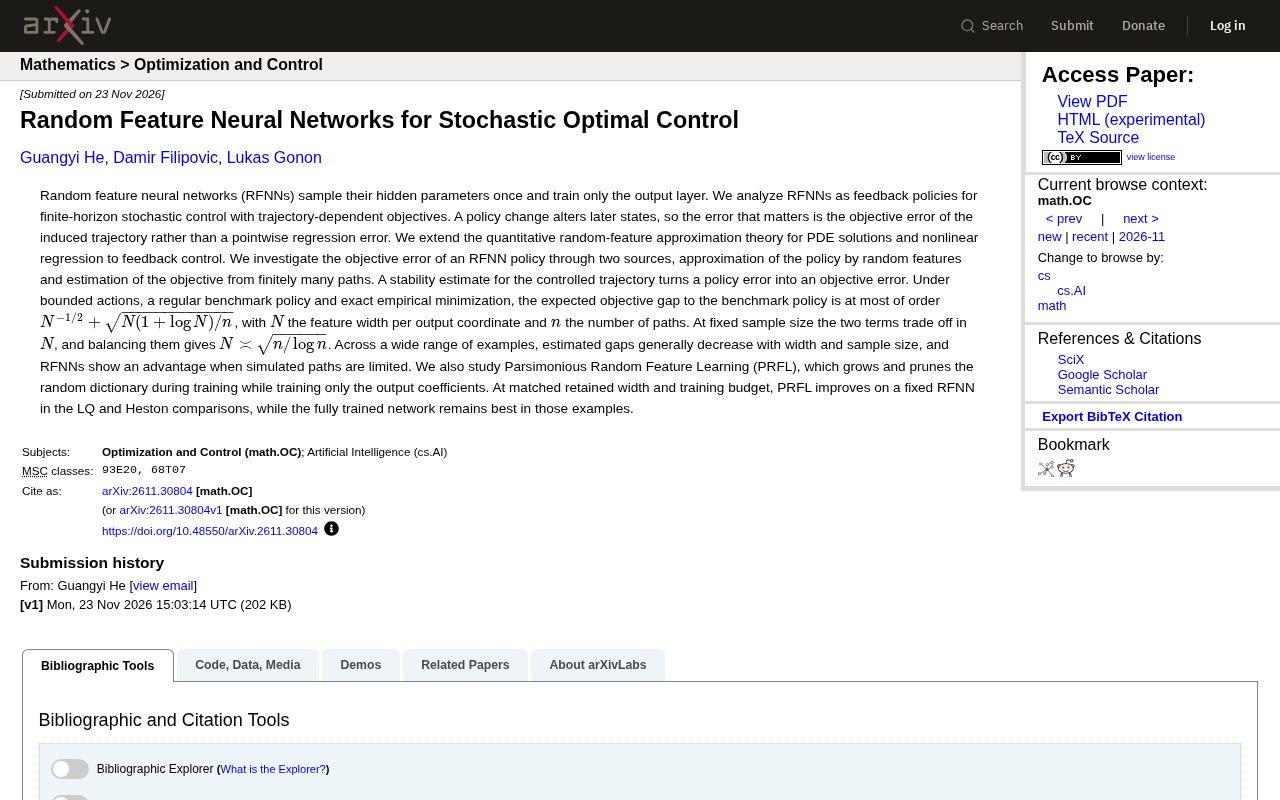
This article examines error propagation when random feature neural networks (RFNN) are used as feedback policies in stochastic optimal control. Traditional analysis focuses on regression error, but in control, policy error affects the objective through trajectories. Under bounded actions, a regular baseline policy, and exact empirical minimization, the expected objective gap is upper bounded by O(N^{-1/2} + sqrt(N(1+log N)/n)), where N is feature width and n is simulated paths. This reveals a trade-off: with fixed sample size, optimal width is ~sqrt(n/log n). Experiments confirm error decreases with width and sample size, and RFNN outperforms deep RL when samples are limited. Parsimonious random feature learning (PRFL) beats fixed-width RFNN in LQ and Heston models, though fully trained networks still perform best. The research offers quantitative guidance for deploying RFNN in control.
Random feature neural networks (RFNNs) have garnered attention for their training efficiency: hidden layer parameters are sampled only once, and only the output layer is trained. But when used as feedback policies to solve stochastic optimal control problems, how do errors propagate? Recent research provides quantitative answers.
From Regression Error to Policy Error: A Shift in Problem Nature
Traditional theoretical analyses of random feature networks mostly focus on function approximation or regression tasks, where error measures point-to-point prediction deviation. However, in finite-horizon stochastic control, changes in policy directly affect subsequent state trajectories, so the truly critical metric is the objective error of the induced trajectory, not the single-step regression error.
This study extends random feature approximation theory from PDE solving and nonlinear regression to feedback control scenarios, analyzing two sources of RFNN policy objective error: first, the approximation error of random features to the policy itself; second, the statistical error when estimating the objective using finite paths.
Random Feature Neural Networks (RFNN) are a class of single-hidden-layer feedforward networks where hidden layer weights and biases are randomly sampled from a fixed distribution (e.g., Gaussian) and then frozen, with only the output layer weights trained via least squares or gradient descent. This structure originates from the random features method, initially used for approximating large-scale kernel methods: inputs are projected to a high-dimensional feature space via random mapping, allowing a linear model to approximate nonlinear functions. RFNN training is highly efficient because only the linear output layer problem needs optimization, avoiding backpropagation in deep networks. In control scenarios, RFNN is used as a parameterization of feedback policies, i.e., policy π(s) = W φ(s), where φ(s) is the random feature vector and W are the output coefficients. Theoretical analysis typically focuses on how approximation error decreases with the number of features N (typical rate O(N^{-1/2})), but in closed-loop control, policy error propagates through system dynamics, requiring more refined stability analysis.
Stability Estimation: Converting Policy Error to Objective Error
To connect policy error with objective error, the authors introduce a stability estimate for controlled trajectories. Under assumptions of bounded actions, existence of a regular baseline policy, and exact empirical minimization, the expected objective gap of the RFNN policy relative to the baseline policy is upper bounded by:
O(N^{-1/2} + sqrt(N(1+log N)/n))
where N is the feature width per output coordinate and n is the number of simulated paths. This result clearly characterizes the trade-off between two errors: larger feature width N yields more accurate policy approximation; but with fixed path number n, increasing N exacerbates estimation error.
Empirical Risk Minimization (ERM) assumption means: given finite path samples, the output layer weights are optimized to minimize the empirical objective (or achieve global optimum). In RFNN, since the output layer is linear, this typically reduces to solving a linear least squares problem. This assumption excludes effects of optimization algorithms failing to converge or getting stuck in local optima, allowing theoretical analysis to focus on statistical and approximation errors. In stochastic optimal control, the empirical objective is usually the accumulated cost along simulated paths, so the ERM solution depends on path sample randomness. The stability estimate leverages a regular baseline policy (e.g., linear feedback or known stabilizing policy) to bound the sensitivity of trajectory cost to policy perturbations: if actions are bounded and the system satisfies certain dissipativity, trajectory deviations caused by policy error can be controlled, thereby converting the error upper bound in policy space to that in objective value. This step is the key bridge connecting approximation theory and control performance.
Balancing Optimal Width and Sample Size
Interestingly, with fixed sample size, the two errors trade off with N. By balancing them, the optimal feature width is approximately N ≍ sqrt(n/log n). This means richer path samples support larger effective feature widths.
The authors validate this trend across extensive examples: estimated objective gaps typically decrease with increasing width and sample size, and RFNN shows clear advantages when simulated paths are limited—compared to deep reinforcement learning methods requiring large interaction data, random feature policies are better suited to sample-constrained scenarios.
Pruning Strategy: Improvements and Limitations of PRFL
The study also explores Parsimonious Random Feature Learning (PRFL), which dynamically grows and prunes a random dictionary during training but only trains output coefficients. Under matched retained width and training budget, PRFL outperforms fixed-width RFNN in linear quadratic (LQ) and Heston model comparisons. However, fully trained neural networks still perform best in these examples.
This result suggests that random feature methods offer a compromise between efficiency and performance: when computational resources or sample sizes are limited, RFNN and PRFL are practical choices; when pursuing ultimate performance with sufficient resources, end-to-end trained networks still prevail.
Parsimonious Random Feature Learning (PRFL) is an adaptive dictionary construction method whose core idea is to dynamically adjust the number of random features during training: prune features with small contributions to the current task, and add new random features when the model needs stronger expressiveness. Unlike fixed-width RFNN, PRFL only trains output coefficients, but the feature dictionary size adapts to data. This mechanism resembles online dictionary learning or growing neural networks, but maintains the efficiency of linear output layer optimization. PRFL's advantage lies in avoiding manual selection of feature width N and controlling model complexity via pruning, thus reducing overfitting risk with limited samples. However, its performance is still limited by the quality of random features and the design of pruning criteria; in complex control tasks, fully end-to-end trained networks can learn task-specific feature representations and thus typically achieve lower costs. PRFL represents a compromise between computational efficiency and expressiveness.
Practical Implications
For practitioners, this theory conveys several key messages:
- Sample size determines the upper limit of feature width: Don't blindly increase the number of random features; choose a balance point based on available path count.
- RFNN is suitable for rapid prototyping and online control: The characteristic of training only the output layer makes it easy to update in dynamic environments.
- PRFL can serve as an automatic width selection tool: Through grow-and-prune mechanisms, adaptively adjust dictionary size during training, avoiding manual tuning.
This research provides a rigorous theoretical foundation for applying random feature networks in control and points out error trade-off principles for practical deployment. As stochastic optimal control finds deeper applications in finance, robotics, and other fields, such quantitative guidance will become increasingly important.
One-line Summary
When random feature neural networks serve as feedback policies, the objective error upper bound is O(N^{-1/2}+sqrt(N(1+logN)/n)), with optimal width approximately sqrt(n/log n).
Paragraph Summary
This article explores error propagation when random feature neural networks (RFNN) are used as feedback policies in stochastic optimal control. Traditional analysis focuses on regression error, but in control, policy error affects the objective through trajectories, so the key metric is the objective error of the induced trajectory. Under assumptions of bounded actions, existence of a regular baseline policy, and exact empirical minimization, the authors derive an expected objective gap upper bound of O(N^{-1/2} + sqrt(N(1+log N)/n)), where N is feature width and n is the number of simulated paths. This bound reveals a trade-off between approximation and statistical errors: with fixed sample size, the optimal feature width is approximately N ≍ sqrt(n/log n). Experiments verify that error decreases with increasing width and sample size, and RFNN outperforms deep reinforcement learning when samples are limited. Additionally, parsimonious random feature learning (PRFL) outperforms fixed-width RFNN in linear quadratic and Heston models, but fully trained networks still perform best. The research provides quantitative guidance for deploying RFNN in control.
Related articles

From 0 to 1: Vibe Coding an AI Knowledge Base — A Practical Retrospective and Tech Stack Breakdown
A retrospective on building the AI knowledge base OilBook from scratch with Vibe Coding: Next.js+Neon stack, Oil Dev Skill workflow, Stripe paywall security, interview-style writing, AI-flavor control, and Vercel deployment.

GLM-5.4 Hands-On: Native Vision Meets a New Vibe Coding Workflow
Hands-on with Zhipu GLM-5.4: native vision tested across a 3D product demo, pure-code video generation, and remote-control Vibe Coding, compared with GPT-6.2 and Gemini Neon.

AI and Humans Claim to Prove the Riemann Hypothesis: Machine-Verified, Yet Nobody Can Understand It
Anthropic mathematician and AI Claude claim to prove the Riemann Hypothesis with 17 million lines of Lean code, machine-verified but unreadable by humans. This article analyzes the event, the zero proportion record from 41.6% to 67.2%, and the gap between machine verification and human understanding.