How Do We Ensure Quality in AI Psychiatric Interviews? A Clinical Validation Platform Offers an Answer

InterviewPlayground uses simulated patients to benchmark AI psychiatric interview tools against clinical standards.
A new arXiv study introduces InterviewPlayground, a clinician-grounded evaluation platform that uses memory-augmented simulated patients to assess AI psychiatric intake tools. A small pilot comparing a GPT-based system with 6 clinicians found LLMs far ahead on clinical information coverage (88.0% vs 38.9%), but more prone to unsupported inferences (56.8% vs 27.8%) and significantly worse at documenting safety concerns (33.3% vs 66.7%). The study's key contribution is a practical quality assurance framework for responsibly deploying AI interview tools before they reach real patients.
As AI-assisted healthcare moves rapidly into real-world settings, psychiatric intake interviews have emerged as a particularly complex scenario for large language models (LLMs). Unlike routine physical exams, psychiatric intake relies heavily on the openness and flexibility of doctor-patient dialogue — and clinicians often adopt strikingly different interviewing styles. This raises an unresolved question: before AI interview tools ever enter the clinic, how should healthcare systems evaluate them against their own clinical standards on a routine basis?
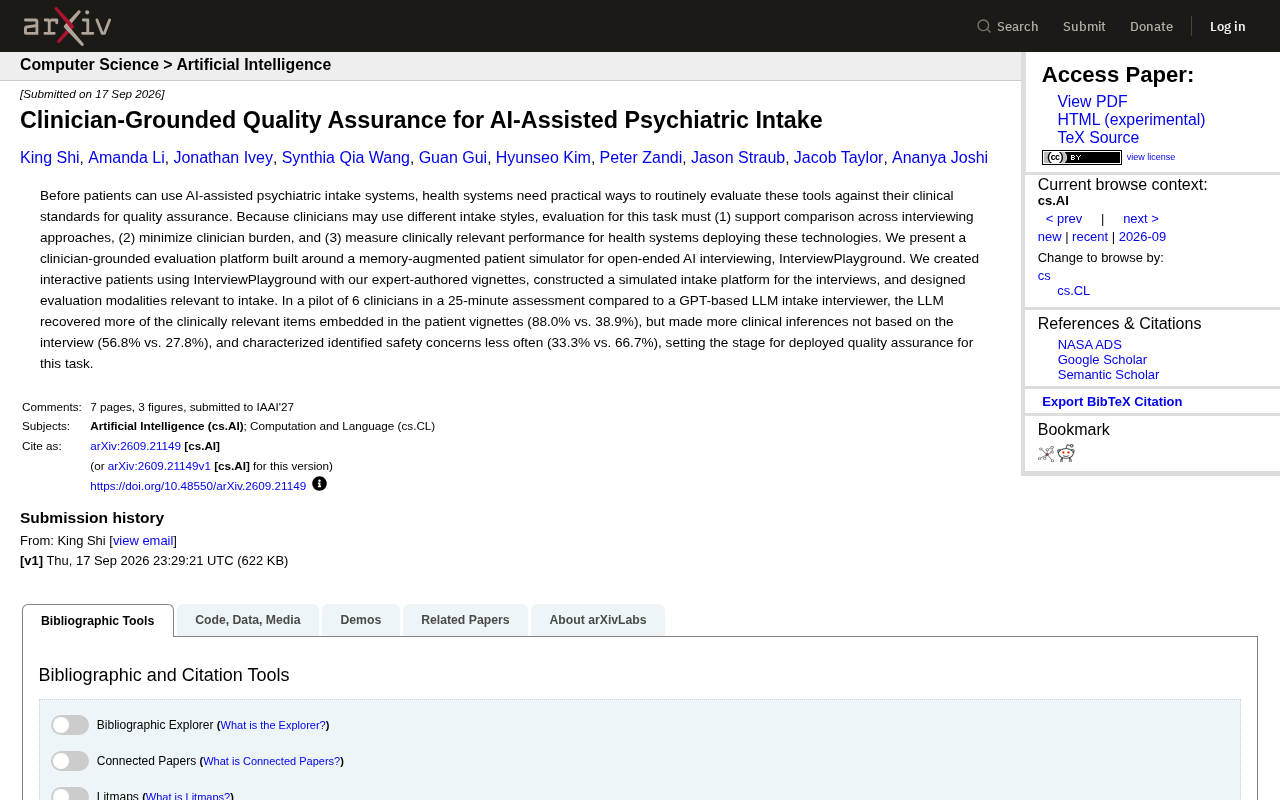
A recent study posted on arXiv (arXiv:2609.21149) attempts to answer exactly that. The research team proposes a clinician-grounded evaluation platform built around a memory-augmented patient simulator, specifically designed for open-ended AI psychiatric interview scenarios. They call it InterviewPlayground.
Why Evaluating AI in Psychiatric Interviews Is So Difficult
The core challenge lies in the unstructured nature of psychiatric intake. Within a limited time window, clinicians must use open-ended dialogue to surface a patient's underlying symptoms, risk factors, and safety concerns — and different clinicians take very different paths to get there. This means no single fixed scoring rubric can fairly evaluate an AI interview tool.
The researchers explicitly argue that any viable evaluation framework must satisfy three criteria simultaneously: it must support cross-comparison between different interviewing styles; it must minimize the burden placed on clinicians doing the evaluating; and it must measure performance indicators that are genuinely clinically meaningful to the deploying institution (i.e., the healthcare system). These requirements sound straightforward, but they cut to a real pain point — healthcare organizations simply don't have the capacity to manually review every single AI interview interaction.
Psychiatric intake has its own established clinical frameworks. Widely used structured tools include the PHQ-9 for depression screening and the Columbia Suicide Severity Rating Scale (C-SSRS) for risk assessment — but none of these instruments dictate the order in which a clinician should ask questions or how they should probe further. Unlike general medicine, psychiatrists rely on open-ended questions (e.g., "How have you been feeling lately?") to gradually build therapeutic rapport before patients will open up. This conversational openness makes traditional "compare against a model answer" scoring completely unworkable — two clinicians can follow entirely different interview paths and both arrive at high-quality clinical judgments. Designing an evaluation framework that respects this clinical diversity while still enabling quantitative comparison between AI systems is the fundamental methodological challenge in this space.
InterviewPlayground: Using Simulated Patients as a Quality Check
The technical centerpiece of this research is a memory-augmented patient simulator. The team used expert-authored clinical vignettes to build interactive "simulated patients" within InterviewPlayground, then constructed a simulated interview environment to host real interview sessions. The "memory-augmented" aspect means the simulated patient maintains a consistent medical history and state memory throughout the conversation — more faithfully recreating the conditions of an open-ended clinical interview, so that both AI interviewers and human clinicians face the same "patient" during evaluation.
The elegance of this design is that it transforms evaluation from "manual post-hoc review" into "standardized scenario-based testing." Because each simulated patient's vignette contains a predefined set of clinically relevant information items, evaluators can directly check whether the interview successfully elicited those key details — enabling quantifiable, comparable scoring.
Clinical vignettes are a well-established tool in medical education and research, typically authored by experts and containing structured information including demographics, chief complaint, symptom descriptions, medical history, and risk factors. Traditionally, they serve medical student assessments or clinical decision research. Converting them into interactive "simulated patients" is a technical challenge: the system must dynamically generate vignette-consistent responses to any question while maintaining coherent "memory" across the conversation — for example, a patient cannot claim "I've never had suicidal thoughts" early in the interview and then describe a specific suicide plan later on. The memory-augmentation mechanism addresses precisely this consistency problem, typically implemented through structured case-state tracking or dedicated context management modules, ensuring that simulated patient behavior is both realistic and reproducible.
Pilot Results: LLMs Have Real Strengths — and Clear Weaknesses
The research team conducted a small-scale pilot comparing 6 clinicians against a GPT-based LLM interview system, with each evaluation session lasting approximately 25 minutes. The results paint a picture of genuine trade-offs.
On information completeness, the LLM performed impressively. It successfully elicited 88.0% of the clinically relevant items embedded in the case vignettes, compared to just 38.9% for human clinicians. This is a substantial gap, suggesting that LLMs have a natural advantage in systematically and comprehensively covering interview checklist items — they don't skip questions out of fatigue or habit.
However, the other side of the coin demands equal attention. The LLM made significantly more clinical inferences that were not grounded in interview content — 56.8% of its inferences, compared to 27.8% for clinicians. In other words, the LLM was more prone to "filling in the blanks" — drawing conclusions without conversational support. This is one of the most dangerous forms of hallucination in a medical context.
The safety dimension is even more critical. Among identified safety concerns, the LLM appropriately documented and characterized them in only 33.3% of cases, compared to 66.7% for human clinicians — twice the rate. In psychiatric intake, safety concerns often involve self-harm or suicide risk, and inadequate handling of this information can have serious consequences.
LLM hallucination in medical settings is one of the central issues in current AI safety research. In general text generation, hallucination refers to the model producing content that is factually incorrect; in the interview context, it manifests as the model inferring that a patient has a certain symptom, risk, or diagnostic tendency without any conversational basis. What makes this "over-inference" dangerous is that it can appear in clinical language that sounds entirely plausible — and if a subsequent clinician treats an AI-generated summary as an objective record and accepts unverified patient information without corroboration, the result can be misdiagnosis or inappropriate treatment decisions. This study quantifies this risk through the metric of "clinical inferences not grounded in interview content," providing an operationalizable dimension for assessing LLM clinical reliability.
Implications for Real-World AI Healthcare Deployment
The value of this research is not in declaring whether LLMs "beat" clinicians — it lies in providing a practical quality assurance framework for deploying AI interview tools responsibly. The data make one thing clear: LLMs excel at information coverage but fall significantly short on inferential restraint and safety characterization. This is precisely why AI interview tools cannot be deployed "as-is" — they need accompanying routine quality evaluation mechanisms to monitor for risky behavior.
The researchers position this work as "laying the foundation for deployment-level quality assurance for this task." From a practical standpoint, platforms like InterviewPlayground enable healthcare systems to stress-test AI tools through standardized simulated scenarios — repeatedly, before those tools ever interact with real patients — and to set their own clinical pass/fail thresholds.
One caveat: this study is a preliminary pilot involving only 6 clinicians, so the generalizability of the findings awaits validation at larger scale. But the evaluation approach it proposes — anchored in clinical vignettes, delivered through simulated patients, and measured against multi-dimensional clinical metrics — offers a pragmatic starting point for the responsible deployment of AI-assisted psychiatric interviewing.
Related articles

Python 3.15 New Feature: Is the sentinel Type Better Than None?
Python 3.15 adds the sentinel type, using named unique sentinel objects to replace None and bare object(), resolving confusion among missing values, explicit emptiness, and invalid input while avoiding type hint failures.

Deep Learning's Three Architectures and the Universal Approximation Theorem: A Complete Guide to MLPs, CNNs, and Transformers
Explaining the inductive bias differences among MLP, CNN, and Transformer, the existence meaning of the Universal Approximation Theorem (UAT), and the role of Taylor expansion in approximation analysis, while clearing up common misconceptions.

GitLab Emergency Patch Release: Analysis of Critical Security Fixes
GitLab releases critical patch 19.5.1, sparking 355 points of discussion on Hacker News. This article analyzes the background, upgrade steps for self-hosted instances, and verification points to help DevOps teams respond quickly to security updates.