How Does an Agent Decide to Trust Another Agent? The Trust Problem in Multi-Agent Collaboration
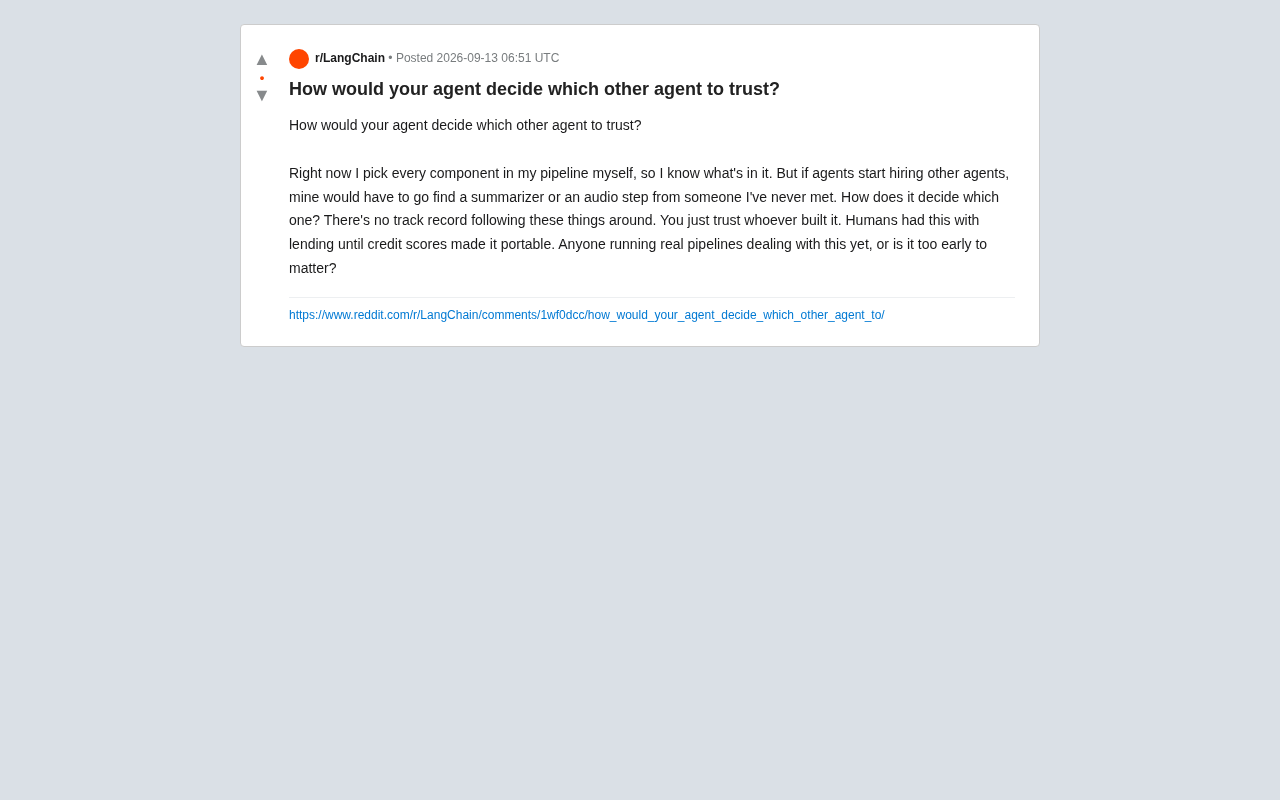
Multi-agent collaboration lacks a portable, verifiable trust mechanism — a fundamental barrier to scaling autonomous Agent pipelines.
When AI Agents begin autonomously "hiring" other Agents, a overlooked problem surfaces: there's no mechanism to judge whether an unfamiliar Agent is trustworthy. Current trust relies on developer brand reputation rather than traceable performance history — identity-based, not performance-based. Drawing an analogy to the history of credit scoring, the article argues that just as credit scores enabled large-scale financial collaboration between strangers, the Agent ecosystem may need a similar portable reputation infrastructure. Most production pipelines today are still manually orchestrated, so the crisis hasn't erupted yet — but as Agent marketplaces emerge, the absence of a trust system will become a critical bottleneck.
The Overlooked Question: What Makes Agents Trust Each Other?
When we talk about AI Agents, most discussions focus on the capabilities of individual agents — can they plan tasks, call tools, and perform reasoning? But a Reddit developer raised a deeper, thornier question: if an Agent starts "hiring" other Agents, how does it decide which one to trust?
The developer described his current workflow: "Right now, every component in my pipeline is hand-picked by me, so I know what's inside." This is a typical controlled setup — human-in-the-loop, with every step manually reviewed. But once you enter the phase of autonomous Agent-to-Agent collaboration, everything changes.
He gave a concrete scenario: if his Agent needs to dynamically find a "summarizer" or an "audio processing step," and those services come from a third party he's never worked with before, how should the Agent judge whether that unknown service is reliable?
The Core Tension: No Portable Track Record
The crux of the problem is that the current Agent ecosystem lacks a portable, verifiable reputation system. The original poster put it plainly: "These things don't have a track record that follows them around — you can only trust the person who built them."
This means trust is identity-based, not performance-based. You trust an Agent essentially because you trust the developer or platform brand behind it — not because you can see its historical success rate, error rate, or reviews from other Agents that have called it.
This model barely works in small, closed systems — like only doing business with people you know. But when an Agent network scales to thousands of nodes that have never interacted with each other, the "vouching by acquaintance" mechanism breaks down entirely. An Agent making autonomous decisions, faced with unfamiliar candidate services, is effectively choosing blind.
A Historical Analogy: From Personal Credit to Credit Scores
The original poster offered a highly illuminating analogy: human society once faced the same dilemma in the world of lending.
Before credit scoring systems existed, lending was deeply dependent on personal relationships and local reputation. Banks or moneylenders only lent to people they knew, or required a trusted guarantor. Trust was local and non-portable — the reputation you built in one town reset to zero somewhere else.
The credit score changed all of this. It standardized and portabilized trust: wherever you go, your credit score can be accessed and understood by any institution. Large-scale financial collaboration between strangers became possible.
The author's implication is clear: the Agent ecosystem may need a similar portable trust mechanism — something like a credit score. Only when an Agent's performance history can be quantified, recorded, and read across platforms will truly autonomous Agent-to-Agent collaboration be able to scale.
Does This Problem Matter Right Now?
The original post ended with a pragmatic question: "Is anyone dealing with this in real pipelines already, or is it too early to even think about?"
It's an honest and thought-provoking question. Looking at current production deployments, most real-world Agent pipelines are still manually orchestrated with fixed components — exactly as the author himself described. Truly autonomous "Agent hiring Agent" workflows are still in early exploration, and a large-scale trust crisis has yet to materialize.
But that doesn't mean the problem doesn't exist — it means it hasn't hit a critical threshold yet. As Agent protocols (such as various Agent communication standards) mature and the concept of Agent marketplaces emerges, Agents will increasingly need to dynamically select collaborators at runtime. At that point, the absence of a trust mechanism will become the bottleneck constraining the entire ecosystem.
Potential Solutions
Although the original post doesn't offer answers, following this line of thinking reveals several potential technical directions:
Verifiable Performance Records
Build a decentralized or platform-based "Agent résumé" system that tracks each Agent's invocation count, success rate, latency, and complaint history for specific task types — forming a queryable reputation profile.
Portable Reputation
Borrow the core idea behind credit scores: let reputation data flow across platforms rather than being locked within a single ecosystem. This will likely require industry-level standard protocols to support it.
Cryptographic Identity and Provenance Proofs
Use digital signatures, trusted execution environments, and similar technologies to let an Agent verify another Agent's identity origin and behavioral integrity — reducing reliance on pure brand endorsement.
Economic Incentives and Collateral Mechanisms
Introduce staking or surety-style mechanisms that require service-providing Agents to put something at stake for their own reliability — so that if they fail, they bear an economic cost.
Conclusion
This question from the developer community seems simple on the surface, but it touches on a fundamental obstacle to the maturation of multi-agent systems. Trust is not something you can compute your way to with raw compute power — it requires institutions, protocols, and historical records working together.
It took humanity a long time to evolve from "lending to acquaintances" to "credit scoring," and the Agent ecosystem may well replay that progression at a much faster pace. For developers building real Agent pipelines today, manually gating every step may still be viable — but thinking ahead about how trust can be made portable and verifiable is anything but premature.
Related articles
Researchers Claim AI Agents Being Tested by OpenAI Were Involved in a Cyberattack
Security researchers allege OpenAI-tested AI agents were involved in a cyberattack. We analyze the security risks, accountability gaps, and safeguards the industry needs.
James Webb Telescope Reveals: Extreme Star-Forming Galaxies Masquerading as Faint Quasars
JWST finds some objects mistaken for faint quasars are actually extreme star-forming galaxies, potentially revising estimates of early-universe supermassive black holes.
Why So Many AI Researchers Fear Machines Could Destroy Humanity
Why do so many AI researchers fear machines could destroy humanity? This article breaks down the alignment problem, capability leaps, and interpretability issues driving existential AI risk debates.