How Does Shared Information Determine the Limits of Multi-View Matching?
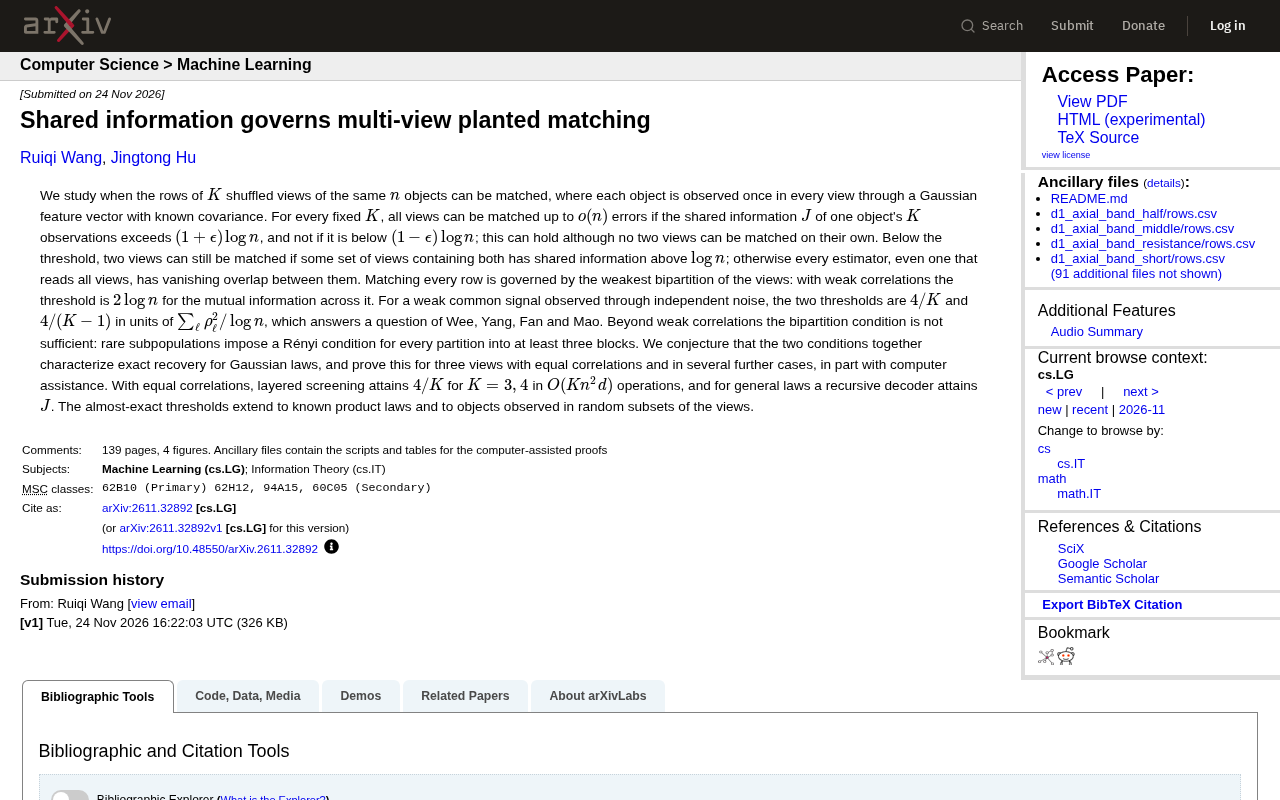
Shared information governs multi-view matching: the threshold is about log n, with weakest bipartition and Rényi conditions characterizing exact recovery limits.
This article explores multi-view planted matching: n objects observed once in each of K views, with scrambled row order and Gaussian features, aiming to recover the correct matching. Shared information J is the key quantity: above (1+ε)log n, all views can be matched with o(n) errors; below (1-ε)log n, impossible. Below the threshold, two views remain matchable if a view subset containing them has shared information above log n. The weakest bipartition sets the overall threshold (2log n under weak correlation, 4/K and 4/(K-1) for weak common signals). Beyond weak correlation, a Rényi condition is needed. Hierarchical screening achieves the 4/K threshold for K=3,4, and a recursive decoder attains the J threshold for general distributions.
Multi-view matching is a core problem in many data integration tasks. When we observe the same set of objects from different sources, can we accurately align them? A recent theoretical study provides precise threshold conditions: the amount of shared information is the key factor determining whether matching succeeds.
Problem Setup: Planted Matching Across Multiple Views
The study considers a "planted matching" model: there are (n) objects, each observed once in each of (K) views, with each observation yielding a Gaussian feature vector whose covariance matrix is known. The row order across views is scrambled, and the goal is to recover the correct matching based on the observed feature vectors. This setup abstracts the entity alignment problem in multi-source data fusion, such as matching profiles of the same group of users across different platforms.
Shared Information Determines the Matching Threshold
The core conclusions revolve around shared information (J), which measures the amount of information shared across the (K) observations of an object. For any fixed (K), when (J) exceeds ((1+\epsilon)\log n), all views can be matched with only (o(n)) errors remaining; when (J) falls below ((1-\epsilon)\log n), this is impossible. The existence of this threshold means that as long as shared information is strong enough, all views can jointly recover the matching even if no two views can be matched individually.
Partial Matching Below the Threshold
If the overall shared information is insufficient, two views may still be matchable, provided there exists a set of views containing these two whose shared information exceeds (\log n). Otherwise, any estimator—even one that reads all views—will have vanishing overlap between these two views. This shows that matching capability depends not only on the global amount of information but also on the structure of view subsets.
The Weakest Bipartition Determines Overall Matching
To match every row, the key lies in the weakest bipartition of the views. In the weakly correlated regime, the threshold is determined by the mutual information across this bipartition, which is (2\log n). For a weak common signal observed through independent noise, the two thresholds are (4/K) and (4/(K-1)), measured in units of (\sum_\ell\rho_\ell^2/\log n). This result answers the question raised by Wee, Yang, Fan, and Mao.
Beyond Weak Correlation: The Rényi Condition
When correlations exceed the weakly correlated regime, the bipartition condition alone is no longer sufficient. Rare subpopulations impose a Rényi condition on every partition into at least three blocks. The authors conjecture that these two conditions together suffice to characterize exact recovery for Gaussian distributions, and they prove this in the three-view equicorrelated case and several other settings, partly with computer assistance.
Algorithmic Implementation and Extensions
In the equicorrelated case, a hierarchical screening algorithm achieves the (4/K) threshold for (K=3,4) with computational complexity (O(Kn^2d)). For general distributions, a recursive decoder can attain the (J) threshold. These nearly exact thresholds also extend to known product distributions and to settings where objects are observed only in random subsets of views.
This research provides theoretical limits and practical algorithms for multi-view matching, offering guidance for the practice of multi-source data fusion.
One-line Summary
Multi-view matching success is determined by the amount of shared information, with a threshold around log n; the weakest bipartition and Rényi conditions characterize the exact recovery limit.
Paragraph Summary
This article studies the multi-view planted matching problem: n objects are each observed once in K views, with observations being Gaussian feature vectors with known covariance, view row orders scrambled, and the goal being to recover the correct matching. The core finding is that shared information J is the key quantity determining matching success: when J exceeds (1+ε)log n, all views can be matched with only o(n) errors; below (1-ε)log n, it is impossible. Even if no two views can be matched individually, all views jointly can still recover the matching if the joint information is sufficient. Below the threshold, two views remain matchable if there exists a set containing them whose shared information exceeds log n. Matching all rows is determined by the weakest bipartition, with threshold 2log n under weak correlation and 4/K and 4/(K-1) for weak common signals. Beyond weak correlation, an additional Rényi condition is required. Algorithmically, hierarchical screening achieves the 4/K threshold in the equicorrelated case with complexity O(Kn^2d); for general distributions, a recursive decoder attains the J threshold.
Related articles

Michael Nielsen Takes Down His Classic Neural Network Textbook, Sparking Community Discussion
Michael Nielsen's classic free textbook Neural Networks and Deep Learning has been taken offline, sparking discussion on Hacker News about the reasons and impact.

Inside the AI Training Data Market: The Trade-off Between Exclusivity and Discounts
G2i founder Gabe Greenberg reveals the dual-track pricing of the AI training data market: labs pay a premium for exclusive data or accept discounts that allow others to buy it.

SessionGraph: Unifying All Coding Agent Sessions in One Interactive Graph
SessionGraph aggregates coding agent sessions into an interactive graph, helping developers review, debug, and manage AI coding workflows across sessions. This article examines its positioning, value, and open questions.