How Does Text Grouping Distort Latency Comparisons in Simultaneous Interpretation?

Text grouping strategy changes simultaneous interpretation latency comparison conclusions depending on the synthesizer.
A study reveals that in simultaneous speech translation evaluation, text update grouping (how translated text is batched before TTS) significantly affects latency comparisons between translators, depending on the synthesizer used. Four-second grouping increased StreamAtt's average completion lead on XTTS-v2 from 106.6s to 229.1s but decreased it on Piper from 169.5s to 146.5s. The opposite effect stems from playback idle time differences. Results were reproduced across twenty speeches, and persistent CosyVoice 3 sessions showed grouping delayed completion. The study stresses that timing comparisons must specify how text enters synthesis, not just synthesizer choice.
Introduction
In Simultaneous Speech Translation systems, measuring the latency gap between different translators typically relies on the completion time of speech synthesis (TTS). However, a new study reveals an easily overlooked variable: Text Grouping—that is, how translation updates are batched into the TTS before speech synthesis. This seemingly minor engineering detail is enough to change the conclusion of latency comparisons between two translators.
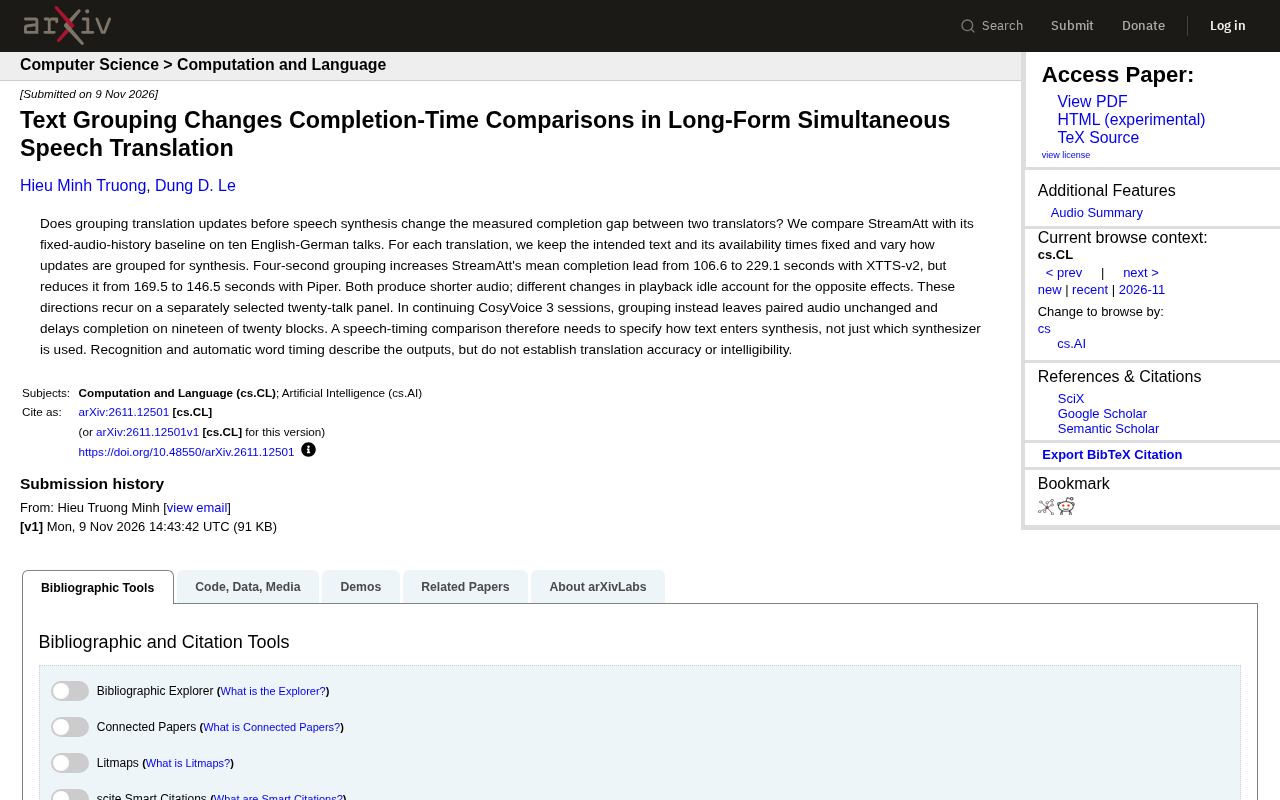
The study compared StreamAtt with its fixed-audio-history baseline on ten English-German speeches. The core finding is that the impact of grouping strategy is not consistent, but rather depends on the speech synthesizer used. Specifically, four-second grouping increased StreamAtt's average completion lead on XTTS-v2 from 106.6 seconds to 229.1 seconds, but on Piper it decreased from 169.5 seconds to 146.5 seconds. This opposite effect stems from different changes in playback idle time.
Simultaneous Speech Translation refers to a machine starting to translate and output the target language before the speaker has finished speaking, pursuing low latency and high fluency. Unlike traditional sentence-by-sentence translation, simultaneous interpretation systems need to handle "partial input" and continuously update translations, so latency becomes a core evaluation metric.
Text-to-Speech (TTS) is responsible for converting translated text into speech output. In simultaneous interpretation evaluation, "completion time" is commonly used to measure the duration from the start of source speech to the end of target speech playback, which depends on the TTS processing speed and playback rhythm.
StreamAtt is a streaming attention translation model that dynamically decides output timing based on real-time source speech input; the fixed-audio-history baseline uses a fixed audio context window for translation. The two differ in latency characteristics, and text grouping strategy may amplify or shrink this difference.
Experimental Setup and Core Findings
The research team conducted comparative experiments on ten English-German speeches. For each translation, the expected text and its availability time were kept unchanged, and only the way updates were grouped during synthesis was altered.
The Double-Edged Effect of Grouping Strategy
When four-second grouping was adopted, StreamAtt's completion time advantage over the baseline changed significantly:
- XTTS-v2: Average completion lead expanded from 106.6 seconds to 229.1 seconds.
- Piper: Average completion lead shrank from 169.5 seconds to 146.5 seconds.
Both synthesizers produced shorter audio, but differences in playback idle time led to opposite effects. This means that the interaction between grouping strategy and synthesizer directly affects the conclusion of latency comparisons.
Playback idle time refers to audio playback interruptions or waiting time during speech synthesis and playback caused by text not yet being ready or synthesis not being complete. Grouping strategy affects synthesis efficiency by changing when text is fed into the TTS: longer grouping windows allow the TTS to batch-process more text, potentially shortening synthesis time, but also delaying text availability and increasing playback idle time.
XTTS-v2 is a deep learning-based multi-speaker TTS model that is relatively sensitive to batch input, with noticeable efficiency gains from grouping; Piper is a lightweight fast TTS with low single-synthesis latency, but limited benefit from batch processing, so grouping may instead introduce extra waiting. Therefore, the same grouping strategy may affect playback idle time in opposite directions on different synthesizers, thereby changing the latency comparison conclusions between translators.
Reproducibility of Results
These directional changes reappeared on an independently selected panel of twenty speeches, indicating that the phenomenon is not accidental. The research team also tested persistent CosyVoice 3 sessions and found that in this scenario, grouping instead kept the paired audio unchanged and delayed completion time on nineteen out of twenty chunks. This further demonstrates that the impact of grouping is highly dependent on the specific synthesizer and operating mode.
CosyVoice 3 is a TTS system that supports streaming synthesis, and its persistent session mode allows state to be maintained across long conversations, reducing repeated initialization overhead. In this mode, text grouping may not change the total amount of paired audio, but it changes the rhythm at which text reaches the synthesizer, thereby affecting completion time. The study observed that grouping delayed completion time on nineteen out of twenty chunks, indicating that persistent sessions have different sensitivity to grouping strategy than one-off synthesis, further emphasizing that operating mode (whether persistent session) is an important variable affecting latency comparisons.
Why Is Grouping Strategy So Important?
Speech synthesis is not instantaneous; it requires a certain amount of processing time. When translated text is grouped and fed into the TTS, the synthesizer can process batched text more efficiently, thereby shortening audio generation time. But then again, grouping delays text availability—translation updates must wait for the grouping window to end before entering synthesis. This trade-off manifests differently across synthesizers: some are more sensitive to batch processing, while others are more sensitive to latency.
The study also points out that speech timing comparisons need to specify how text enters synthesis, not just which synthesizer is used. Recognition and automatic word timing describe the output, but do not establish translation accuracy or comprehensibility. This means that when evaluating simultaneous interpretation systems, text grouping strategy must be explicitly reported as part of the experimental design, otherwise latency comparisons may be misleading.
Word timing refers to the start and end times of each output word in the audio stream, commonly used to evaluate the latency and synchronization of simultaneous interpretation systems. Automatic word timing extracts word boundaries from synthesized audio through algorithms, while recognition word timing aligns based on speech recognition results. Both describe the temporal structure of output audio, but do not directly reflect translation accuracy or comprehensibility—they only indicate "what was said when," not "whether it was said correctly." Therefore, when comparing translator latency, text grouping strategy must be explicitly reported as part of the experimental design; otherwise, conclusions based solely on word timing or completion time may be misleading.
Implications for Simultaneous Interpretation System Evaluation
This study poses important challenges to the evaluation methodology of simultaneous speech translation systems. Traditionally, researchers may focus on translation quality or synthesizer choice, but the preprocessing step of text grouping is equally critical.
Experimental Design Needs Transparency
In future comparisons of different translators, the method of text grouping (such as grouping window size), synthesizer type, and session mode (such as whether persistent session) should be clearly specified. Otherwise, the results of latency comparisons may not be reproducible or may be misleading.
The Complexity of Latency Metrics
The completion time gap is not an inherent property of the translator itself, but is jointly influenced by the synthesizer, grouping strategy, and playback idle time. Therefore, when reporting latency advantages, a more detailed analysis of the interactions among these factors is needed.
Conclusion
Text grouping strategy plays a key role in completion time comparisons for simultaneous interpretation. The study experimentally demonstrates that four-second grouping can significantly change the latency gap between StreamAtt and the baseline, and the direction depends on the synthesizer. This finding emphasizes that when evaluating simultaneous interpretation systems, the way text enters synthesis must be specified, not just the choice of synthesizer. For researchers and engineers, this means more rigorous experimental design and more transparent reporting standards are needed to ensure the reliability and reproducibility of latency comparisons.
One-line Summary
Text grouping strategy changes simultaneous interpretation latency comparison conclusions depending on the synthesizer.
Paragraph Summary
A study reveals that in simultaneous speech translation system evaluation, text update grouping (i.e., how translated text is batched before being fed into the TTS) significantly affects latency comparisons between translators, and the effect depends on the speech synthesizer used. Experiments comparing StreamAtt with a fixed-audio-history baseline on ten English-German speeches showed that four-second grouping increased StreamAtt's average completion lead on XTTS-v2 from 106.6 seconds to 229.1 seconds, but decreased it on Piper from 169.5 seconds to 146.5 seconds. The opposite effect stems from different changes in playback idle time. Results were reproduced on a panel of twenty speeches, and in persistent CosyVoice 3 sessions, grouping actually delayed completion. The study emphasizes that speech timing comparisons need to specify how text enters synthesis, not just the choice of synthesizer, otherwise latency comparisons may be misleading.
Related articles

Prompt Engineering for Beginners: From Writing Prompts to Engineering Thinking
Starting from the essence and four functions of prompts, this article systematically explains the six-step process, four success criteria, learning value, and practical limitations of prompt engineering to help you build a complete understanding.

Anthropic Launches Nasdaq IPO: AI Giant's Listing and Risk Disclosures
Anthropic officially launches its Nasdaq IPO under ticker ANT, with market valuation expected to potentially exceed SpaceX's record. The prospectus devotes nearly 100 pages to AI risks, while first-half revenue grew over 14x but net losses widened sharply, reigniting the AI bubble debate.

Rust cURL Clone Uses 4,832 unsafe Blocks—Is the Memory Safety Myth Broken?
A Rust cURL clone uses 4,832 unsafe keywords, challenging Rust's memory safety narrative. We analyze what unsafe really means, compare Fil-C, and examine rewrite motives.