How Evidence Masking Improves Compositional Generalization in AI: Insights from 60 Preregistered Four-Cell System Experiments
Restricting AI module information access significantly improves compositional generalization in multi-agent systems.
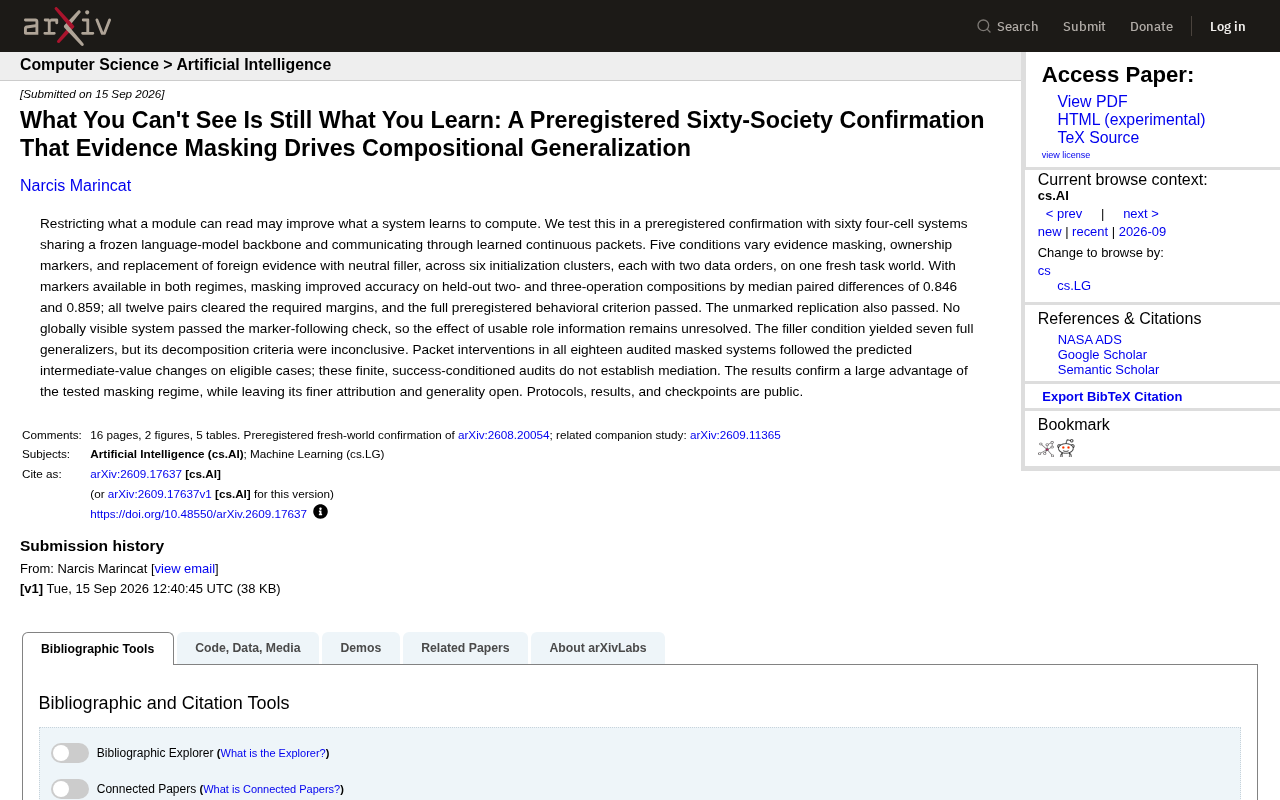
A rigorous preregistered experiment found that applying "evidence masking" — limiting a module's access to other modules' raw evidence — in multi-agent AI systems significantly improves generalization accuracy on unseen composite tasks. Using 60 four-cell systems sharing a frozen language model backbone, the study found median accuracy improvements of 0.846 and 0.859 on two-step and three-step compositional tasks under masking conditions, with all twelve comparisons passing pre-specified thresholds. The effect held in an unmarked replication, confirming robustness. The team honestly acknowledged that the precise role of role markers and causal mechanisms remain unclear, and released all protocols and checkpoints for independent verification. The findings challenge the "more information is better" engineering intuition and offer new directions for modular AI architecture design.
A Counterintuitive Finding: What You Can't See, You Learn Better
In multi-agent AI system design, intuition often tells us that the more information each module can access, the smarter the system becomes. But a preregistered study published on arXiv presents the opposite evidence — restricting what a module can read may actually enhance the entire system's ability to learn computations.
The paper, titled What You Can't See Is Still What You Learn, validates the significant role of "evidence masking" in driving compositional generalization through a large-scale, methodologically rigorous experiment. Compositional generalization refers to a model's ability to recombine previously learned basic operations to solve composite tasks never seen during training — widely regarded as a critical threshold on the path to genuine intelligent reasoning.
Compositional generalization is a core problem that cognitive science and AI have long grappled with. Humans naturally possess this ability — once we learn to "jump" and "spin" separately, we can understand "spin while jumping" without dedicated training. Traditional neural networks, however, tend to perform poorly here: they often memorize tasks as holistic patterns rather than decomposing them into recombinable primitives. Benchmarks like SCAN and COGS have revealed clear shortcomings in large language models when it comes to systematic compositional ability. This is precisely why the findings of this study are so striking — constraining information rather than enriching it actually fosters more compositionally structured collaboration between modules.
Experimental Design: Rigorous Validation Across 60 Four-Cell Systems
The weight of this study lies first in its methodology. The research adopts a preregistered confirmation approach — publicly locking in hypotheses, evaluation criteria, and analysis procedures before the experiment begins. This fundamentally eliminates the possibility of cherry-picking results after the fact, substantially increasing the credibility of the conclusions.
The experiment constructed 60 "four-cell systems" that share a frozen language model backbone and communicate with each other through learned continuous "packets." Five experimental conditions were set up, adjusting three variables:
- Evidence masking: whether a module can read other modules' evidence
- Ownership markers: labels identifying the source role of information
- Neutral filler replacement: replacing external evidence with meaningless neutral content
These conditions spanned six initialization clusters, each containing two data orderings, all tested within the same novel task world. This multi-dimensional cross design ensures the conclusions are not merely artifacts of a single configuration.
Preregistration is an important mechanism in scientific research for combating p-hacking and selective reporting bias. Before collecting data, researchers submit their hypotheses, sample sizes, primary measurements, and statistical analysis plans to a public registry (such as OSF), with no changes permitted afterward. This practice gained widespread adoption following the replication crisis in psychology and is gradually making inroads into computer science and AI research. For AI experiments, preregistration is especially important because the hyperparameter search space is vast, and the temptation to post-hoc select the best-performing configuration and present it as a "discovery" far exceeds that in traditional experimental science. This study's use of preregistration means its median differences of 0.846 and 0.859 were computed according to pre-committed standards, not selected from a pool of metrics.
Core Results: Significant Advantage From Masking
The most critical finding is this: when both parties have access to role markers, evidence masking significantly improves model accuracy on held-out composite tasks.
The specific numbers are compelling — for compositional tasks requiring two-step and three-step operations, the median paired accuracy differences under masking conditions reached 0.846 and 0.859, respectively. More importantly, all twelve pairwise comparisons exceeded the pre-specified threshold margin, fully satisfying the preregistered behavioral criterion.
The study also conducted an "unmarked replication," which similarly passed the test. This indicates that the core effect of masking does not depend entirely on the presence of role markers, further confirming its robustness.
Open Questions: The Mechanism Remains Unresolved
Commendably, the paper does not overstate its conclusions but honestly delineates the boundaries of its findings.
Regarding the role of role information: no globally visible system passed the "marker-following" check, so the extent to which available role information actually contributed remains an open question.
Under the neutral filler condition, seven fully generalizing systems emerged, but their decomposition criteria results were ambiguous and no firm conclusions could be drawn.
The research team also conducted packet interventions on 18 audited masking systems, finding that they all showed "intermediate value changes" as predicted on qualifying cases. However, the paper cautiously notes that these limited, success-conditioned audits do not establish causal mediation.
In other words, the experiment powerfully confirms the fact that "masking brings substantial gains," but regarding why this is the case and how far this effect generalizes, the authors maintain appropriate scientific restraint.
Implications for AI System Design
The value of this research extends far beyond a single experimental number. It touches on a core tension in multi-agent systems and modular AI architectures: the trade-off between information visibility and generalization ability.
Engineering practice has long favored having modules share as much information as possible. But this study provides a counterexample — appropriate information isolation may force individual modules to learn more abstract, more composable internal representations, enabling stronger transfer when facing novel task combinations. This offers an intriguing parallel to how "division of information" in human collaboration can enhance overall output.
The research team is to be commended for publicly releasing the full protocol, results, and model checkpoints, paving the way for independent verification and mechanistic exploration. In the current climate of heightened concern about AI research reproducibility, this level of transparency is itself a significant contribution.
For practitioners in multi-agent systems, emergent communication, and compositional generalization research, this paper offers both a solid empirical finding and sufficiently enticing open questions — through what pathway does masked information shape a model's learning? The answer remains to be uncovered.
This finding resonates theoretically with several lines of work in the emergent communication field, which studies how agents spontaneously develop communication systems without pre-specified language protocols. Research has found that when communication bandwidth between agents is constrained, the symbol systems they develop tend to exhibit stronger compositional structure, akin to morpheme-combination rules in natural language. Evidence masking can be understood as a form of structural pressure — it prevents the receiving module from relying on direct access to raw evidence, forcing it to depend on abstract representations distilled by the sending module, thereby compelling the entire system to evolve toward more modular, more transferable internal specialization. This provides a non-obvious design dimension for future multi-agent systems: the granularity and form of information isolation.
Related articles

The Open Source Dilemma: A Non-Autoregressive Architecture Pioneer Overshadowed by Frontier Labs
An indie developer claims a frontier lab repackaged his year-old open-source non-autoregressive RL architecture as a breakthrough. We compare PPO sequence embeddings vs. RLCD parallel sampling and examine open source attribution gaps.

AI Plans an Entire Vineyard: A Real-World Experiment with 100 Grapevines
A Spokane hobbyist let Muse AI plan his entire vineyard — variety, spacing, irrigation, even the logo. He planted 100 Cabernet Franc vines and is documenting everything publicly.

Iceland's Treble Raises $18M to Bet on Voice Simulation Platform
Iceland-based voice simulation company Treble raises $18M. Its platform serves voice AI developers, AI wearables, and robotics firms. A deep dive into the technology and what the funding signals.