How Fine-Tuning Data Preprocessing Affects LLM Recommendation: Utility and Fairness Trade-offs

Fine-tuning data preprocessing choices affect both utility and demographic fairness in LLM recommendation and require joint multi-dimensional evaluation.
This study systematically examines how fine-tuning data preprocessing choices simultaneously affect recommendation utility and fairness in LLM-based generative recommendation. Using a controlled pipeline with supervised fine-tuning, catalog-constrained decoding, and prompt augmentation on MovieLens-1M, it compares three strategies: raw item titles improve HR@10 and Coverage@10; age balancing and auxiliary knowledge enrichment narrow group utility gaps with little utility loss; gender balancing reduces utility without improving fairness metrics. The study advocates joint evaluation across utility, output behavior, and demographic sensitivity.
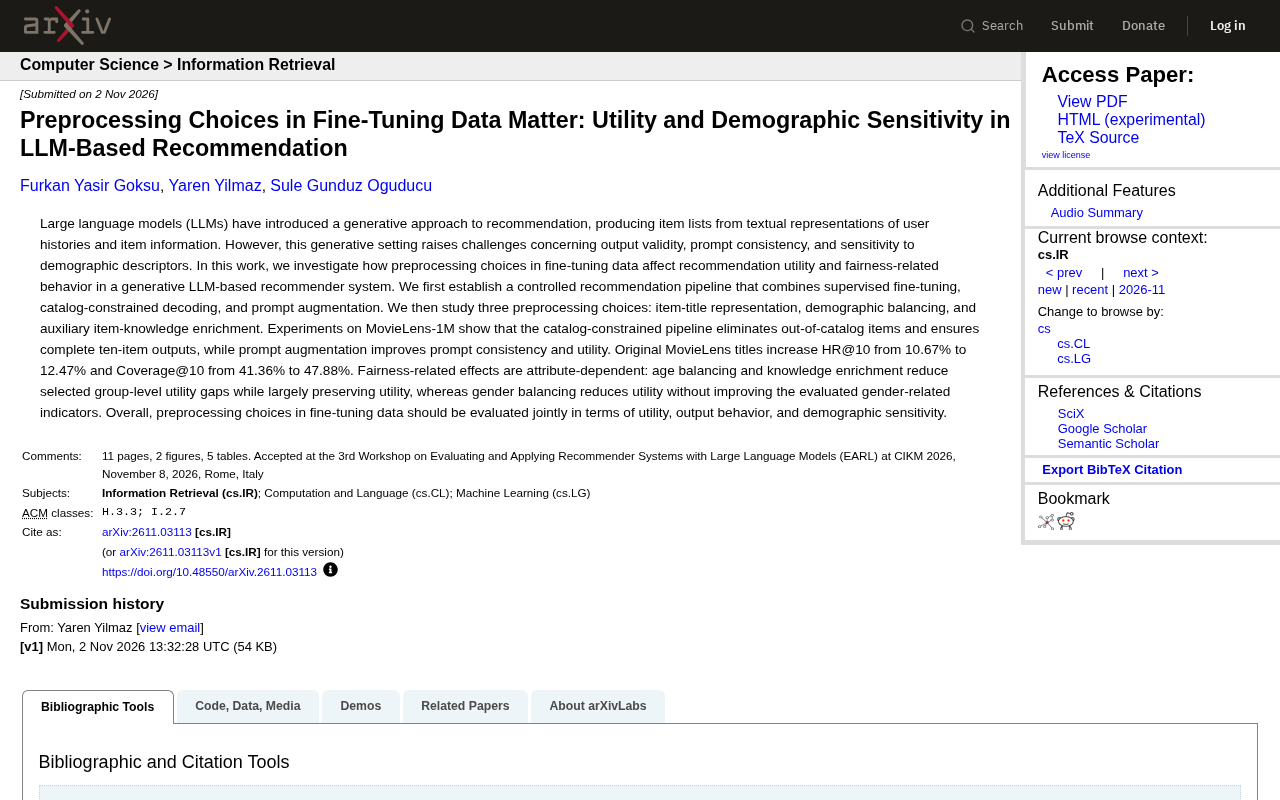
In recommendation systems based on large language models (LLMs), generative approaches are gradually becoming mainstream. Models directly generate recommendation lists from textual representations of user history and item information, but this paradigm also brings new challenges in output validity, prompt consistency, and sensitivity to demographic descriptors. A study titled "Preprocessing Choices in Fine-Tuning Data Matter: Utility and Demographic Sensitivity in LLM-Based Recommendation" systematically examines how fine-tuning data preprocessing choices simultaneously affect recommendation utility and fairness-related behavior.
Research Background and Core Questions
Traditional recommendation systems are typically based on collaborative filtering or two-tower models, whereas the introduction of LLMs turns recommendation into a text generation task: user history and item information are converted into prompts, and the model directly generates item lists. Although this generative setting is flexible, it requires additional constraint mechanisms to ensure that outputs do not fall outside the catalog (i.e., do not recommend non-existent items), while also facing inconsistency caused by variations in prompt format.
More critically, generative models may learn demographic biases from training data, leading to gaps in recommendation quality across different groups (e.g., age, gender). Therefore, the research team poses a core question: Do preprocessing choices in fine-tuning data produce measurable trade-offs between utility and fairness?
Construction of a Controlled Recommendation Pipeline
To isolate the effects of preprocessing variables, the authors built a controlled recommendation pipeline containing three key components:
- Supervised Fine-Tuning (SFT): Fine-tune an LLM on the MovieLens-1M dataset so that it learns to generate recommendation lists based on user history.
- Catalog-Constrained Decoding: During generation, restrict the model to output only items that exist in the catalog, thereby completely eliminating out-of-catalog items and ensuring that each output contains a complete set of ten recommendations.
- Prompt Augmentation: Enrich the expression of prompts to improve prompt consistency and recommendation utility.
This pipeline provides a clean foundation for subsequent comparisons of different preprocessing strategies.
Supervised Fine-Tuning (SFT) refers to continuing to train a pretrained large language model on labeled data for a specific task (here, sample pairs of "user history → recommendation list") so that the model adapts to the behavioral patterns of the target domain. Unlike prompt engineering, SFT writes task knowledge into model parameters through gradient updates, so the way training data is represented directly shapes model outputs. In recommendation scenarios, SFT samples usually consist of user interaction sequences and corresponding target item lists, and the model learns to generate reasonable subsequent recommendations under given historical conditions. This is also the fundamental reason why preprocessing choices can affect final recommendation behavior.
Catalog-constrained decoding is a decoding strategy that imposes hard constraints during the generation stage: at each token generation step, the candidate vocabulary is restricted to the set of tokens corresponding to valid item identifiers in the current context, thereby mathematically excluding the possibility of generating out-of-catalog items. Common implementations include trie-based constrained decoding and vocabulary masking based on finite-state machines. Unlike post-hoc filtering, this method guarantees output validity from the source of decoding, but it also introduces additional computational overhead and may affect generation diversity due to overly strong constraints.
Three Preprocessing Choices and Their Effects
The study focuses on three preprocessing choices and conducts experiments on MovieLens-1M:
1. Item-Title Representation
Using original MovieLens titles rather than cleaned or simplified titles significantly improves recommendation utility. Specifically, HR@10 increases from 10.67% to 12.47%, and Coverage@10 increases from 41.36% to 47.88%. This suggests that detailed information in titles (such as year, subtitle, etc.) may provide richer semantic signals for the model, helping it match user preferences more accurately.
2. Demographic Balancing
The effect of this choice shows clear attribute dependence. Age balancing reduces utility gaps at the selected group level while keeping overall utility essentially unchanged; gender balancing, however, leads to a decline in utility without improving the evaluated gender-related metrics. This indicates that fairness interventions are not always effective, and different demographic attributes need to be treated differently.
3. Auxiliary Item-Knowledge Enrichment
Supplementing items with additional knowledge information (such as genre, director, etc.) can likewise reduce group-level utility gaps, with little impact on overall utility. This is similar to the effect of age balancing, indicating that knowledge enrichment is a relatively "safe" means of fairness improvement.
HR@10 (Hit Rate@10) measures the proportion of test samples in which the actually interacted item appears in the top 10 of the recommendation list, reflecting the model's ability to "hit" items of interest to users. Coverage@10 counts the proportion of unique items covered by all recommendation results relative to the total catalog, measuring the diversity and long-tail exploration capability of the recommendation system. Using the two together avoids evaluating solely by hit rate while ignoring excessive concentration in recommendation results. In this study, improvements in title representation increased both metrics simultaneously, showing that its gains did not come at the expense of diversity.
Implications of the Utility-Fairness Trade-off
The experimental results send a clear signal: preprocessing choices cannot be evaluated solely on utility. Original titles improve utility but may inadvertently amplify differences among certain groups; although gender balancing is well intentioned, it incurs a utility cost and fails to achieve the expected fairness goals. In contrast, age balancing and knowledge enrichment achieve a better balance between utility and fairness.
The authors therefore suggest that during the fine-tuning data preprocessing stage, joint evaluation should be conducted across three dimensions: utility, output behavior, and demographic sensitivity. For developers of LLM-based recommendation systems, this means carefully selecting preprocessing strategies according to specific application scenarios and fairness goals, rather than blindly pursuing optimization of a single metric.
Implications for LLM Recommendation Practice
The value of this research lies in bringing the often-overlooked step of "data preprocessing" to the forefront. In generative recommendation, how data is represented, balanced, and enriched is embedded into model behavior through the fine-tuning process. Although engineering methods such as catalog-constrained decoding and prompt augmentation can solve output validity issues, they cannot automatically eliminate demographic sensitivity—the latter requires targeted interventions at the data level.
Future designs of LLM-based recommendation systems may need to treat preprocessing choices as a multi-objective optimization problem, seeking the Pareto frontier among utility, consistency, and fairness. The controlled experimental framework provided by this study offers a reusable methodological foundation for such exploration.
One-line Summary
Fine-tuning data preprocessing choices simultaneously affect utility and demographic fairness in LLM recommendation and require joint multi-dimensional evaluation.
Paragraph Summary
This study systematically examines how fine-tuning data preprocessing choices simultaneously affect recommendation utility and fairness in LLM-based generative recommendation. The authors constructed a controlled pipeline including supervised fine-tuning, catalog-constrained decoding, and prompt augmentation, and compared three preprocessing strategies on MovieLens-1M. The results show that using original item titles significantly improves HR@10 and Coverage@10; age balancing and auxiliary knowledge enrichment can narrow group-level utility gaps while largely preserving utility; whereas gender balancing reduces utility and does not improve relevant fairness metrics. The study therefore argues that preprocessing choices should not be judged by utility alone, but should be jointly evaluated across utility, output behavior, and demographic sensitivity.
Related articles
 Tech Frontiers
How Do You Stop AI Agent Emails From Sounding Like AI? One Developer's Solution
AI agent emails always sound like AI? A developer shares reright: a rewrite step that validates numbers, names, and links, preventing humanizers from tampering with key info. Test data and integration details inside.
 Tech Frontiers
Starlink Mobile: SpaceX's Carrier Ambitions and the 5G Deployment Challenge
SpaceX plans to make Starlink Mobile a mainstream carrier, deploying thousands of direct-to-cell satellites and building a terrestrial 5G network to challenge AT&T, Verizon, and T-Mobile. This article analyzes its dual-track strategy, 5G deployment challenges, and the competitive landscape.
 Tech Frontiers
OpenAI Raises Another $11 Billion, Valuation Hits $1.25 Trillion
OpenAI has raised an additional $11 billion in a new funding round at a valuation of $1.25 trillion. The deal is not yet closed and is expected to be completed in the coming weeks, further consolidating its leading position in AI.