How Generative AI Is Fueling Transnational Repression: A New Frontier in Technology Abuse

Generative AI lowers the cost and boosts the efficiency of transnational repression, amplifying the structural asymmetry between state violence and individual defense.
The article explores how generative AI is changing the operational logic of transnational repression. Traditional repression relies on diplomatic pressure, intelligence tracking, and proxy harassment, constrained by geographic and manpower bottlenecks; LLMs, voice cloning, and deepfakes now enable mass production of intimidating texts, fabricated distress calls, and fake evidence—work once requiring a team can now be done by one operator with a set of models. The article highlights a structural resource asymmetry: defense is point-like, attack is area-wide. The issue is underestimated due to dispersed victims, difficult cross-border evidence collection, and moderation systems geared toward large-scale disinformation; open-source models and fine-tuning tools further weaken abuse protections. It calls for a human rights perspective in AI safety discussions.
When Generative AI Becomes a Tool of Transnational Repression
Transnational repression is not a new phenomenon—authoritarian governments have long extended control abroad by threatening dissidents overseas and their families, conducting cross-border harassment, and carrying out cyberattacks. But the emergence of generative AI is dramatically lowering the cost and rapidly expanding the scale of such operations. A recent article on Hacker News, How Generative AI Is Scaling Transnational Repression, raises an alarming proposition: AI not only changes how information is produced, but also changes the operational logic of state violence.
The core of this discussion lies in the word "scale." Traditional transnational repression relies on manpower—diplomats applying pressure, intelligence officers tracking targets, proxies harassing individuals—and every link has geographic and human-resource bottlenecks. Generative AI punches right through these bottlenecks: text generation can mass-produce intimidation messages targeting individuals, voice cloning can fabricate distress calls from relatives, and deepfake videos can destroy a dissident's public credibility. Work that once required a team can now be done by one operator with a set of models.
Transnational repression is a key concept in recent human rights and intelligence research, referring to state actors extending their coercive capacity beyond borders to threaten, surveil, harass, abduct, or coerce the relatives of exiles, diaspora communities, journalists, and dissidents. Academic research (such as Freedom House's annual reports on transnational repression) shows that dozens of countries worldwide have been documented carrying out such operations, using tactics including abuse of INTERPOL Red Notices, pressure through diplomatic immunity, deploying proxies to track targets, and cyberattacks to obtain dissidents' communications records. Its defining feature is crossing sovereign borders, placing victims in a gap where host-country legal protections are insufficient while the home country's jurisdiction extends extraterritorially. Only by understanding this background can we see why generative AI is regarded as a capability multiplier: it does not create new types of repression, but compresses the execution cost and time of every existing tactic.
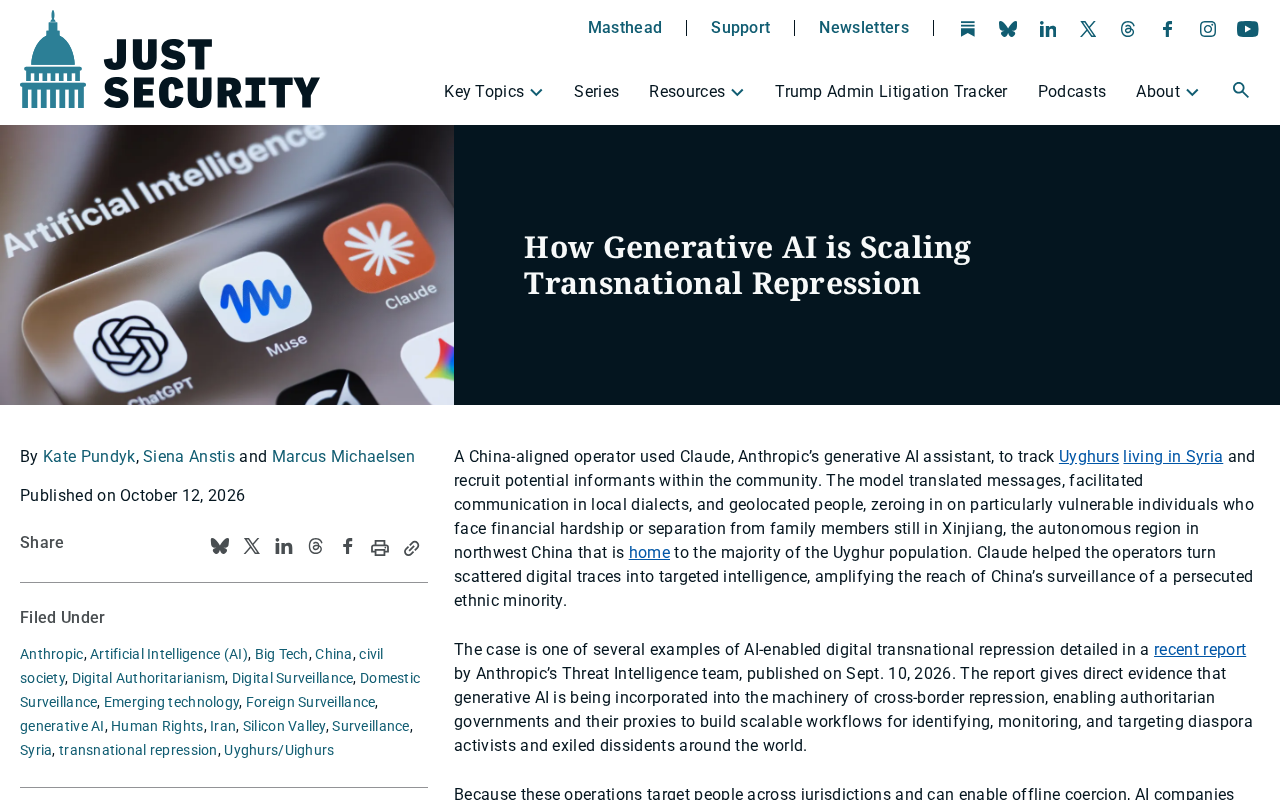
How Technology Lowers the Barrier to Repression
From "Handcraft" to "Assembly Line"
The key to understanding this shift is to view transnational repression as a production chain of information and intimidation. Before AI entered the picture, a pressure campaign against a single overseas dissident required customized investment: understanding their social network, writing targeted threatening content, and selecting appropriate channels for delivery. Generative models automate all three steps at once. Large language models can generate highly personalized intimidating text based on public social media data, voice synthesis tools can mimic a specific person's voiceprint, and image generation can be used to fabricate "evidence" to pressure relatives back home.
Although the Hacker News post received only 6 points and no comments at the time, the topic itself touches on a relatively overlooked area of AI safety discussion. Compared with deepfakes used for fraud or election interference, AI's use in transnational repression is more covert, and victims are often individuals lacking public visibility.
The reason large language models can generate highly personalized intimidating text lies in the contextual modeling and style-transfer capabilities they acquire from training on massive public corpora. Given a target's publicly posted social media content, a model can infer their language habits, topics of concern, social networks, and emotional vulnerabilities, and then write threats that match their tone and carry credible details. Meanwhile, voice cloning technology (such as text-to-speech synthesis based on small audio samples) and diffusion-model image generation have lowered the barrier for fabricating relatives' distress recordings or producing so-called "evidence photos" to the level of ordinary users. Together, these three capabilities form a complete automated chain from intelligence gathering to content production to channel delivery—and this is the technical essence of "scaling": unit cost approaches zero, and marginal replication requires no additional manpower.
The Asymmetry of the Attack Surface
A structural feature of technology abuse is the resource imbalance between attackers and defenders. Authoritarian governments can concentrate AI capabilities on a small number of targets, while dispersed dissident communities worldwide have almost no access to comparable technical protection. This asymmetry already existed in the pre-AI era; AI simply magnifies it. An exiled journalist may use AI tools for fact-checking, but their adversaries can use the same class of models to mass-produce harassing messages targeting their families—defense is point-like, while attack is area-wide.
The proliferation of open-source models and fine-tuning tools is an important variable in this asymmetry. Mainstream closed-source model providers typically set abuse protections in their terms of service and output layers—for example, refusing requests involving threats, doxxing, or identity fabrication—but once open-weight models are released, protections can be removed or bypassed through fine-tuning. Parameter-efficient fine-tuning methods such as low-rank adaptation (LoRA) allow ordinary users to customize model behavior with small amounts of data, further lowering the barrier to abuse. This means the effective boundary of abuse protection depends not on the ethical constraints of the strongest models, but on the openness of the weakest available models, creating a so-called "safety haven" effect: defenders must cover all attack paths, while attackers only need to find one path that has not been blocked.
Why This Problem Tends to Be Underestimated
AI abuse in transnational repression struggles to enter mainstream tech ethics discussions for several reasons. Victim groups are dispersed and lack a voice, incidents often occur in cross-border legal gray zones, and evidence collection is difficult. Platform content moderation mechanisms mainly target large-scale disinformation and have limited ability to identify highly customized, small-scale targeted harassment. In addition, in many cases the traces of AI-generated content are deliberately obscured, complicating attribution.
Another overlooked dimension is the supply chain problem. The democratization of generative AI capabilities means that even if mainstream model providers set abuse protections, open-source models and fine-tuning tools may still be used for such purposes. The Hacker News community has traditionally supported the open-source ecosystem, but when the topic turns to state-sponsored transnational repression, the tension between open capabilities and abuse risk becomes hard to avoid.
At the content governance level, the technical architecture of platform moderation systems itself favors identifying large-scale disinformation: detection methods based on传播 volume, coordinated account behavior, and pattern matching are almost useless against a customized intimidating message sent to only a few dozen people. Such content lacks viral传播 characteristics and does not form a coordinated behavior network that can be identified through clustering, so it falls into the blind spot of moderation thresholds. Content provenance and watermarking technologies face similar dilemmas, because victims are often unable to obtain original generation records, and cross-border evidence collection involves lengthy judicial assistance procedures and inconsistent platform data retention policies. The combination of difficult attribution, difficult evidence collection, and difficult accountability makes targeted AI harassment a high-reward, low-risk pressure tactic.
Response Approaches and Open Questions
Current responses to this problem remain at an early stage. At the technical level, watermarking, content provenance, and abuse detection are common directions, but their effectiveness is limited when facing highly customized, narrowly传播 targeted content. At the policy level, the difficulty of cross-border evidence collection and legal cooperation makes accountability chains fragile.
More fundamentally, victims of transnational repression are often outside the视野 of tech discussions. The low-traffic Hacker News post is itself a footnote: a serious issue about AI amplifying state violence receives far less attention in the tech community than product launches or model benchmarks. This may suggest that AI safety discussions need to more proactively incorporate a human rights perspective into the agenda, rather than waiting for incidents to become headlines before reacting.
The scaling capability of generative AI is neutral, but it amplifies existing power asymmetries. Transnational repression is just one facet of this logic—but one of the facets that most needs to be seen.
One-line Summary
Generative AI lowers the cost and boosts the efficiency of transnational repression, amplifying the structural asymmetry between state violence and individual defense.
Paragraph Summary
The article explores how generative AI is changing the operational logic of transnational repression. Traditional transnational repression relies on diplomatic pressure, intelligence tracking, and proxy harassment, constrained by geographic and manpower bottlenecks; large language models, voice cloning, and deepfakes now make it possible to mass-produce intimidating texts, fabricated distress calls, and fake evidence—work that once required a team can now be done by one operator with a set of models. The article points out a structural resource asymmetry between attackers and defenders: defense is point-like, while attack is area-wide. The issue is underestimated because victim groups are dispersed, cross-border evidence collection is difficult, and platform moderation favors large-scale disinformation; the proliferation of open-source models and fine-tuning tools further weakens abuse protections. The article calls for incorporating a human rights perspective into AI safety discussions.
Related articles

Hands-On with the Gemini 4 Argon API: Thinking Levels and Background Mode Explained
A Free Code Camp crash course on the Gemini 4 Argon API: from getting a key and sending your first request to controlling reasoning costs with thinking levels, enabling multi-turn chat with previous_interaction_id, and generating a Breakout game in background mode—plus a Google engineer's take on the model's capabilities.

Reinforcement Learning Takes On Getting Over It: Distributed Training Strategies Behind 63% Progress
A developer uses deep reinforcement learning to tackle Getting Over It. The agent climbs from the bottom to 63% progress but gets stuck at the anvil. The project is open-sourced, using divide-and-conquer training and CPU-only training, seeking community collaboration to break the bottleneck.

Sigma FP2 Released: The World's Smallest Full-Frame Camera Gets Sensor and Screen Upgrades
Sigma launches the FP2 full-frame camera, retaining its smallest-and-lightest design with three key upgrades: improved sensor, articulating LCD screen, and longer battery life—built for portable video creators.