How Guided Diffusion Models Are Revolutionizing Spatial Prediction: From Method to Empirical Validation

Guided diffusion models bypass MCMC bottlenecks in spatial prediction, enabling accurate and scalable posterior sampling.
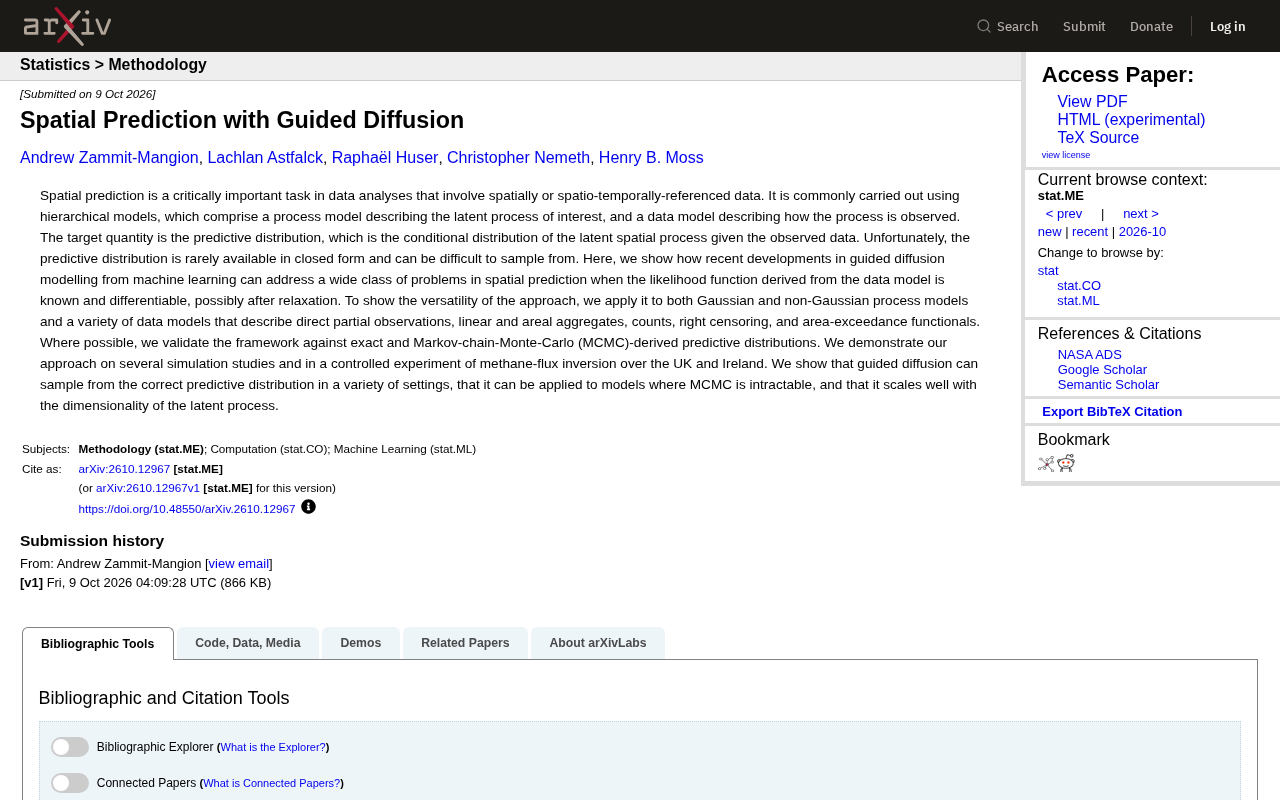
This study introduces guided diffusion models from machine learning into geostatistics and spatial prediction, offering a systematic alternative to traditional MCMC inference. The core task — sampling from a posterior predictive distribution of a latent spatial process given sparse observations — typically has no closed form and becomes intractable under high dimensionality or complex likelihoods. The key insight is that a known, differentiable likelihood enables diffusion models to provide prior generative capacity while likelihood gradients serve as guidance signals, together approximating the correct predictive distribution. The framework is validated across Gaussian and non-Gaussian process models, partial observations, areal aggregates, counts, right censoring, and area-exceedance functionals, and successfully applied to methane flux inversion over the UK and Ireland.
Spatial prediction is a core task in geostatistics, environmental science, and spatial data analysis. Whether interpolating pollutant concentrations across space or inverting methane fluxes over a region, researchers must infer latent spatial processes under sparse observations and complex models. A new study proposes incorporating Guided Diffusion — a technique that has advanced rapidly in machine learning — into spatial prediction, offering a new solution path for a broad class of problems that traditional methods struggle to handle.
The Core Challenge of Spatial Prediction
Spatial prediction typically relies on hierarchical models to structure the problem. These models consist of two components: a process model that describes the latent process of interest, and a data model that describes how that process is observed.
The ultimate goal is to obtain the predictive distribution — the conditional distribution of the latent spatial process given observed data. The practical difficulty is that this predictive distribution almost never has a closed form, and sampling from it is often extremely challenging.
Traditionally, researchers use Markov Chain Monte Carlo (MCMC) methods to approximate the predictive distribution. But when the latent process is high-dimensional or the model is complex enough to make MCMC intractable, this approach hits a wall. This is precisely where diffusion models come in.
Markov Chain Monte Carlo (MCMC) is the dominant posterior sampling method in Bayesian statistical inference. The core idea is to construct a Markov chain that is stationary under the target distribution, then approximate the posterior by collecting samples from a long run of the chain. Classic algorithms include Metropolis-Hastings and Hamiltonian Monte Carlo (HMC). However, MCMC's practical utility is constrained by several key factors: mixing can be extremely slow in high-dimensional parameter spaces (meaning the chain needs a very long time to adequately explore the distribution); when the likelihood involves complex spatial operators (such as integrals or nonlinear transformations), gradient computation or probability density evaluation can be prohibitively expensive or even infeasible; and determining whether the chain has converged is itself a challenge. Latent fields in spatial statistics are often continuous variables with thousands to hundreds of thousands of dimensions — exactly the scenario where MCMC most easily becomes a bottleneck.
The Core Idea Behind Guided Diffusion
The key insight of this study is that when the likelihood function derived from the data model is known and differentiable (or can be made differentiable through relaxation), guided diffusion modeling can be used to sample from the predictive distribution.
Diffusion models excel at generating samples from complex high-dimensional distributions, while the "guidance" mechanism allows observations to inject constraint information during the generation process. In other words, the process model provides generative capacity for prior structure, and the data model acts as a "guidance signal" through its differentiable likelihood — together, they approximate the correct posterior (predictive) distribution.
The elegance of this design lies in transforming a conditional distribution problem that is difficult to sample from directly into a sampling process driven by a prior generative model with gradient-based guidance — circumventing the computational barriers MCMC faces under high dimensionality and complex likelihoods.
Diffusion models are one of the dominant paradigms in generative AI today. Their working principle has two phases: a forward process that gradually adds Gaussian noise to data until it becomes pure noise, and a reverse process that trains a neural network (typically a U-Net or Transformer) to progressively denoise, thereby reconstructing real samples from random noise. Guided Diffusion builds on this by introducing additional signals — most commonly classifier guidance or classifier-free guidance — applying gradients at each step of the reverse denoising process to make the generated output satisfy specific conditions. In the spatial prediction context of this paper, the "prior" is provided by the process model (by training a diffusion model to learn the distribution of spatial fields), while the "guidance signal" comes from the log-likelihood gradient of the observed data. Together, they make diffusion sampling equivalent to sampling from the Bayesian posterior distribution — a key bridge that transfers image generation techniques to statistical inference.
Coverage Across Diverse Models and Observation Types
To validate the method's generality, the research team tested it across a wide range of settings.
At the process model level, the method works for both Gaussian process models and non-Gaussian process models, not limited to the Gaussian case that is most analytically convenient.
At the data model level, the coverage is particularly broad, including:
- Direct partial observations
- Linear and areal aggregates
- Counts
- Right censoring
- Area-exceedance functionals
These observation types are very common in practice — for example, count data arises in disease or species counts, right censoring appears in environmental measurements below detection limits, and area-exceedance functionals address risk assessment questions like "the probability that a region exceeds some threshold." The ability to handle such a diverse range of likelihood structures in a unified framework is a significant demonstration of the approach's practical value.
Right censoring is extremely common in environmental monitoring: when an instrument's limit of detection (LOD) is higher than the actual concentration, we can only know that "the true value is below a certain threshold" without obtaining a precise reading — such observations are statistically referred to as right-censored data. Area-exceedance functionals are a class of observation that aggregates a spatial field into a risk indicator — for example, the event that "more than 50% of a city's area has PM2.5 exceeding 75 μg/m³" does not correspond to a point observation but rather a nonlinear functional of the latent spatial field. Both observation types pose severe challenges to traditional Gaussian linear frameworks: right censoring violates the linear data model assumption, while area-exceedance functionals introduce non-differentiable indicator functions (which require differentiable relaxation). The guided diffusion framework's ability to handle both uniformly demonstrates its adaptability to non-standard likelihood structures.
Validation and Empirical Application
The credibility of any methodology ultimately depends on whether it reproduces correct answers. Where feasible, the study benchmarks the guided diffusion framework against both exact predictive distributions and MCMC-derived predictive distributions.
The findings have three layers:
First, across multiple settings, guided diffusion is able to sample from the correct predictive distribution, demonstrating that it does not sacrifice accuracy for scalability.
Second, it can be applied to models where MCMC is intractable, extending the boundary of problems that can be modeled.
Third, it scales well as the dimension of the latent process grows — a critical property for high-resolution, large-scale spatial data.
The study demonstrates these properties through multiple simulation experiments, and applies the method to methane-flux inversion over the UK and Ireland in a controlled experiment. As an important greenhouse gas, the spatial inversion of methane emission sources is a quintessential high-dimensional, highly constrained spatial prediction problem — this case highlights the method's real-world relevance for environmental monitoring.
Methane flux inversion is a classic Bayesian inverse problem in atmospheric science: what researchers observe on the ground or from satellites is a spatial integral of atmospheric methane concentrations (where an atmospheric transport model maps surface emissions to concentration fields), and the goal is to infer the emission flux at each surface location. The challenge lies in the fact that the atmospheric transport operator is linear but high-dimensional, the number of observations is far smaller than the number of flux grid points to be inverted, and both observation noise and model error are present simultaneously — forming a classic underdetermined linear inverse problem. Traditional methods (such as optimal interpolation or variational data assimilation) rely on Gaussian assumptions, while real emission distributions often exhibit heavy tails or localized hotspot characteristics that do not conform to a Gaussian prior. Applying guided diffusion here allows the complex structure of the emission field to be characterized through a non-Gaussian process prior, while observation constraints are incorporated through a likelihood in the form of linear aggregates — a demanding test of the method's practical effectiveness.
Implications for the Intersection of Spatial Statistics and Machine Learning
This work represents a direction in which generative machine learning methods are penetrating the domain of classical statistical inference. Diffusion models have until now been primarily known for image and audio generation tasks; using their "guidance" capability for Bayesian spatial posterior sampling is an imaginative transfer of ideas.
For practitioners, the most immediate value is this: as long as a differentiable likelihood function can be written down, there is an opportunity to replace individually customized MCMC schemes for different models with a unified diffusion sampling framework — especially in high-dimensional scenarios where traditional methods fail. Of course, the method's requirement for likelihood differentiability also means it cannot be directly applied to all problems, and the quality of differentiable relaxations will affect final results — a boundary condition that deserves attention in downstream applications.
Overall, guided diffusion offers a new path for spatial and spatiotemporal data analysis that balances correctness with scalability — one that deserves joint attention from both the spatial statistics and machine learning communities.
Related articles

From Python to AI Agents: A Full-Stack Learning Path with 488 Lessons and 23 Projects
A Udemy course covering Python, machine learning, deep learning, LLMs, RAG, and AI Agents, with 488 lessons and 23 real-world projects. This article analyzes the logic of this full-stack AI learning path, who it suits, and self-study advice.

Creating Your Ideal Home: A Practical Guide to Curated Home Decor
Curated home decor guide: wall paintings, decorative mirrors, wall clocks, lamps, coffee tables, and more — with buying tips and styling advice for a cozy, comfortable home.

The US Military's Race to Make Fake Blood: Real-World Needs and Technical Challenges in Battlefield Life-Saving
Why is the US military investing heavily in artificial blood? This article analyzes the real-world dilemmas of battlefield transfusion, the pros and cons of hemoglobin-based oxygen carriers and other technical approaches, and the potential impact of artificial blood on civilian emergency medicine.