The US Military's Race to Make Fake Blood: Real-World Needs and Technical Challenges in Battlefield Life-Saving

The US military is driving artificial blood research to solve battlefield transfusion challenges and benefit civilian medicine.
This article explores the US military's urgent need for artificial blood in the context of the Iraq War. Fresh blood faces battlefield limitations like cold-chain transport, blood type matching, and short shelf life, while freeze-dried plasma has issues with reconstitution time and insufficient function. Three main technical approaches exist — hemoglobin-based oxygen carriers, perfluorocarbon emulsions, and stem cell-cultured red blood cells — each with pros and cons. Blood's complexity and challenges in production, cost, and regulation keep artificial blood far from large-scale use, but its maturation could transform battlefield care, ease global shortages, and prevent bloodborne diseases.
During the most intense phase of the Iraq War, a twin-rotor medical evacuation helicopter code-named "Morphine 1-2" had just delivered three critically wounded soldiers to the Balad Field Hospital north of Baghdad when it received another emergency mission — to conduct a rescue operation through insurgent-controlled territory in broad daylight. For battlefield medics, such scenes are far from uncommon. And one of the most vexing problems they face is how to obtain enough blood products under extreme conditions to save wounded soldiers' lives.
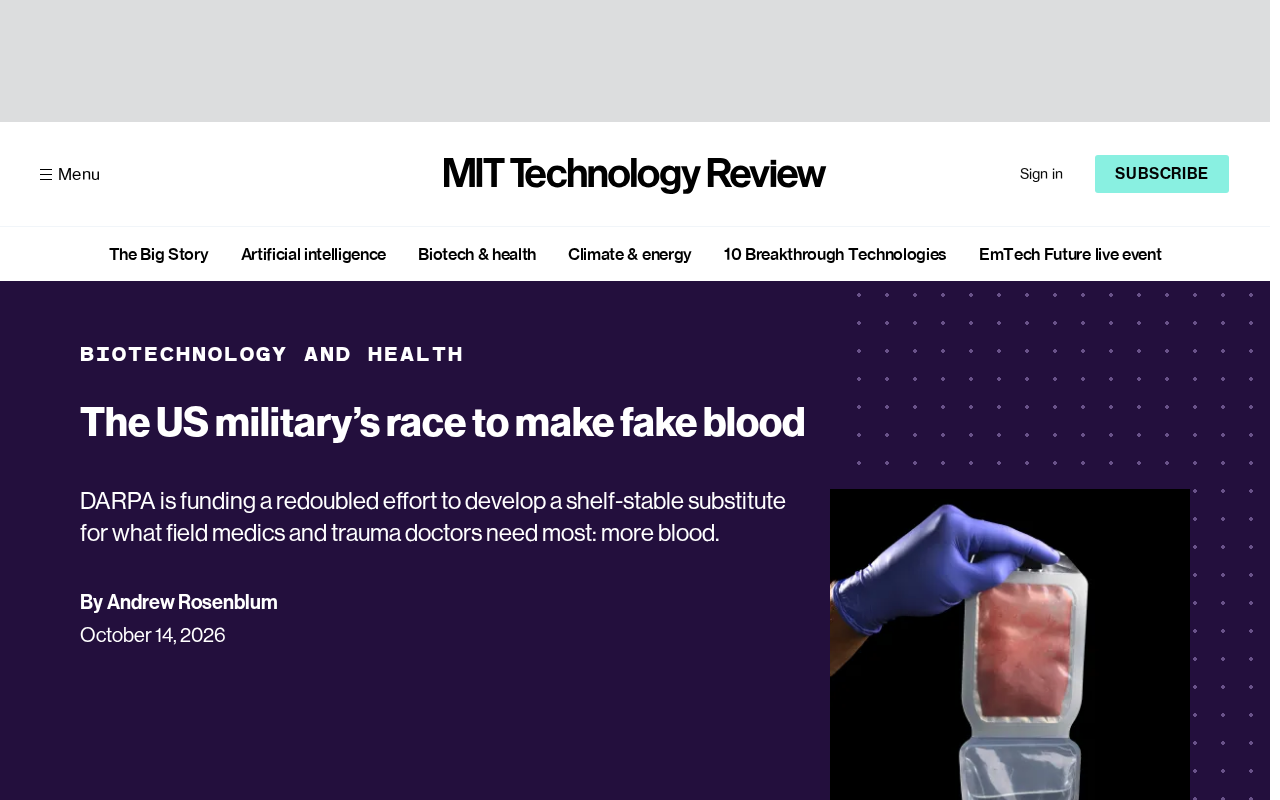
The Brutal Reality of Battlefield Blood Transfusion
In battlefield environments, blood supply faces almost insurmountable obstacles. Fresh whole blood requires strict blood type matching, cold-chain transport, and has a limited shelf life — conditions that are often impossible to meet at frontline positions. When soldiers suffer massive blood loss from explosions or gunshot wounds, medics frequently face the dilemma of having "no blood to transfuse." Although traditional freeze-dried plasma is easy to transport, it requires reconstitution time and falls short of fresh blood in terms of function.
This predicament has spawned an ambitious research direction: creating artificial blood — a blood substitute that can be stored at room temperature, requires no blood type matching, and can be mass-produced. According to relevant reports, the US military has continuously invested in this field for years, attempting to fundamentally change the rules of battlefield emergency care.
Freeze-dried plasma is a powdered product made by freeze-drying fresh plasma; it only needs to be reconstituted with sterile water or saline before transfusion. Its advantages include long-term storage at room temperature and easy portability, making it ideal for battlefields and other scenarios lacking cold-chain conditions. However, the reconstitution process for freeze-dried plasma typically takes several minutes, and in split-second battlefield emergency care, those few minutes can mean the difference between life and death. Additionally, the freeze-drying process causes some loss of coagulation factor activity, making it less effective than fresh frozen plasma in correcting severe coagulation disorders. For these reasons, the military has been searching for alternatives that can be stored at room temperature, used immediately, and function more like whole blood — which has become the direct impetus driving artificial blood research.
Technical Approaches to Artificial Blood
Artificial blood research is not a single-track endeavor. The main current technical approaches include hemoglobin-based oxygen carriers, perfluorocarbon emulsions, and stem cell-cultured red blood cells.
Hemoglobin-based oxygen carriers attempt to use chemically modified bovine or human hemoglobin to carry oxygen; these products can be freeze-dried and reconstituted for use within minutes. Perfluorocarbons transport oxygen through physical dissolution, but their oxygen-carrying capacity is relatively limited. The stem cell culture approach could theoretically produce substitutes functionally identical to natural red blood cells, but costs are extremely high and production capacity is constrained.
Each approach has its pros and cons. Although hemoglobin-based products are easy to store, early clinical trials revealed side effects such as vasoconstriction. Perfluorocarbons, while relatively safe, require patients to inhale high concentrations of oxygen to be sufficiently effective. The stem cell approach, though closest to "real blood," remains far from large-scale production.
Hemoglobin-based oxygen carriers (HBOCs) are a class of blood substitutes made from chemically modified cell-free hemoglobin. Natural hemoglobin exists within red blood cells; once freed into plasma, it is rapidly cleared by the kidneys and may cause nephrotoxicity. Therefore, researchers use chemical modification methods such as cross-linking, polymerization, or PEGylation to extend its half-life in circulation and reduce toxic side effects. Early products like HemAssist and PolyHeme experienced serious adverse events such as vasoconstriction and myocardial infarction in clinical trials, primarily because cell-free hemoglobin scavenges nitric oxide, leading to abnormal vascular tone. Despite repeated setbacks, new-generation HBOCs continue to attempt to overcome these problems through more refined molecular design.
Why This Is So Difficult
Blood is one of the most complex tissues in the human body. Red blood cells are not merely oxygen couriers; they also participate in immune regulation, coagulation, and maintenance of vascular function. Simply replicating the oxygen-carrying function of red blood cells cannot fully replace the comprehensive role of real blood in the body.
Another core challenge is large-scale production. Battlefields may require thousands upon thousands of units of blood products, yet laboratory-scale production processes often cannot meet demand at that magnitude. Cost control is equally critical — if the price per unit of artificial blood far exceeds that of natural blood, the military's willingness to procure it on a large scale would be greatly diminished.
Regulatory approval is also a high barrier. Blood substitutes are biological products and require rigorous clinical trials to verify their safety and efficacy. Moreover, battlefield use scenarios are difficult to evaluate through standard clinical trial designs, making the approval process even more complex.
Blood's immunoregulatory and coagulation functions extend far beyond simple oxygen transport. The surface of red blood cells carries complement receptors that can bind immune complexes and transport them to the liver and spleen for clearance, thereby participating in innate immune defense. Red blood cells also regulate local vascular tone by releasing signaling molecules such as ATP and NO, influencing blood flow distribution. In coagulation, red blood cells provide a phospholipid surface that accelerates the assembly of coagulation factor complexes, which is crucial for thrombus formation. Furthermore, blood type antigens on the red blood cell membrane determine transfusion compatibility, and if artificial products are to fully replace blood, they must simultaneously solve the dual challenges of immune compatibility and functional integration. These complex physiological roles make it difficult for any single-function blood substitute to comprehensively mimic real blood.
Potential Impact on Civilian Medicine
The US military's investment in artificial blood has significance far beyond the battlefield. In the civilian sector, blood shortages are likewise a global problem. Natural disasters, traffic accidents, and surgical procedures all require large quantities of blood products, and blood bank supplies are frequently stretched thin.
If artificial blood technology matures and achieves mass production, transfusion challenges in medical facilities in remote areas, emergency scenes, and mass casualty events would all be alleviated. Additionally, artificial blood could avoid the risk of transmitting bloodborne infectious diseases, which is particularly important in regions with high incidence of diseases such as AIDS and hepatitis.
From a longer-term perspective, a breakthrough in artificial blood will redefine the boundaries of emergency medicine. When blood is no longer a scarce resource, doctors will have greater freedom in formulating treatment plans, and patient survival rates are expected to improve significantly.
Bloodborne infectious diseases refer to pathogen infections transmitted through blood transfusion or blood products, including human immunodeficiency virus (HIV), hepatitis B virus (HBV), hepatitis C virus (HCV), and Treponema pallidum. Although modern blood banks have adopted nucleic acid testing technology to greatly shorten the window period, in resource-limited areas, screening coverage and detection sensitivity remain difficult to guarantee. Because artificial blood does not depend on donors, it fundamentally eliminates the risk of pathogen introduction. This is especially significant for regions with high HIV and hepatitis prevalence such as sub-Saharan Africa, where it could significantly reduce secondary infections caused by blood transfusion and improve overall public health.
The Intersection of Technology and Ethics
The development of artificial blood has also triggered a series of ethical discussions. Who should have priority access to this scarce medical resource? On the battlefield, can all wounded soldiers obtain artificial blood equally? If the technology is monopolized by a few countries or corporations, will it exacerbate global inequality in medical resources?
These questions have no simple answers. But what is certain is that the US military's investment in this "fake blood race" is pushing the entire field of transfusion medicine forward. Regardless of which technical approach ultimately prevails, soldiers on the battlefield and patients in hospitals will be the ultimate beneficiaries.
One-line Summary
The US military is driving artificial blood research to solve battlefield transfusion challenges and benefit civilian medicine.
Paragraph Summary
This article explores the US military's urgent need for artificial blood in the context of the Iraq War. Because fresh blood faces limitations on the battlefield such as cold-chain transport, blood type matching, and short shelf life, and freeze-dried plasma has issues with reconstitution time and insufficient function, the military has continuously invested in artificial blood research. There are currently three main technical approaches — hemoglobin-based oxygen carriers, perfluorocarbon emulsions, and stem cell-cultured red blood cells — each with its own pros and cons. The complexity of blood — such as immune regulation and coagulation functions — makes complete replacement extremely difficult, and combined with challenges in large-scale production, cost control, and regulatory approval, artificial blood remains far from large-scale application. However, once this technology matures, it will not only transform battlefield emergency care but also alleviate global blood shortages, prevent bloodborne infectious diseases, and spark ethical discussions about fairness in resource allocation.
Related articles

2026 AI Coding Tools Comparison: Claude, ChatGPT, Gemini — Which Is the Best?
A 2026 comparison of five mainstream AI coding tools — Claude Code, ChatGPT Codex, Gemini, DeepSeek, and GitHub Copilot — on real projects, pricing, and code quality, to help you decide where that $20/month should go.

ChatGPT Codex Can Clone Any Software? Testing the Risks and the Truth
YouTube shorts claim ChatGPT Codex or Claude Code can clone Adobe, Excel, and Figma for lifelong free use. We break down the feasibility, legal risks, and DM-funnel tactics—and explain what AI coding tools are truly good for.

Kilo Code Is Free to Install but Charges for API: Cost Estimation and Configuration Guide
Kilo Code is free to install, but connected AI models are billed per token. This guide covers VS Code extension and CLI setup and shows how to estimate API costs.