How Is Codex Different from ChatGPT? Breaking Down the Core Differences of the AI Coding Agent

Codex is an AI coding agent that executes tasks autonomously, while ChatGPT provides conversational guidance.
This article breaks down the core differences between OpenAI's Codex and ChatGPT. While ChatGPT serves as a conversational assistant for answering questions and generating code snippets, Codex is an AI coding agent that autonomously reads codebases, writes code, fixes bugs, and runs tests in a cloud sandbox. The piece explores how AI coding agents are reshaping the development paradigm and why developers need to adapt by mastering prompt engineering and AI collaboration skills.
What Is Codex? More Than Just a Chatbot
Codex is an AI coding agent developed by OpenAI. The key word here is "agent" — it's not merely a conversational tool that generates code snippets, but a working partner capable of autonomously completing programming tasks.
The concept of an "Agent" is one of the most important technical paradigms in AI today. Unlike traditional conversational AI, an agent possesses three core capabilities: autonomous planning, tool invocation, and environment interaction. It can break down a complex task into multiple sub-steps, sequentially call different tools (such as code editors, terminals, and file systems) to carry out execution, and dynamically adjust its subsequent strategy based on intermediate results. This "perceive-plan-act" loop transforms AI from a passive responder into an active executor. OpenAI made Agents a core strategic direction in 2025, and Codex is the concrete implementation of that strategy in the software development domain.
Specifically, Codex can help developers with the following tasks:
- Generating code: Automatically writing code based on requirement descriptions
- Reading and understanding code: Analyzing the logic of existing project codebases
- Fixing bugs: Locating issues and autonomously repairing them
- Running tests: Automatically executing test cases to verify code correctness
- Executing commands and scripts: Performing various operations within the development environment
The reason Codex can truly "execute autonomously" rather than merely generate text lies in its cloud-based sandbox execution environment. Whenever a user initiates a task, Codex spins up an isolated computing environment in the cloud, pre-loaded with the project's code repository and dependencies. Within this sandbox, Codex can freely read and write files, execute commands, and run tests — all without affecting the user's local development environment or production systems. This design ensures both security and gives the AI genuine "hands-on" capability — it's not simulating execution but running code in a real environment and receiving feedback.
This means Codex's positioning goes far beyond a "code generator." If all you want is for AI to write a code snippet that you then copy and paste, tools like Doubao, DeepSeek, or ChatGPT itself are sufficient. But what Codex aims to do is truly "do the work" for you.
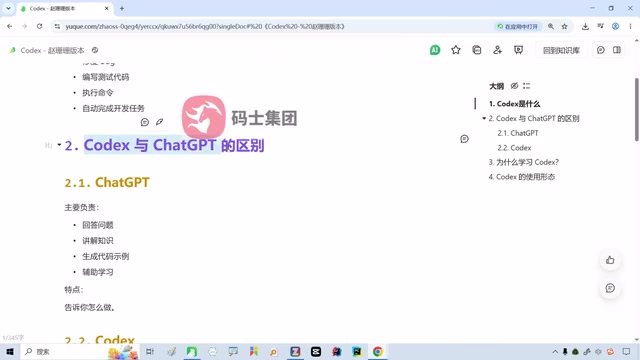
Codex vs ChatGPT: The Core Difference Between Talking and Doing
Many people wonder when they first encounter Codex: isn't this just ChatGPT? After all, the large model underlying Codex is indeed ChatGPT. But the two have fundamentally different positioning and capability boundaries.
From a technical perspective, the reason the large language model (LLM) underlying Codex possesses powerful programming capabilities is that its training data includes massive amounts of open-source code repositories (such as public projects on GitHub), technical documentation, and content from Q&A communities like Stack Overflow. Through pre-training on this data, the model learned syntax rules, design patterns, API usage, and common bug-fixing approaches across various programming languages. OpenAI also performed specialized fine-tuning and reinforcement learning from human feedback (RLHF) for coding scenarios, significantly improving the model's accuracy, safety, and style consistency in code generation. The codex-1 model is a version specifically optimized for this use case.
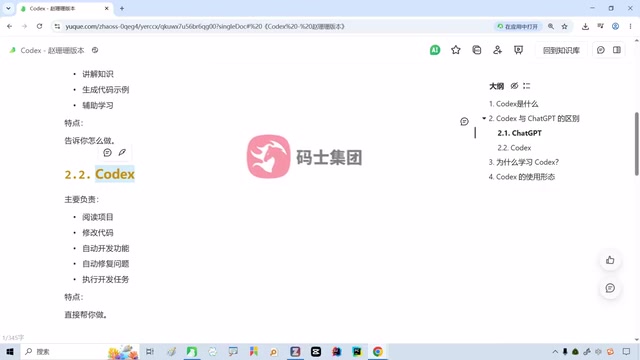
ChatGPT: Like a Technical Instructor
ChatGPT's core interaction mode is conversation. You can ask it: "How do I implement a login feature in Spring Boot?" It will explain the principles in detail, provide example code, and even help you organize your implementation approach. But ultimately, you need to do the work yourself — copy and paste the code into your IDE, debug it yourself, and get it running on your own.
Scenarios where ChatGPT excels include:
- Answering technical questions
- Explaining knowledge and concepts
- Generating code snippets
- Assisting with learning and comprehension
Codex: Like a Programmer Colleague
Codex's interaction mode is task-driven. You can simply say: "Build the login feature for me." Then Codex will autonomously carry out a series of operations — reading the project code, understanding the context, writing new code, modifying existing files, running tests, debugging issues — and finally tell you: "It's done."
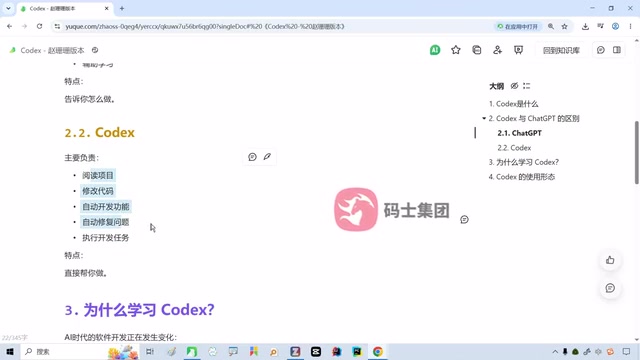
The difference between the two can be summed up in one sentence:
ChatGPT does the talking; Codex does the doing.
ChatGPT plays the role of a consultant, providing advice and solutions; Codex plays the role of an executor, directly implementing them. The two are not replacements for each other but serve different stages of AI-assisted programming, each fulfilling its own role.
Why Developers Need to Learn Codex
The Programming Paradigm Is Undergoing a Fundamental Shift
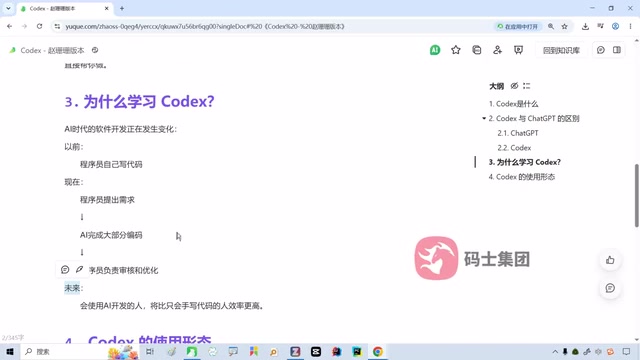
We are experiencing a major transformation in software development. In the past, a programmer's core job was "writing code by hand" — every line, every function had to be typed out manually. Now, the development workflow is evolving into:
- The programmer defines the requirements → 2. The AI agent completes most of the code → 3. The programmer reviews and optimizes
In fact, this isn't the first time the software development paradigm has shifted. From machine language to assembly, from assembly to high-level languages (C, Java), from hand-written code to visual development (low-code/no-code platforms) — each increase in abstraction level has allowed developers to accomplish more business logic with fewer low-level operations. AI coding agents can be seen as the latest link in this evolutionary chain — they raise the abstraction level from "writing code" to "describing intent." But just as high-level languages didn't eliminate the need for understanding low-level principles, AI programming won't eliminate the dependency on foundational programming knowledge. In fact, it raises the bar for developers' system design capabilities and engineering judgment.
Under this model, programmers who know how to use AI development tools will be far more productive than those who write code purely by hand. Tools like Codex, Claude Code, and Cursor are all products of this trend.
AI Won't Replace Programmers, but It Will Redefine Core Competencies
A common anxiety is: will AI coding agents make programmers obsolete? The answer is no, but the core competencies of programmers are shifting.
In the past, a programmer's ability might have been measured by "how fast they write code" or "how many lines they can write in a day." In the AI era, the most valuable skill is the ability to communicate requirements to AI — specifically:
- Can you clearly decompose and describe business requirements?
- Can you judge whether AI-generated code is correct and optimal?
- Can you optimize at the architectural level based on AI output?
- Can you understand the big picture of a project and provide sufficient context to the AI?
This "ability to communicate requirements to AI" is technically known as Prompt Engineering. In the context of coding agents, this skill is far more complex than simple chat prompts. Developers need to master how to provide sufficient project context (such as tech stack, architectural conventions, and coding standards), how to translate vague business requirements into clear, AI-executable instructions, how to set reasonable constraints (such as "don't modify the existing database schema"), and how to iteratively guide the AI toward the desired result through feedback. This is essentially a new kind of "programming language" — using natural language to precisely describe intent and constraints.
If you know nothing about programming, even if AI writes the code for you, you won't be able to review it, optimize it, or make the right judgment when something goes wrong. So, programming fundamentals remain important, but the way they're applied has changed.
Where Codex Fits in the AI Programming Tool Ecosystem
The AI programming tool space is already quite crowded: OpenAI's Codex, Anthropic's Claude Code, Cursor, Windsurf, Trae, and other products each have their own strengths. Codex's core advantage lies in being backed by OpenAI's model capabilities and entering the market positioned as an "agent" rather than an "autocomplete assistant."
From an industry landscape perspective, current AI programming tools can be roughly divided into three tiers: The first tier is code completion tools, such as GitHub Copilot, which provides real-time line-level or function-level code suggestions within the IDE — the earliest widely adopted form of AI programming assistance. The second tier is AI-enhanced IDEs, such as Cursor and Windsurf, which deeply integrate AI capabilities into the editor, supporting multi-file editing and context awareness, allowing developers to interact with AI at any point during coding. The third tier is coding agents, such as Codex and Claude Code, which can operate independently of the IDE and autonomously complete the entire workflow from requirement understanding to code delivery. Anthropic's Claude Code uses a command-line interaction approach, emphasizing fine-grained developer control over the execution process, while Codex offers a more intuitive task management experience through a web interface. ByteDance's Trae represents active investment from Chinese tech companies in this space.
For developers, the significance of learning Codex lies not just in mastering a specific tool, but in understanding the working paradigm of AI coding agents — how to collaborate with AI, how to allocate tasks between humans and machines, and how to maximize development efficiency. This capability is transferable — regardless of which tool ultimately wins out, the core methodology remains the same.
Summary
Codex represents the evolution of AI-assisted programming from "conversational generation" to "autonomous execution." It's not a simple wrapper around ChatGPT, but a coding agent capable of understanding project context and autonomously completing development tasks. For developers, getting familiar with these tools early and learning to "direct AI to write code" rather than "burying yourself in writing code" will be key to future career competitiveness.
Key Takeaways
Related articles

Disaster and Glory of the Apollo Program: The History We Must Revisit Before Returning to the Moon
From the fatal Apollo 1 fire to Apollo 8's daring lunar orbit to Apollo 11's successful landing—revisiting the disasters, fears, and compromises of the Apollo program and their lessons for today's return to the Moon.

Netflix Trust Exercise Turns Into Firing Trap: Where Are the Boundaries of Corporate Trust?
A Netflix employee was fired after sharing private info in a trust exercise. We analyze the risks of corporate trust exercises and how employees can protect themselves.

AMD CDNA5 Architecture Deep Dive: Technical Evolution and the AI Computing Competition Landscape
Deep analysis of AMD's CDNA5 architecture covering Chiplet packaging upgrades, HBM memory evolution, and low-precision compute optimization, examining how AMD challenges NVIDIA's AI chip dominance.