How Language Model Prediction Depth Affects Human Reading Times

Language model prediction depth independently predicts human reading times, beyond final-layer surprisal.
A new study proposes that language model prediction depth—the network layer near which the model finalizes a word prediction—independently predicts human reading times. Using a tuned lens to obtain layer-by-layer surprisal trajectories, it defines resolution depth as the depth where surprisal changes most sharply. Across eight English corpora and ten GPT-2, OPT, and Pythia models, later-predicted words and their successors take longer to read, even with equal final-layer surprisal. Adding resolution depth improves prediction by 0.26 millinats per word, about one-third of the entropy gain. Untrained networks show no such effect.
Language model (LM) surprisal—the model's predicted probability of the next word—has been widely used to predict human reading times. However, models don't make predictions only at the final layer; they compute and refine predictions layer by layer. A new study proposes that the "depth" of a prediction (i.e., the network layer at which the model essentially finalizes its prediction for a word) can also independently predict reading times, offering a new dimension for understanding the link between language models and human cognition.
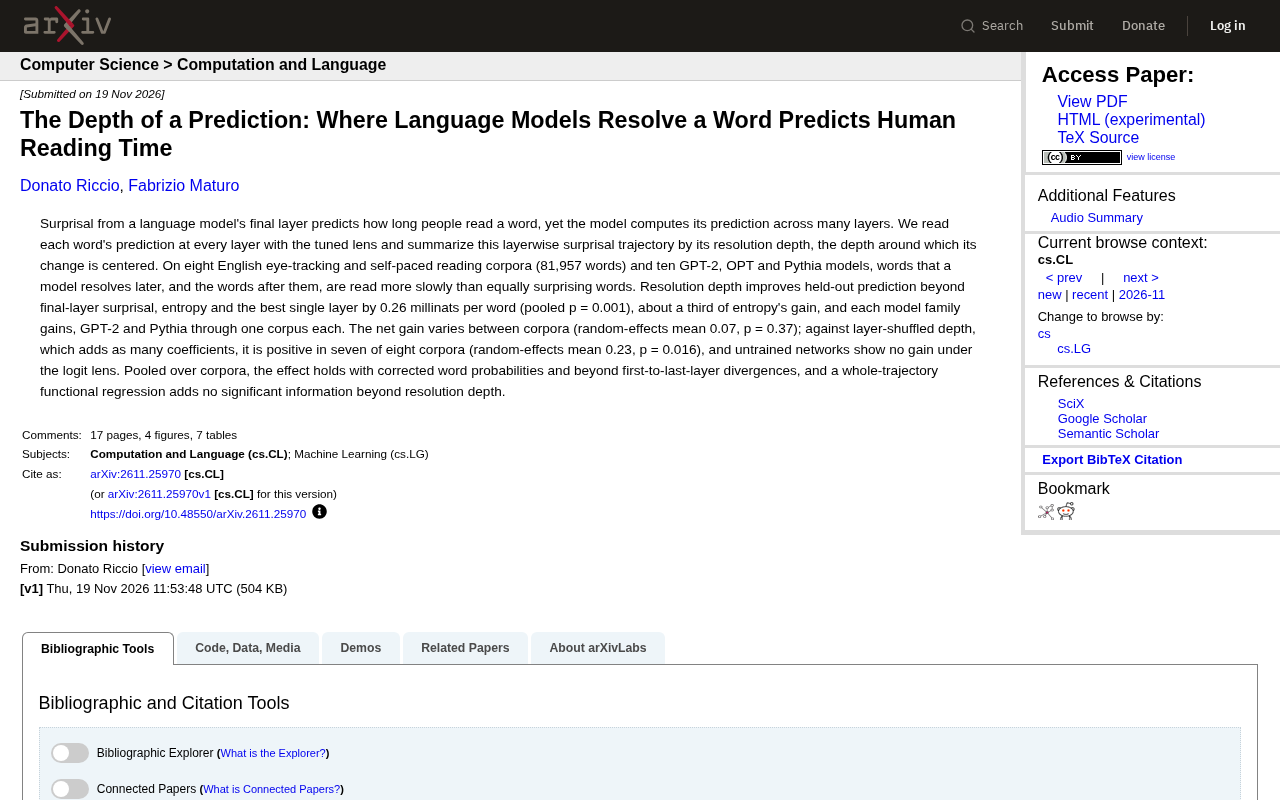
From the Final Layer to Layer-by-Layer Trajectories: Introducing Prediction Depth
Traditional research typically computes surprisal only from the final layer's output and finds it correlates with reading times. But a model's prediction for each word is gradually formed across layers: early layers may offer vague guesses, and later layers progressively converge. The researchers used a "tuned lens" technique to read out the model's predictive distribution for the current word at each layer, yielding a "layer-by-layer surprisal trajectory" for each word.
They summarize this trajectory with "resolution depth," the central depth at which surprisal changes most sharply. In other words, this metric measures the layer near which the model "makes up its mind" to predict a given word.
Tuned lens is a technique for interpreting neural network internal representations. Its core idea: for each layer, train a simple affine transformation (or small linear mapping) that maps that layer's hidden state into the output vocabulary space, yielding that layer's predictive distribution for the next word. Compared with directly using an untuned logit lens, the tuned lens trains a separate mapping for each layer and thus more accurately reflects the predictive information contained in that layer. Specifically, the tuned lens mapping parameters are learned on training data by minimizing the difference between each layer's predictive distribution and the final layer's predictive distribution. This lets researchers "read out" the model's prediction for the current word at each layer and track how it changes with depth, providing the basis for defining "resolution depth."
Experimental Design: Eight Corpora and Ten Models
The study used eight English eye-tracking and self-paced reading corpora, totaling 81,957 words, and tested ten models from the GPT-2, OPT, and Pythia families. These models span different sizes and architectures, ensuring the robustness of the conclusions.
The analysis focused on two questions: first, whether prediction depth provides additional information beyond final-layer surprisal; second, whether this effect is consistent across multiple corpora and models.
GPT-2, OPT, and Pythia are three widely used families of autoregressive language models spanning different sizes and training strategies. GPT-2, developed by OpenAI, ranges from 117 million to 1.5 billion parameters and uses a Transformer decoder architecture; OPT (Open Pre-trained Transformer), released by Meta, ranges from 125 million to 175 billion parameters and aims to promote reproducible research on large models; Pythia, introduced by EleutherAI, ranges from 70 million to 12 billion parameters and trains multiple checkpoints on the same data order, facilitating research on training dynamics. The diversity of these model families in architecture, training data, and scale allows researchers to test whether the prediction-depth effect robustly exists across different models rather than being an incidental phenomenon of a particular model.
Key Finding: Later Predictions, Slower Reading
Results show that the later a model predicts a word (i.e., the greater the resolution depth), the longer human readers take to read that word and the word immediately following it—even when those words have the same final-layer surprisal. This indicates that the "delay" of a prediction itself reflects the difficulty of cognitive processing.
When predicting reading times, adding resolution depth improved held-out predictive performance by 0.26 millinats per word (pooled p = 0.001) over using only final-layer surprisal, entropy, or the best single-layer metric—roughly one-third of the entropy gain. Every model family showed an improvement, with GPT-2 and Pythia each significant on one corpus.
A detail: this net gain varies across corpora (random-effects mean 0.07, p = 0.37). But compared with layer-shuffled depth—which adds the same number of coefficients—resolution depth performed better on seven of eight corpora (random-effects mean 0.23, p = 0.016). Moreover, untrained networks under the logit lens showed no such gain, indicating the effect depends on knowledge learned by the model.
Nat is a unit of information in information theory based on the natural logarithm; 1 nat equals the base-2 logarithmic unit bit multiplied by ln(2), approximately 0.693 bits. In language model evaluation, surprisal is typically computed in nats, i.e., negative log probability: -ln P(w|context). Thus, a gain of 0.26 millinats (0.00026 nats) per word means the log loss of the model's predicted probability is reduced by 0.00026; though seemingly tiny, it accumulates over large numbers of word tokens to be statistically significant. The comparison with the entropy gain (about one-third) suggests that prediction depth provides additional information independent of surprisal, with an effect size that is meaningful in cognitive modeling.
Robustness Checks and Theoretical Implications
After pooling corpora, the effect persists even when using corrected word probabilities or controlling for divergence from the first to the last layer. Full-trajectory function regression also provided no significant additional information beyond resolution depth, indicating that resolution depth is a concise and effective summary metric.
These findings suggest that human reading times are sensitive not only to the "unexpectedness" of a prediction but also to the "process of formation" of that prediction. The layer-by-layer computational trajectory of language models may partially mimic the real-time language processing dynamics of the human brain.
Limitations and Future Directions
The study also notes that the effect varies across corpora and that the gain is relatively small. In addition, only English corpora and a few model families were tested; generalizability across languages and architectures remains to be verified. Future work could explore finer-grained trajectory features and the possibility of combining prediction depth with other cognitive metrics.
One-line Summary
Language model prediction depth for words independently predicts human reading times, beyond final-layer surprisal.
Paragraph Summary
A new study proposes that language model prediction depth (the network layer near which the model finalizes its prediction for a word) can independently predict human reading times. Using a tuned lens to obtain layer-by-layer surprisal trajectories, the researchers define resolution depth as the central depth where surprisal changes most sharply. Across eight English reading corpora and ten models (GPT-2, OPT, Pythia families), they find that words predicted later—and the words following them—take longer for humans to read, even with equal final-layer surprisal. Adding resolution depth improves reading-time prediction by 0.26 millinats per word over final-layer surprisal alone—about one-third of the entropy gain. Untrained networks show no such effect, indicating it depends on learned knowledge. The effect varies across corpora, and cross-language and cross-architecture generalizability remains to be verified.
Related articles

Prompt Engineering for Beginners: From Writing Prompts to Engineering Thinking
Starting from the essence and four functions of prompts, this article systematically explains the six-step process, four success criteria, learning value, and practical limitations of prompt engineering to help you build a complete understanding.

Anthropic Launches Nasdaq IPO: AI Giant's Listing and Risk Disclosures
Anthropic officially launches its Nasdaq IPO under ticker ANT, with market valuation expected to potentially exceed SpaceX's record. The prospectus devotes nearly 100 pages to AI risks, while first-half revenue grew over 14x but net losses widened sharply, reigniting the AI bubble debate.

Rust cURL Clone Uses 4,832 unsafe Blocks—Is the Memory Safety Myth Broken?
A Rust cURL clone uses 4,832 unsafe keywords, challenging Rust's memory safety narrative. We analyze what unsafe really means, compare Fil-C, and examine rewrite motives.