How Lexical Interventions Enable Cross-Lingual Knowledge Transfer for Low-Resource Languages
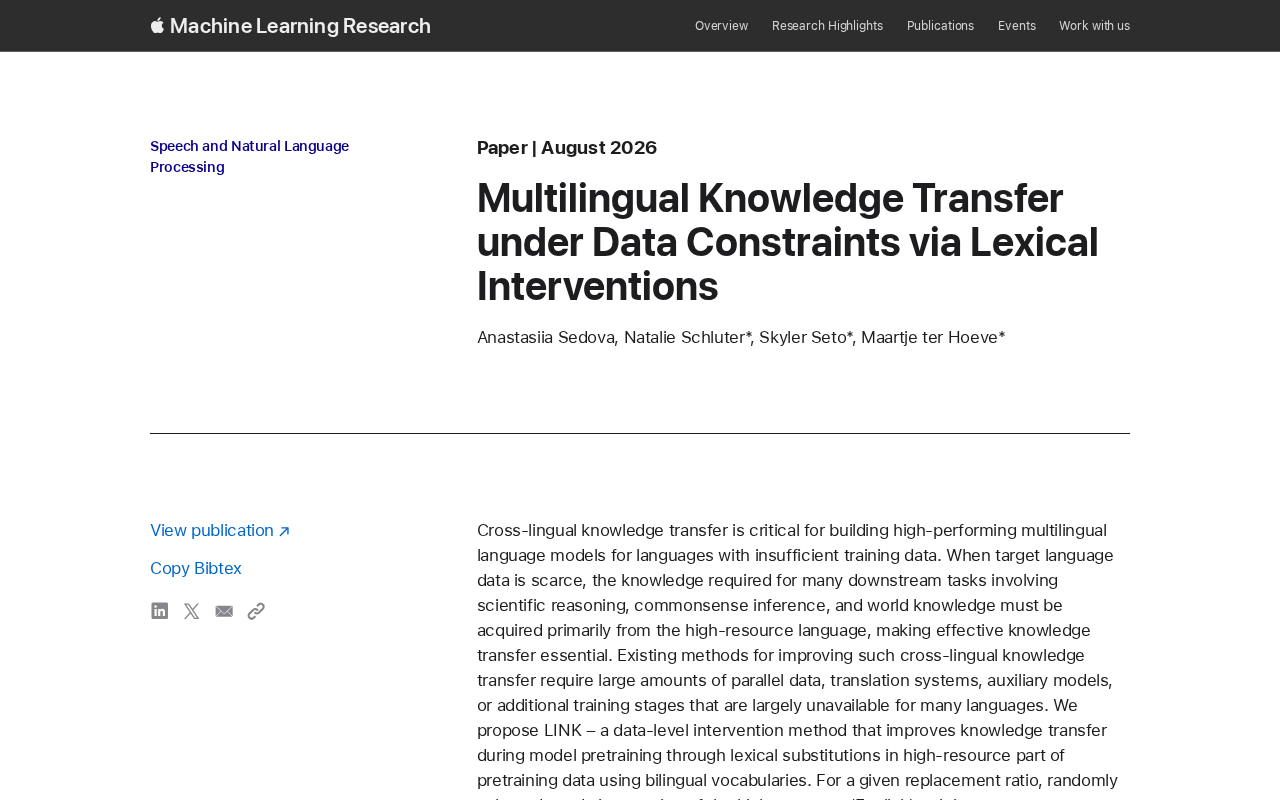
Lexical interventions offer a lightweight path to transfer knowledge from high-resource to low-resource languages.
This article examines how lexical intervention methods address the challenge of cross-lingual knowledge transfer for low-resource languages. By operating at the vocabulary and embedding level rather than relying on costly parallel corpora, translation systems, or auxiliary models, these lightweight approaches lower the barrier for transferring scientific reasoning, commonsense inference, and world knowledge from high-resource languages to data-scarce ones, advancing the democratization of multilingual AI.
The Knowledge Gap Facing Multilingual Models
Building high-performance multilingual language models has always faced a fundamental challenge: the extreme imbalance in data distribution. High-resource languages like English have access to massive training corpora, while the vast majority of the world's languages—especially low-resource ones—suffer from a severe lack of available data. According to Ethnologue, there are approximately 7,000 living languages worldwide, yet over 90% of internet text content covers fewer than 100 of them. In NLP research, languages with abundant digitized text (such as English, Chinese, and Spanish) are typically classified as high-resource languages, while those with extremely scarce text data (such as Yoruba, Chichewa, and many South Asian and African languages) are classified as low-resource languages. The roots of this data imbalance lie in historical and economic factors, as well as technical barriers like digital infrastructure and the degree of writing system standardization.
This imbalance leads directly to a thorny question: when a target language lacks sufficient training data, where should the knowledge required for downstream tasks come from?
Research indicates that for many downstream tasks involving scientific reasoning, commonsense inference, and world knowledge, the necessary knowledge must primarily be acquired from high-resource languages (typically English). In other words, cross-lingual knowledge transfer is no longer a nice-to-have optimization—it is a core prerequisite for making low-resource language models truly usable. Cross-lingual knowledge transfer is one of the central research directions in NLP. Its basic idea is to leverage the linguistic representations and world knowledge learned from high-resource languages to help models perform corresponding tasks in low-resource languages. The theoretical foundation of this paradigm stems from the cross-lingual shared representation spaces that multilingual pre-trained models (such as mBERT and XLM-R) spontaneously develop during training—meaning that the semantics of different languages are mapped to nearby vector regions within the model. However, the quality of this spontaneous alignment is highly dependent on the amount of training data for each language and the typological distance between languages.
The Cost Dilemma of Existing Cross-Lingual Transfer Methods
Cross-lingual knowledge transfer is not a new research topic, and the academic community has proposed numerous improvement approaches. However, these methods generally share a common problem—they are costly and have steep entry barriers.
Mainstream existing approaches typically depend on one or more of the following resources:
- Large-scale parallel corpora: High-quality bilingual aligned data, which is itself extremely scarce for low-resource languages. Parallel corpora refer to bilingual or multilingual texts precisely aligned at the sentence or paragraph level, with typical sources including United Nations documents, European Parliament proceedings, and religious text translations. Such data is the cornerstone for training machine translation systems and cross-lingual alignment models. However, building high-quality parallel corpora requires the involvement of professional translators and is extremely expensive. For low-resource languages, available parallel corpora are often limited to a handful of domain-specific texts like Bible translations, with extremely limited domain coverage that cannot support general NLP task requirements.
- Translation systems: Using machine translation to convert high-resource language data into the target language, which introduces translation quality issues and error propagation
- Auxiliary models: Requiring additional models to be trained or deployed to support the transfer process
- Extra training stages: Adding complex multi-stage procedures beyond the standard training pipeline, significantly increasing computational overhead and engineering complexity
These dependencies create a paradox: the more data-scarce a language is, the harder it is to meet these methods' high resource requirements. For the long-tail languages that genuinely need help, existing approaches often fall short. This is precisely the impasse that lexical intervention methods aim to break.
Lexical Interventions: A Lightweight Approach to Knowledge Transfer
The core value of lexical interventions lies in bypassing the heavy dependence on parallel data, translation systems, and additional training stages, and instead performing lighter-weight operations at the lexical level to achieve cross-lingual knowledge transfer.
Why Focus on the Lexical Level
Vocabulary is the most fundamental unit of language and a natural bridge for knowledge mapping between different languages. Compared to constructing complete parallel sentence pairs or training complex alignment models, lexical-level interventions have several inherent advantages:
- Low cost: Lexical interventions typically do not require massive aligned corpora and can be implemented with limited resources
- Strong interpretability: Operations at the lexical level are more transparent, making it easier to analyze how knowledge actually flows from high-resource to low-resource languages
- Good generalizability: These methods have the potential to adapt to multiple languages and downstream tasks without redesigning complex pipelines for each scenario
From a technical perspective, the intuition behind lexical intervention methods comes from an important observation: the vocabulary and embedding layer of multilingual models are critical bottlenecks for knowledge interaction across languages. In the Transformer architecture, input text is first segmented into subword units by a tokenizer, then mapped to vector representations through the embedding layer. Because different languages use different writing systems, their subword distributions vary dramatically. The core strategy of lexical interventions is to perform targeted operations at this level—such as lexical replacement, vocabulary expansion, and cross-lingual lexical mapping—enabling low-resource language vocabulary to more effectively borrow the knowledge representations of corresponding concepts in high-resource languages.
It is worth noting that current mainstream multilingual pre-trained models, such as Google's mBERT, Meta's XLM-RoBERTa, and recent models like BLOOM and the Llama series, naturally develop a certain degree of cross-lingual representation sharing through joint pre-training on mixed-language corpora. This sharing mechanism is partly attributable to loanwords between languages, shared subwords, and similar syntactic structures. However, research has shown that this spontaneously formed cross-lingual alignment degrades significantly for typologically distant language pairs and still shows notable deficiencies in tasks requiring deep semantic understanding. Lexical intervention methods are designed precisely against this backdrop, attempting to compensate for the shortcomings of spontaneous alignment through more proactive and precise lexical-level operations.
Unique Value in Data-Constrained Scenarios
This research explicitly targets its application scenario to "data-constrained" conditions. This positioning is highly relevant to real-world needs—in the real world, the vast majority of languages exist in a state of data scarcity. A method that does not rely on large-scale parallel data, translation systems, or auxiliary models means it can be deployed to a wider range of languages at a lower threshold, thereby truly advancing the democratization of multilingual AI.
Profound Implications for Multilingual AI Development
Multilingual capability is a critical benchmark for measuring whether a large language model is truly "general-purpose." Current mainstream large models perform excellently in high-resource languages like English, but there remains a clear performance gap in low-resource languages. This gap is not merely a technical issue—it also concerns the fairness and inclusivity of AI technology. If advanced AI capabilities can only serve users of a handful of languages, the technology divide will further deepen digital inequality.
Inequality in language technology has attracted widespread attention from the academic community and international organizations. UNESCO explicitly stated in its Recommendation on the Ethics of AI that AI systems should respect linguistic diversity and promote the development of multilingual content. On a practical level, the absence of language technology means that hundreds of millions of non-English speakers cannot equally access AI-driven services such as information retrieval, intelligent customer service, educational assistance, and medical consultation. This "Digital Language Divide" not only affects individual development opportunities but may also accelerate the extinction of endangered languages, as languages lacking a digital presence are more likely to be abandoned by younger generations.
The value of lightweight methods like lexical interventions lies precisely here: they lower the resource threshold for cross-lingual knowledge transfer, giving critical capabilities such as scientific reasoning, commonsense inference, and world knowledge the opportunity to be delivered at lower cost to data-scarce language communities.
Of course, as a research effort, the practical effectiveness of lexical intervention methods still needs to be thoroughly validated across specific benchmarks and diverse language scenarios. Their generalization ability across different task types and language families, as well as performance comparisons with existing methods, are all directions worthy of continued attention.
Summary and Outlook
Cross-lingual knowledge transfer is a key component in building inclusive multilingual AI. Lexical intervention methods attempt to find a lighter, lower-barrier path for knowledge transfer under real-world data constraints, avoiding heavy dependence on parallel data, translation systems, and extra training stages. For researchers and practitioners committed to making AI technology serve the world's diverse language communities, this line of exploration points to a valuable direction—bridging the knowledge gap between languages with smarter, rather than more expensive, approaches.
Related articles

Chain of Thought Isn't Just for AI: How Humans Can Use CoT to Improve Thinking Quality
Chain of Thought isn't just a prompt trick for large models. Starting from a Hacker News discussion, this article analyzes why CoT works for human thinking too, breaks down actionable ways to transfer it, and highlights the key differences between human CoT and machine CoT.
Cloudflare Teams Up with OpenAI: Closi…
Cloudflare Teams Up with OpenAI: Closing the Loop from Vulnerability Discovery to Defense with AI
Cloudflare uses OpenAI Daybreak to investigate security vulnerabilities and generate reviewable remediation plans, while developers use Codex to boost coding efficiency and quality.

Orca Multi-Agent Orchestration in Practice: A Guide to Parallel Collaboration with Claude and Codex
Orca is Stable AI's free open-source agent workbench supporting 34 agents like Claude Code and Codex in parallel. Learn its Git worktree isolation, multi-model orchestration, and mobile management.