How LLMs Read Full-Trajectory Evidence to Make Better Between-Round Decisions in Autonomous Research

BRED lets LLMs make between-round decisions using only the champion solution and round logs, outperforming baselines on multiple benchmarks.
BRED (Between-Round Evidence-based Decision) is an LLM-based between-round decision controller for autonomous research systems. It does not rely on search trees, rule engines, or scoring functions; instead, it lets the LLM directly read the current best validated solution (Champion) and past round logs to make decisions based on accumulated evidence. On ETTh1, SST-2, and CIFAR-100, BRED reduces MAE by 4.80% and improves accuracy by 3.44 and 3.43 percentage points, all exceeding published results. Ablation shows that gains drop significantly without historical evidence. On a new speech-based depression detection task, BRED achieves 0.6164 macro F1 under a leakage-free protocol, surpassing the baseline by 5.5 points. Code is open-sourced.
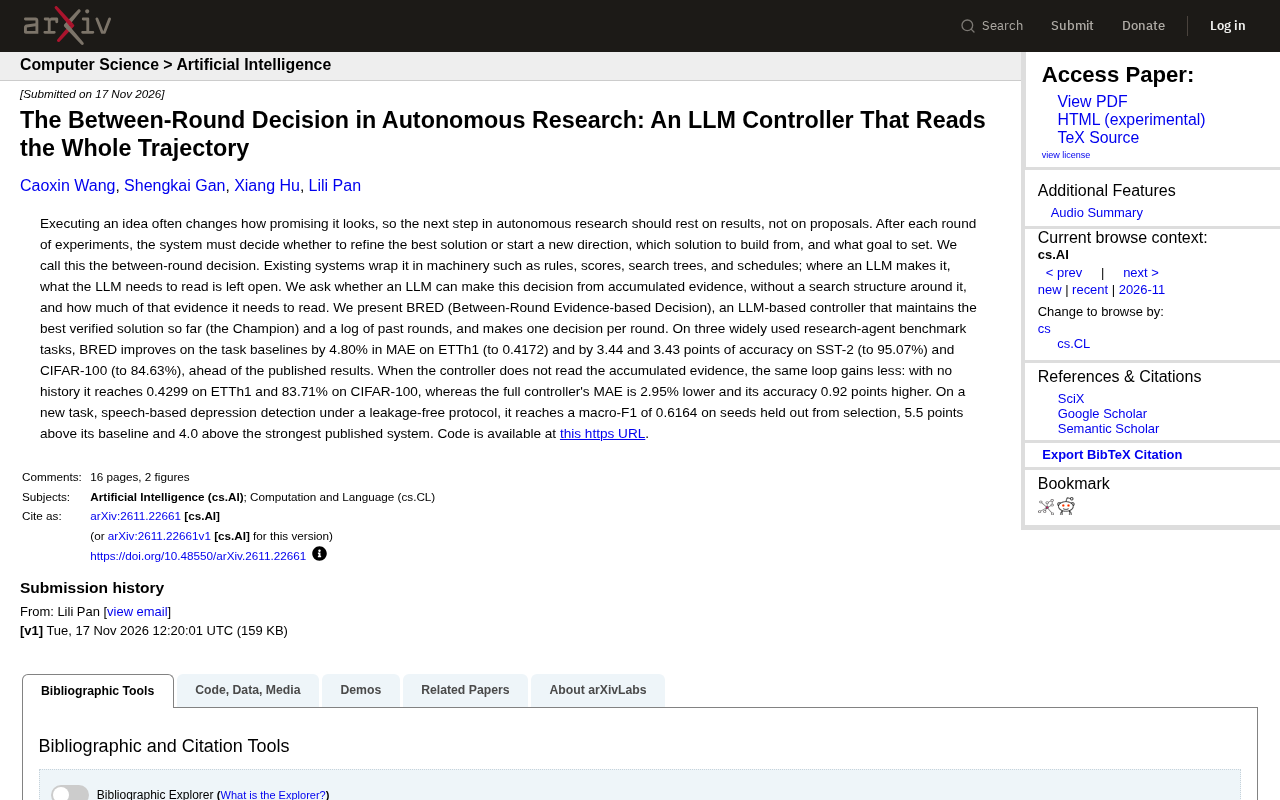
Autonomous research systems often need to adjust direction after running experiments based on actual results. But most existing systems rely on rules, scoring functions, search trees, and schedulers to wrap this decision process, while few studies let LLMs directly judge based on accumulated evidence. A paper from rss proposes BRED (Between-Round Evidence-based Decision), attempting to answer two questions: Can an LLM make between-round decisions based solely on historical evidence without a search structure? And how much evidence does it need to read?
Between-Round Decision: An Overlooked Key Step
The paper defines "between-round decision" as the three questions the system must answer after each round of experiments: whether to optimize the current best solution or open a new direction, which solution to build upon, and what goal to set. The quality of this decision directly affects research efficiency, because executing an idea often changes its apparent potential—the optimism at the proposal stage may be overturned by experimental results.
Existing systems typically manage this decision with external mechanisms, such as rule engines, scoring functions, search trees, or scheduling plans. These methods are effective, but when the LLM is placed at the core of decision-making, there is no clear answer as to what information it should read and how much. BRED's starting point is precisely to fill this gap.
Between-Round Decision is the meta-decision process executed by an autonomous research system after completing one round of experiments and before entering the next round. Unlike intra-round decisions (such as hyperparameter tuning or model architecture search), it focuses on adjusting the research direction: whether to abandon the current solution, from which existing result to continue, and what the specific goal of the next round is. In AutoML and AI Scientist systems, this step is usually implemented by rule engines or schedulers, for example triggering branches based on validation set score thresholds, or using Monte Carlo tree search (MCTS) to manage the exploration-exploitation balance. BRED's innovation lies in handing this decision power entirely to the LLM, which directly reads historical evidence and reasons, rather than relying on predefined algorithmic strategies.
BRED's Design: Champion Solution and Round Logs
BRED is an LLM-based controller that maintains two core components: the current best validated solution (called Champion) and the logs of past rounds. After each round, the controller reads these two pieces of information and makes a decision.
The key is that BRED does not rely on search trees or other structured search mechanisms. It lets the LLM directly face the accumulated evidence, including the history of successes and failures, to determine the next action. This design places the burden of decision-making entirely on the LLM's reasoning ability, rather than an external algorithmic framework.
Champion in BRED specifically refers to the model configuration or experimental solution that has performed best on the validation set and has been validated among all completed rounds so far. It serves as the anchor for decision-making, ensuring that the LLM does not lose the current best result when opening a new direction. Round logs record the complete trajectory of each round of experiments: including proposals, executed configurations, obtained metrics, failure reasons, etc. Together, they provide the LLM with complementary information: "current best" and "full history." This design contrasts with traditional search trees: search trees explicitly encode exploration paths through nodes and edges, while BRED uses unstructured logs to let the LLM induce patterns on its own, reducing engineering complexity but requiring the LLM to have strong long-context reasoning capabilities.
Benchmark Performance: Outperforming Baselines Across the Board
The paper evaluates BRED on three widely used research agent benchmark tasks. On the ETTh1 time series forecasting task, BRED achieves an MAE of 0.4172, a 4.80% improvement over the task baseline. On the SST-2 sentiment classification task, the accuracy reaches 95.07%, an improvement of 3.44 percentage points. On the CIFAR-100 image classification task, the accuracy reaches 84.63%, an improvement of 3.43 percentage points. These results all exceed published results.
Interestingly, these improvements are achieved without additional search structures, indicating that the LLM itself has the ability to extract decision signals from evidence.
ETTh1 is a classic benchmark dataset in the time series forecasting field, part of the Electricity Transformer Temperature dataset (ETT) at hourly level, containing 7 features. The task is multivariate time series forecasting, commonly evaluated with MAE (mean absolute error). SST-2 is the Stanford Sentiment Treebank binary classification task, where the input is movie review sentences and the output is positive/negative sentiment, measured by accuracy. CIFAR-100 is an image classification dataset with 100 fine-grained categories, each containing 600 32x32 images, also measured by accuracy. These three tasks cover time series, text, and visual modalities respectively, testing BRED's cross-domain generalization.
The Value of Evidence Reading: Insights from Ablation Experiments
BRED's core claim is that "reading accumulated evidence" is crucial for decision-making. The paper verifies this through comparative experiments: when the controller does not read historical evidence, the gains from the same loop are significantly reduced.
Specifically, without historical information, the system achieves an MAE of 0.4299 on ETTh1 and an accuracy of 83.71% on CIFAR-100. The full controller's MAE is 2.95% lower and accuracy is 0.92 percentage points higher. This gap indicates that the information the LLM reads from historical trajectories is indeed converted into better decisions, not just process decoration.
New Task Validation: Speech-Based Depression Detection
To test generalization ability, the paper evaluates BRED on a new task: speech-based depression detection, using a leakage-free protocol. On seeds held out from the selection process, BRED achieves a macro F1 score of 0.6164, 5.5 percentage points higher than its baseline and 4.0 percentage points higher than the strongest published system.
This result shows that BRED's decision mechanism is not limited to specific task types and is equally effective in healthcare-related speech analysis scenarios. The leakage-free protocol setting also increases the credibility of the results, avoiding inflation caused by data leakage.
Leakage-free protocol is a strict experimental setting used in machine learning evaluation to prevent data leakage. In healthcare tasks such as speech-based depression detection, data leakage commonly occurs when samples from the same subject appear in both training and test sets, or when test set information is used in feature selection. The leakage-free protocol requires: subject-level data splitting (all speech segments from the same person appear in only one set), feature engineering and model selection completed entirely within the training set, and the test set used only once for final evaluation. The paper adopts this protocol, meaning that BRED's advantage on the depression detection task does not come from information leakage, making the results more clinically relevant. Macro-F1 is the arithmetic mean of per-class F1 scores, particularly suitable for class-imbalanced depression detection tasks.
Implications for Autonomous Research Systems
BRED's experiments send a clear signal: in autonomous research systems, when the LLM acts as a between-round decision-maker, reading the full historical trajectory pays off. This challenges the view that LLMs only need local context to make good decisions.
At the same time, BRED's deliberate avoidance of structures like search trees also suggests a design philosophy: rather than wrapping decisions in complex engineering mechanisms, it is better to organize the evidence well and let the LLM reason on its own. Of course, this requires the LLM to have a sufficient context window and reasoning ability, and the evidence logs need to be designed clearly enough.
The paper's code is open-sourced on GitHub, providing a reproducible foundation for future research. For teams building autonomous research agents, BRED offers a decision architecture worth referencing.
One-line Summary
BRED lets LLMs make between-round decisions using only the champion solution and round logs, outperforming baselines on multiple benchmarks.
Paragraph Summary
BRED (Between-Round Evidence-based Decision) is an LLM-based between-round decision controller designed to solve the problem of how to adjust direction after each round of experiments in autonomous research systems. It does not rely on external structures such as search trees, rule engines, or scoring functions, but instead lets the LLM directly read the current best validated solution (Champion) and past round logs, making decisions based on accumulated evidence of successes and failures. On three benchmarks—ETTh1, SST-2, and CIFAR-100—BRED reduces MAE by 4.80% and improves accuracy by 3.44 and 3.43 percentage points respectively, all exceeding published results. Ablation experiments show that gains are significantly reduced without reading historical evidence, proving the value of evidence reading. Furthermore, on a new speech-based depression detection task, BRED achieves a macro F1 of 0.6164 under a leakage-free protocol, surpassing the baseline by 5.5 points. The paper's code is open-sourced.
Related articles

Prompt Engineering for Beginners: From Writing Prompts to Engineering Thinking
Starting from the essence and four functions of prompts, this article systematically explains the six-step process, four success criteria, learning value, and practical limitations of prompt engineering to help you build a complete understanding.

Anthropic Launches Nasdaq IPO: AI Giant's Listing and Risk Disclosures
Anthropic officially launches its Nasdaq IPO under ticker ANT, with market valuation expected to potentially exceed SpaceX's record. The prospectus devotes nearly 100 pages to AI risks, while first-half revenue grew over 14x but net losses widened sharply, reigniting the AI bubble debate.

Rust cURL Clone Uses 4,832 unsafe Blocks—Is the Memory Safety Myth Broken?
A Rust cURL clone uses 4,832 unsafe keywords, challenging Rust's memory safety narrative. We analyze what unsafe really means, compare Fil-C, and examine rewrite motives.