How Machine Learning Engineers Can Adapt in the AI Era: A Guide to Skill Trade-offs and Career Reinvention

How ML engineers can reinvent their careers in the AI era through smart skill trade-offs.
Sparked by a Reddit discussion, this article explores how machine learning engineers' work is evolving in the AI era—from building models to using them. It covers new skills worth investing in (LLM engineering, MLOps, business understanding), skills becoming marginalized, and how to treat AI as career leverage rather than a threat.
An Open Discussion About Career Anxiety
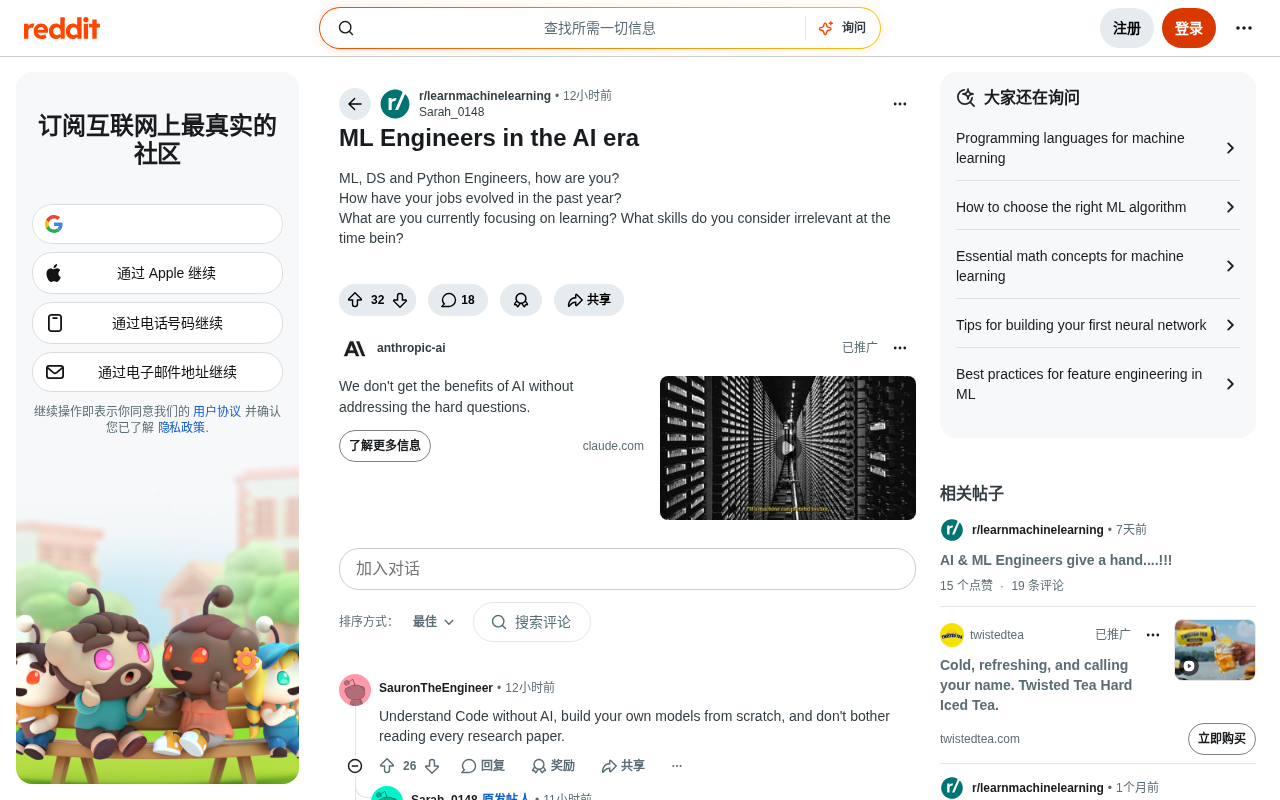
Amid the rapid advance of AI technology, a Reddit user raised a topic that struck a chord with many: Machine learning engineers in the AI era, how are you holding up?
The core question of this post was simple but hit the mark: Over the past year, how has the work of ML engineers, data scientists, and Python engineers evolved? Where is everyone focusing their learning efforts now? And which once-prized skills are quietly losing their value?
The reason this question resonated so strongly in the tech community is that it touches a collective nerve across the entire industry. When large language models (LLMs) can automatically generate code, when AutoML tools grow increasingly mature, and when various AI platforms continually lower the barrier to entry for machine learning, engineers who spent years honing their specialized skills are forced to reexamine their professional positioning.
Technical background: Large language models (LLMs) are neural network models based on the Transformer architecture, pre-trained on massive amounts of text data. Representative products include GPT-4, Claude, Gemini, and others. Through the scale effect of hundreds of billions or even trillions of parameters, these models demonstrate powerful capabilities in code generation, logical reasoning, and natural language understanding. AutoML (Automated Machine Learning), meanwhile, is a technical system that automates traditional ML processes such as feature selection, model selection, and hyperparameter tuning. Platforms like Google's AutoML and H2O.ai enable non-expert users to quickly build usable models. The combination of the two fundamentally changes the boundaries of an ML engineer's work.
The Quiet Transformation of Job Content
Looking back at the day-to-day work of ML engineers in recent years, a clear trend is emerging: a shift from "building models" to "using models."
Before the explosion of generative AI, machine learning engineers spent much of their time on data cleaning, feature engineering, model training, and parameter tuning—a relatively classic and mature workflow. Today, an increasing number of real-world scenarios have become: how to effectively call pre-trained large models, how to design high-quality prompts (Prompt Engineering), how to build RAG (Retrieval-Augmented Generation) systems, and how to seamlessly embed model capabilities into products.
Understanding RAG systems: RAG (Retrieval-Augmented Generation) is one of the most important architectural patterns in current LLM application engineering. Its core idea is: before asking a question to a large model, first retrieve the most relevant document fragments from an external knowledge base, then feed these fragments along with the original question into the model, enabling the model to answer based on the latest and most accurate private knowledge. This effectively overcomes the two core weaknesses of large models—the "knowledge cutoff date" and "hallucination." RAG systems typically rely on vector databases (such as Pinecone, Weaviate, and Chroma) to store the Embedding representations of text, and achieve efficient recall through semantic similarity retrieval. Building a reliable RAG system requires engineers to deeply understand multiple technical details such as Embedding quality, chunking strategies, retrieval ranking, and context window management.
Reassessing the Value of Traditional Skills
This does not mean traditional skills have become obsolete. On the contrary, a solid mathematical foundation, a deep understanding of model principles, and a keen grasp of the nature of data have instead become the key dividing line in the AI era between "people who can use tools" and "people who can truly solve problems."
The parts that are easily replaced by tools—such as simple model construction and standardized data processing scripts—are indeed depreciating in value. But what is truly scarce is the engineering judgment to determine "when to use a large model and when not to," as well as "how to evaluate the reliability of AI output." This kind of judgment requires deep fundamentals to support it.
What to Learn and What to Let Go
The most practically valuable part of this discussion is about the trade-offs in learning direction.
New Skills Worth Investing In
LLM application engineering is becoming the new core competency. This includes areas such as vector databases, Embedding techniques, Agent frameworks, and model fine-tuning. Being able to engineer and productize large model capabilities creates more real business value than simply training a small model.
The technical boundary between Fine-tuning and Prompt Engineering: Fine-tuning and Prompt Engineering represent two main paths for adapting pre-trained large models to specific tasks. Prompt Engineering guides model output by carefully designing input formats, few-shot examples, and chain-of-thought techniques—all without modifying model weights. It is extremely low-cost, but its upper limit is constrained by the capabilities of the base model. Fine-tuning, on the other hand, continues training on domain-specific data to adjust model parameters and adapt to vertical scenarios, delivering more stable results but requiring labeled data and computational resources. Parameter-efficient fine-tuning techniques that have emerged in recent years (such as LoRA and QLoRA) have dramatically lowered the barrier to fine-tuning, enabling small and medium teams to economically customize their own models. This is becoming one of the new core skills for ML engineers.
System design and MLOps capabilities are equally critical. As AI capabilities are widely integrated into production systems, ensuring the stability, scalability, and cost-controllability of model services has become an important benchmark for measuring a senior engineer's level.
The engineering essence of MLOps: MLOps (Machine Learning Operations) is an engineering practice system that brings the DevOps philosophy into the full lifecycle management of machine learning systems, covering aspects such as data version control, automated model training pipelines, model registration and deployment, online monitoring and drift detection, and A/B testing. As AI systems enter production environments at scale, the importance of MLOps capabilities has become no less than that of the model's own performance. A typical toolchain includes MLflow, Kubeflow, Weights & Biases, and Seldon. Engineers with MLOps skills can ensure that model services run stably under production conditions of high concurrency, low latency, and controllable costs—a system engineering competency that engineers with a pure algorithm background often lack.
In addition, cross-domain business understanding has become more important than ever. When the technical barrier is leveled by tools, the ability to accurately identify business pain points and translate AI capabilities into real commercial value often determines an engineer's career ceiling.
Skills Becoming Increasingly Marginalized
The discussion also contained clear-eyed judgments about the "depreciation" of certain skills: pure manual feature engineering, implementing common algorithms from scratch, and large amounts of repetitive data preprocessing—these tasks are gradually being taken over by automation tools and large models. This isn't to say such knowledge is meaningless, but rather that it no longer constitutes an individual's professional moat.
Is AI a Threat or a Lever?
Around this topic, two starkly different voices exist among practitioners.
One camp believes AI tools are compressing the demand for ML engineering positions. Since large models can write code and perform analysis, why would companies still need to maintain large algorithm teams? This anxiety is not baseless, and the challenge is especially real for junior engineers whose work leans toward the execution level.
The other camp argues that AI is more like a lever that amplifies individual capability. Engineers who master AI tools can multiply their productivity, with a single person able to accomplish the workload that once required an entire small team. From this perspective, the real competition is not "human vs. AI," but the divergence between "people who can use AI" and "people who cannot."
The divergence between these two judgments essentially reflects the real situations faced by practitioners at different career stages confronting the same technological wave. From the perspective of labor economics, this is precisely the concrete manifestation of the classic pattern of "Skill-Biased Technological Change"—new technologies tend to widen the relative advantage of high-skilled workers. The executive, standardized work handled by junior engineers overlaps heavily with the capabilities of AI tools, making it the highest replacement risk. Meanwhile, senior engineers and architects, due to their comprehensive judgment about business, systems, and technical boundaries, become even more scarce and prominent in the AI era.
A Few Reflections for Machine Learning Practitioners
From this discussion, several judgments of broad reference value can be distilled:
First, proactively embrace tools rather than passively resist them. Instead of worrying about being replaced by AI, become someone who skillfully commands AI tools as early as possible, positioning yourself on the beneficiary side of technological change.
Second, move upstream in the value chain. As low-level execution work is taken over by automation, engineers should migrate toward harder-to-replace stages such as problem definition, solution design, and business implementation.
Third, maintain continuity in learning. The pace of technological iteration is unprecedented, and the only reliable coping strategy is continuous learning. Today's cutting-edge skills may soon become baseline industry requirements.
Ultimately, the AI era is not merely a threat to machine learning engineers, but a profound opportunity for career reinvention. Those who can adapt quickly and are adept at treating AI as an extension of their capabilities will gain room for growth far beyond the past. And this open discussion on Reddit is precisely a true microcosm of countless practitioners standing at a turning point.
Key Takeaways
Related articles

ChatGPT Space Launches: Team Collaboration and New Pages Features Explained
ChatGPT Space is OpenAI's new team collaboration feature with Pages, real-time collaboration, and Slack/Google Drive sync. We break down its privacy design, multi-platform integration, and the full workflow from conversation to document.

Migrating Apache Spark UDFs to GPU Acceleration with AI Agents
NVIDIA developer blog explains how AI Agents rewrite Apache Spark UDFs for GPU acceleration, covering migration criteria, agent rewriting and verification workflows, plus pitfalls like result consistency and CPU-GPU transfer overhead.

Zed Editor v0.40.4-rc2 Released: Usage Credits Now Available Without Upgrading
Zed editor releases v0.40.4-rc2, allowing users to use usage credits for AI features without upgrading to a paid plan, lowering the trial barrier.