How Many Top-Tier Conference Papers Does It Take to Graduate from a Top U.S. ML PhD? A Reddit Debate

Reddit debates whether "4 first-author top-conference papers" is an implicit graduation standard for top ML PhDs—actually an overestimated anchor due to sample bias.
The article centers on a question in the Reddit MachineLearning subreddit: whether PhD graduation from top-10 U.S. computer science programs or comparably competitive ML groups has an implicit standard of "4 first-author top-conference papers." The author points out that this number comes from community discussions, has obvious selection bias, and does not distinguish between the degree of first-author leadership and the evaluation weight of different top conferences. What top research groups really value is research impact and continuity, not paper counting. For current PhD students, a more reliable path is to align expectations with advisors, focus on the completeness of work, and be wary of anxiety from community comparisons. The conclusion: there is no unified standard, and communication and quality take priority over chasing a circulating number.
An "Implicit Standard" That Keeps Coming Up
On Reddit's MachineLearning subreddit, a user posed a question that many current PhD students want answered but few can give a definitive answer to: in a top-10 U.S. computer science program or a machine learning group of comparable competitiveness, how many papers does one actually need to publish to graduate?
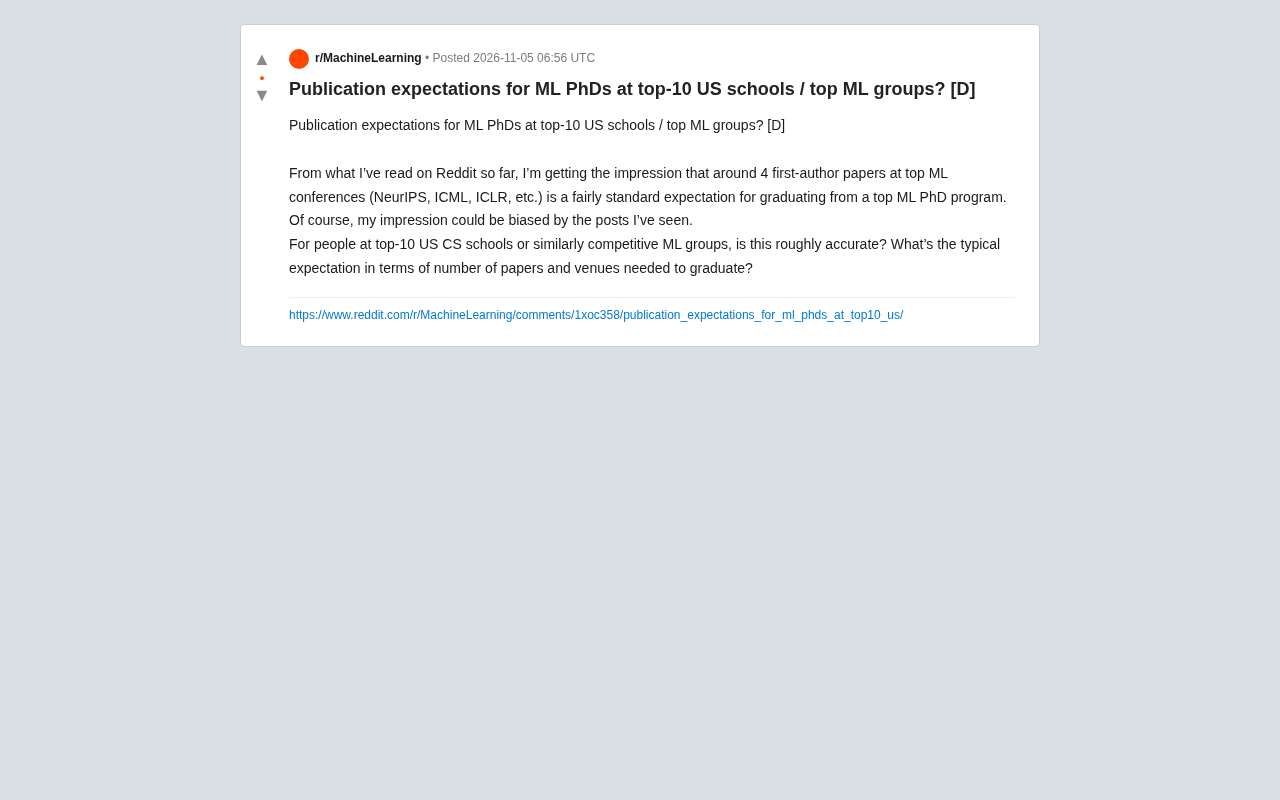
The poster formed an initial impression based on information seen on Reddit—that roughly 4 first-author papers at top conferences (NeurIPS, ICML, ICLR, etc.) is the "standard" expectation for top ML PhD programs. But they acknowledged that this impression may be skewed by the posts they happened to browse, so they asked those on the inside to verify: is this number roughly accurate? What do typical graduation expectations look like in terms of paper count and publication venues?
This question is worth serious discussion because it touches on a long-standing information asymmetry in ML PhD training: official program requirements usually don't state "how many papers you need to graduate," but advisors, peers, and the job market implicitly shape a set of unwritten standards.
Where Does the "4 First-Author Papers" Claim Come From?
The 4 first-author top-conference papers mentioned by the poster didn't come out of nowhere. On platforms like Reddit and Twitter, discussions about paper counts at graduation for top ML PhDs are not uncommon, and current students or applicants often use these discussions as reference points.
But there are several issues that need to be unpacked here.
The "First-Author" Weight of Top Conferences Is Not Uniform
NeurIPS, ICML, and ICLR are known as the three top ML conferences, but a NeurIPS paper and an ICLR paper may carry different weight within a specific research group. More importantly, behind the first-author designation, whether someone "led a piece of work" or "was listed as a participant" makes a huge difference in actual evaluation. The poster didn't distinguish this, and yet this is precisely what determines the true meaning of the number 4.
NeurIPS, ICML, and ICLR are collectively known as the three top ML conferences, but their acceptance mechanisms and evaluation traditions are not entirely the same. NeurIPS and ICML use double-blind review, while ICLR pioneered open review (OpenReview), where review comments and author responses are fully public—making ICLR's review process more transparent and, to some extent, influencing the final evaluation of papers. In terms of acceptance rates, the three conferences have generally remained in the 20%–30% range in recent years, but submissions have grown rapidly; in 2024, NeurIPS received over 12,000 submissions with an acceptance rate of about 25%. In addition, there are subtle differences in the "prestige weight" of the three conferences within the field: NeurIPS has the longest history and broadest coverage; ICML leans toward theory and methods; ICLR started with representation learning and has gradually expanded to generative models, reinforcement learning, and other directions. Therefore, even for a first-author paper, which conference it was published at and in which subfield can lead to different weights being assigned within a research group.
Sample Bias Is Hard to Avoid
The poster themselves recognized that discussions on Reddit have an obvious selection bias. People willing to share their publication records online tend to either have outstanding results or be in a state of anxiety seeking comparison. PhD students who are progressing steadily with average publication counts rarely speak up. Therefore, "4 first-author papers" is more likely an overestimated anchor than a median.
Selection bias is a classic concept in statistics, referring to a situation where the sample is not selected randomly, causing it to fail to represent the population. In communities like Reddit, this bias is particularly pronounced: people who proactively post or reply to share their publication records tend to be high achievers ("survivor bias") or those caught in anxiety seeking comparison, while the large number of PhD students with average publication counts remain silent. The absence of this "silent majority" naturally inflates the numbers circulating in the community. To obtain a median closer to reality, one would need to rely on systematic survey data—such as the CRA (Computing Research Association) PhD graduation survey or employment reports from individual departments—rather than scattered self-reports on forums.
What Top Research Groups Really Value
Although the original post didn't provide specific official data, the context of the discussion suggests that top ML research groups rarely have a single numerical metric for PhD graduation expectations.
A more realistic description is: paper count is a necessary but not sufficient condition. In top-10 programs or groups of comparable competitiveness, having several first-author top-conference papers at graduation is indeed common, but advisors tend to value the impact and continuity of the work more—whether there is a consistent research thread, whether there are representative works cited and discussed by peers—rather than simple counting.
This also explains why, despite similar numbers of top-conference papers, some PhD graduates are highly sought after in the job market while others receive a lukewarm response. Papers are the ticket for entry, but what determines long-term value is research taste and problem selection.
Practical Implications for Current PhD Students
For PhD students concerned about this issue, rather than agonizing over "is 4 enough," it's better to focus on a few more controllable dimensions.
Align Expectations with Your Advisor
Graduation standards vary enormously across advisors and research groups, and no number on Reddit can replace a direct conversation. Clarifying with your advisor early on "what kind of work counts as a qualified first-author paper" is more meaningful than horizontally comparing paper counts.
Focus on the Completeness of the Work
A widely cited top-conference paper may be worth more than several filler publications. When time is limited, doing one piece of work deeply and thoroughly is often more beneficial for long-term development than chasing quantity.
Beware of Anxiety from Comparison
The poster's confusion itself reflects the comparison anxiety that is widespread among ML PhD students. Information on Reddit can serve as a reference, but it should not become the sole yardstick for self-evaluation. Everyone's research direction, advisor style, and career goals are different, and using a single number to measure everyone is inherently unrealistic.
Conclusion
"4 first-author top-conference papers" is more of an impression that has been repeatedly cited and gradually solidified in community discussions than a unified standard for top ML PhD programs. It reminds us that the implicit expectations in ML PhD training deserve more open discussion, but the purpose of that discussion is not to create a numerical threshold—it's to help PhD students more clearly understand the real requirements of their environment. For the question in this Reddit post, the most honest answer is perhaps: there is no standard answer, but communicating with your advisor and insisting on research quality will always be more reliable than chasing a circulating number.
Related articles
 Tech Frontiers
Coldframe: A Honeypot Disguised as a Supermarket Freezer Controller
Coldframe is a honeypot disguised as Danfoss AK-SM 800A and Dixell XWEB freezer controllers, built as a single Python file that detects CVE-2025-41450 attempts and is identified as real devices on Shodan.
 Tech Frontiers
GRFNet: A Lightweight PyTorch Model Designed for Multichannel Time-Series Classification
GRFNet is a lightweight PyTorch model for multichannel time-series classification, originating from EEG decoding research. With only 3,847 parameters, it is based on the ROCKET architecture, combining random convolution kernels with learnable spatial filters, supports arbitrary input lengths, and will soon be evaluated on the PhysioNet dataset.
 Tech Frontiers
CUDA-Accelerated Rocket League Simulator: A Player-Made Hardcore Experiment
A Reddit post shows a "100% Accurate" Rocket League simulator accelerated with CUDA. We analyze its technical context, CUDA's value in game physics simulation, and the significance and limitations of such community projects.